
Food and drinkWater, air and residues
Acrylamide: a cooking by-product in browned starchy foods
CAS 79-06-1.Also known as 2-propenamide, acrylic amide, and prop-2-enamide.
Editorial draft Last reviewed 10 November 2026 About 834 words
CC INDEX
How it works52/100 Moderate
Acrylamide causes cancer in animals at very high doses, and EFSA concluded that dietary levels potentially raise cancer risk, but human studies have not shown a consistent link. Almost everyone is exposed through everyday foods. The EU sets benchmark levels to bring amounts down.
An editorial summary of this article’s cited evidence. It isn’t medical advice or a personal risk estimate.
Age index
What is the age index?Which age groups are more affected by this chemical’s possible health issues, based on this article’s sources.
- Pregnancy Unborn babies Not well studied
- Infants 0 to 1 Not well studied
- Young children 1 to 5 Higher concern
- Children 6 to 12 Higher concern
- Teens 13 to 19 Moderate
- Adults 20 to 64 Moderate
- Older adults 65 and over Moderate
- Young children (higher concern): Most exposed relative to body weight
- Children (higher concern): Most exposed relative to body weight
- Adults (moderate): Possible long-term cancer risk from a lifetime diet
- Older adults (moderate): Possible long-term cancer risk from a lifetime diet

Illustration of browned starchy foods and coffee, the main dietary sources of acrylamide. Lighter golden cooking forms less of it.
Credit: Chemical Century; AI-generated illustration
License: CC0 1.0
Illustration, not a photograph of a specific product. Resized and cropped for the web.
Golden toast, crisp roast potatoes, a fresh cup of coffee: acrylamide is part of these ordinary pleasures because it forms whenever starchy foods are browned at high heat. The question is not how anyone feels after a meal but what happens over a lifetime of eating: animal studies at very high doses show cancer, and European food scientists judge that everyday diets could potentially nudge cancer risk upward, while studies in people have not found a consistent link. For most households this is a reason to brown rather than burn food, not a reason to fear the toaster.
Everyday exposure: where you meet it and how much
Acrylamide is not added to food. It forms when starchy foods are cooked at high temperatures, for example by frying, roasting, baking or toasting. EFSA names fried potato products, coffee, biscuits, crackers and soft bread as the main sources for adults. Children are the most exposed relative to body weight. [1,3]
Exposure is very widespread. FDA cites CDC scientists who found markers of acrylamide exposure in the blood of 99.9% of the US population, while noting that finding the markers does not mean they will cause harm. Levels vary from unit to unit and lot to lot within the same product. Acrylamide is also present in tobacco smoke. [1,3]
Known and suspected harms
Evidence labels are editorial summaries, not individual risk predictions: established means recognized under the stated conditions; probable means a likely contribution with uncertainty; possible means limited evidence; disputed means assessors disagree. These labels do not describe how common an effect is.
- Probable — raises cancer risk at dietary levels, based on animal studies: acrylamide has caused cancer in laboratory animals given very high doses, much greater than levels in human food. The US National Toxicology Program and the FAO/WHO expert committee on food additives (JECFA) consider it a human health concern. EFSA's 2015 opinion concluded that acrylamide in food potentially increases the risk of cancer for consumers of all ages. [1,3]
- Possible — cancer in people from food acrylamide: FDA says there is no consistent evidence from human studies that acrylamide in food causes cancer, and EFSA describes the human evidence as limited and inconclusive. EFSA also considered effects on the nervous system, development and male reproduction, and concluded they are not a concern at current dietary levels. [1,3]
Reducing avoidable exposure and harm
Health Canada suggests storing potatoes somewhere cool and dark but not in the fridge, above about 6 °C. Soaking or blanching cut potatoes before frying, frying at 175 °C or lower, and cooking to a light golden colour rather than brown all help. Toast bread lightly. A varied diet, with fewer fried and heavily browned foods, lowers exposure without cutting out any one food. [2,3]
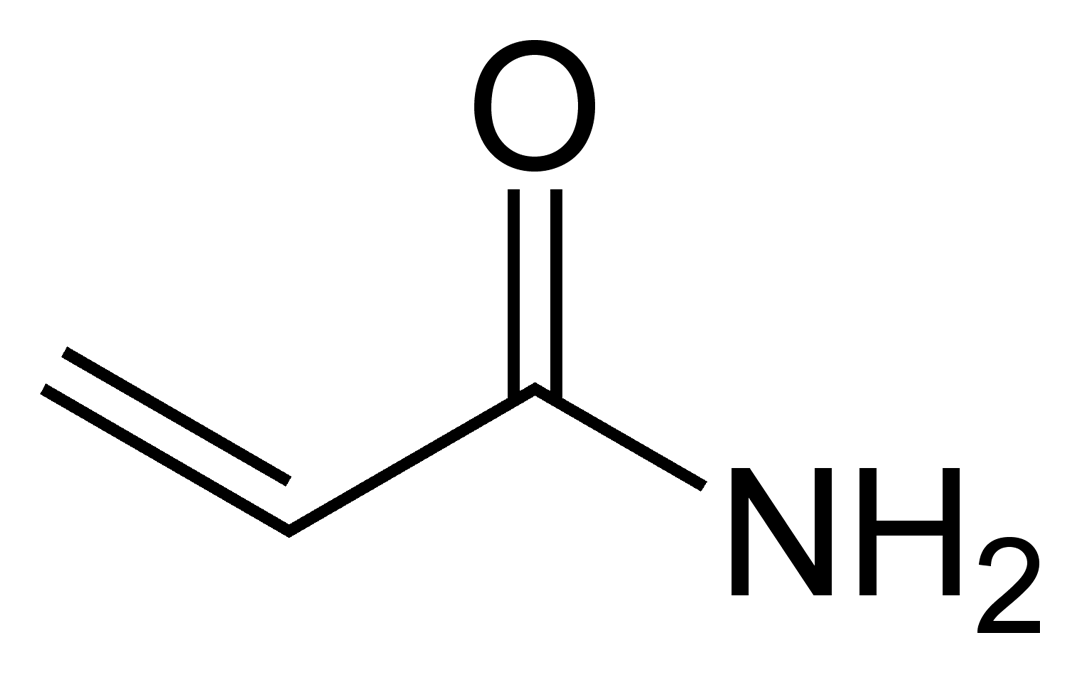
Acrylamide structural formula.
Credit: Wikimedia Commons (public-domain structure image)

License: Public domain
Wikimedia-provided thumbnail; whitespace trimmed, no content edits
What it is
Acrylamide is a small organic compound. Its CAS number is 79-06-1. It forms in food mainly from a reaction between the amino acid asparagine and natural sugars during high-temperature cooking. EFSA notes that this is the same Maillard reaction that browns food and affects its taste. [1,3,5]
What it does and why it is used
In food it is an unwanted by-product, not an ingredient. EFSA notes that acrylamide also has many non-food industrial uses. [3,5]
Regulatory status and health context
Canada
Health Canada has permitted food makers to use the enzyme asparaginase, which breaks down asparagine before cooking, since 2012. It publishes home cooking tips to reduce exposure. In its drinking-water guidance, Health Canada decided that a separate acrylamide guideline is not needed. [2,6]
United States
FDA monitors acrylamide in certain foods and in 2016 published guidance that sets out ways for growers, manufacturers and food-service operators to reduce it. It also publishes advice for reducing acrylamide when cooking at home. FDA says its product data are not designed to guide individual food choices, because levels vary so much between units and lots. [1]
European Union
Commission Regulation (EU) 2017/2158 requires food businesses to apply mitigation measures and to use benchmark levels to check that they work. For example, the benchmark for ready-to-eat French fries is 500 µg/kg. Benchmark levels are performance indicators, not legal maximum limits. [4]
Environmental notes
The food sources used here focus on cooking by-products and do not provide data for an environmental rating. [1–4]
Quick facts
- CAS: 79-06-1. [5]
- Source in food: forms during frying, roasting, baking and toasting of starchy foods. [1,3]
- Main dietary sources: fried potatoes, coffee, biscuits, crackers and bread. [3]
- EU benchmark for French fries: 500 µg/kg. [4]
- Simple tip: aim for golden, not brown. [2]
Sources
All URLs were fetched on 2026-11-10. Source publication dates differ from this draft's review date.
- FDA: Acrylamide.
- Health Canada: Acrylamide.
- EFSA: Acrylamide in food is a public health concern (2015).
- EUR-Lex: Commission Regulation (EU) 2017/2158, mitigation measures and benchmark levels for acrylamide in food.
- PubChem PUG REST: acrylamide synonyms.
- Health Canada: Guidelines for Canadian Drinking Water Quality, summary table.