
Food and drink Makeup and colour
Allura Red AC: Red 40 exposure and the evidence on children
CAS 25956-17-6. Also known as FD&C Red No. 40, Red 40, E129, and CI 16035.
Editorial draft Last reviewed 8 November 2026 About 1144 words
Everyday exposure: where you meet it and how much
Allura Red AC is a synthetic colour that may appear in sweets, soft drinks, bakery products and desserts. The same substance is known as FD&C Red No. 40 in the United States and E129 in European food labelling. Identifying the name is useful, but the amount consumed depends on the product's concentration and the portion. Not every red food contains this dye, and an ingredient list alone rarely gives a personal dose. [1,2,6,7]
Children who consume substantial amounts of relevant coloured foods and drinks were an important group in EFSA's exposure assessments. Its 2009 review identified that some high-consuming children could exceed the then-assessed acceptable daily intake. That is an exposure-model result, not a measurement of every child's lunch or a diagnosis of harm after one serving. [2]
Known and suspected harms
These labels summarize evidence editorially, not as a formal GRADE assessment: Established means recognized under specified conditions; Probable means a likely contribution with uncertainty; Possible means limited or suggestive evidence; Disputed identifies differing interpretations. We do not invent an established harm simply because an ingredient is controversial.
- Possible — effects on activity and attention in some children: EFSA found limited evidence of small effects from mixtures of food colours and sodium benzoate in the Southampton study. Effects were inconsistent across age groups and tested mixtures, and their clinical significance was unclear. The study could not identify which individual additives were responsible. It does not prove that Red 40 alone causes ADHD. [3]
- Possible — intolerance reactions: EFSA's six-colour review said the evidence was too limited for a firm conclusion about intolerance reactions for Allura Red and several other colours. This is not a reason to dismiss a person's symptoms; it is a reason not to present a specific reaction rate or diagnosis without better evidence. [2]
- Disputed interpretation — what the behaviour study establishes: concern about the observed mixture effects is legitimate, but attributing them specifically to Red 40 goes beyond that study's design. EFSA did not use those findings as a basis to change the respective additives' ADIs. The uncertainty is about attribution and significance, not whether the research should be mentioned. [2,3]
An established human cancer effect at ordinary dietary exposure is not demonstrated by the selected authoritative assessments. The US withdrawal of Red No. 3 is not evidence that Red No. 40 has the same toxicology or legal status: these are different colour additives. FDA's current tracker explicitly treats them separately. [2,5,6]
Reducing exposure and protecting at-risk groups
If you prefer to reduce this optional colour, compare ingredient lists for Allura Red, E129 or Red 40 rather than judging colour intensity. Removing a coloured product can reduce that ingredient source, but should not be promised to treat a child's behavioural or developmental condition. A suspected repeatable food reaction or attention concern deserves appropriate clinical assessment, not a diagnosis based on an ingredient website. [3,6,7]
Keep the whole food pattern in view. A colour-free sweetened drink still needs nutritional assessment, while a product using an alternative colour is not automatically safe for every purpose. Our hidden-sugar guide explains why an ingredient-avoidance claim is not a substitute for reading serving and sugar information.
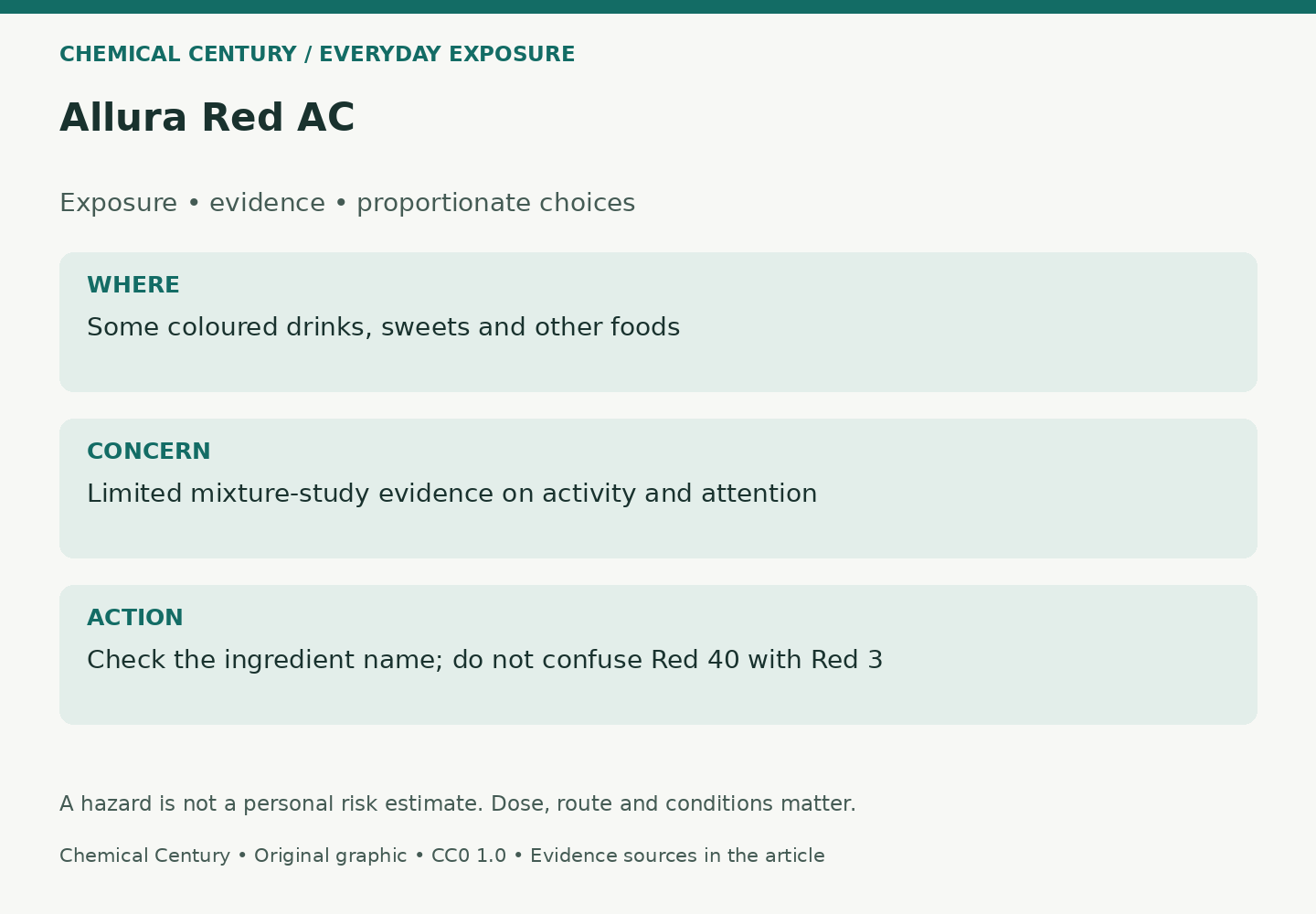
Exposure and evidence guide; not a numerical risk estimate.
Credit: Chemical Century; original graphic
License: CC0 1.0
Data: Data: the sources listed for this article.
What it is
Allura Red AC is one specific dye, with PubChem-verified CAS 25956-17-6. FDA's listing also uses identifiers such as CI 16035 and E129. “Red 40,” “Red 3” and “red food colouring” are not interchangeable chemical identities. Accurate names matter when matching a study, a recall or a legal decision to the product actually used. [6,7]
The European E-number and US FD&C name belong to different regulatory naming systems. An E-number is an identifier, not a hazard grade, and the presence of “certified” in the US system refers to regulatory requirements rather than a promise that no individual will ever react. [4,6]
What it does and why it is used
Its function is colour: manufacturers can use it to produce a desired appearance in permitted products. That is different from an essential nutrient or a preservative needed for microbial control. It is therefore reasonable for a consumer to choose an uncoloured alternative, while still distinguishing a preference from a proven health treatment. Permitted uses and concentrations remain product-specific. [1,2,6]
Regulatory status and health context
Canada
Health Canada's permitted-colouring-agents list includes Allura Red with specified foods, limits and combination rules. The restrictions are not one universal concentration for all foods. For instance, several entries specify a combined maximum when multiple listed colours are used together. This article reports that conditional permission; it does not infer the dye concentration in any current Canadian brand. [1]
United States
FDA's regulatory listing identifies Red 40 as permanently listed, with batch certification required and use-specific conditions. Its current industry-transition tracker says the agency is working with manufacturers, retailers and trade associations to eliminate six remaining certified food colours, including Red 40, by the end of 2027. That is not the same statement as a completed federal revocation of Red 40. [5,6]
Dates matter: an earlier transition announcement and a later tracker may describe different schedules or commitments. We use the current fetched tracker for that target, and distinguish voluntary company pledges from legally completed rule changes. FDA separately identifies Red 3's revoked authorization and deadlines; substituting that name would materially mislead readers. [5]
European Union
Allura Red is included in the EU food-additive framework. Annex V of Regulation 1333/2008 requires specified foods containing E129 and certain other colours to carry additional information that the colour may have an adverse effect on activity and attention in children, subject to the regulation's exceptions. The warning should be reported accurately, not expanded into a claim that every exposed child will develop a disorder. [4]
EFSA supplies scientific advice, while legislation sets permitted conditions and warnings. Its 2009 review did not change Allura Red's existing ADI, and the Southampton assessment highlighted substantial uncertainty about the mixture findings. Both the protective warning and the scientific qualifications belong in the account. [2–4]
Environmental notes
These selected sources address identity, food exposure and regulation. They do not establish a consumer-level environmental risk estimate for Red 40 or a life-cycle comparison with alternative colours. No environmental ranking is assigned.
Quick facts
- Identity: Allura Red AC; CAS 25956-17-6. [7]
- Aliases: Red 40, E129 and CI 16035. [6]
- Possible concern: activity/attention effects in mixture studies, not proven Red-40-only causation. [3]
- Important distinction: Red 40 is not Red 3. [5,6]
Sources
Fetched 2026-11-08 unless a previously fetched archived source is explicitly identified. Regulations are reported with their scope and dates; this draft is not legal advice.