
Cleaning and laundryHousehold materials
Ammonia: the sharp-smelling cleaner that must never be mixed with bleach
CAS 7664-41-7.Also known as ammonium hydroxide, aqueous ammonia, anhydrous ammonia, and azane.
Editorial draft Last reviewed 11 November 2026 About 965 words
CC INDEX
How it works47/100 Moderate
Ammonia's harms are well documented and can be severe at high levels or when it is mixed with bleach, and children face higher risk. Household exposure is usually brief, and most people recover. Consumer controls rely mainly on labels and advice rather than limits, so the score sits in the moderate band.
An editorial summary of this article’s cited evidence. It isn’t medical advice or a personal risk estimate.
Age index
What is the age index?Which age groups are more affected by this chemical’s possible health issues, based on this article’s sources.
- Pregnancy Unborn babies Not well studied
- Infants 0 to 1 Higher concern
- Young children 1 to 5 Higher concern
- Children 6 to 12 Higher concern
- Teens 13 to 19 Moderate
- Adults 20 to 64 Moderate
- Older adults 65 and over Moderate
- Infants (higher concern): Smaller lungs, lower weight, closer to the floor where vapour stays
- Young children (higher concern): Smaller lungs and lower weight; may swallow cleaners left within reach
- Children (higher concern): State health officials say children are at higher risk than adults
- Anyone can be hurt by high levels or by mixing ammonia with bleach; workers who clean for a living have extra exposure.

Illustration of window cleaning. Ammonia is found in many household cleaners, including glass cleaners.
Credit: Chemical Century; AI-generated illustration
License: CC0 1.0
Illustration, not a photograph of a specific product. Resized and cropped for the web.
That sharp smell when you clean a window or a bathroom mirror is often ammonia, and used as directed it makes everyday cleaning easier. The trouble starts in a small, airless room, or when it meets bleach: together they release a gas that can burn the eyes, make it hard to breathe and, at worst, kill. Most people who breathe a little ammonia recover once they get to fresh air, but a cough or a frightening chest tightness can turn a routine chore into a trip for help. Small children are the most vulnerable, because they are closer to the floor where vapour lingers and may drink a cleaner left within reach.
Everyday exposure: where you meet it and how much
Ammonia is found in many household and industrial-strength cleaners. [1] Health Canada names glass cleaners as an example of ammonia-containing household products. [3] Ammonium hydroxide, the solution ammonia forms in water, is found in some flooring strippers, brick cleaners and cements, and ammonia is also used in some detergents, stain removers, bleaches and dyes. [2] Beyond the home, ammonia is commonly used as a farm fertilizer, a refrigerant gas, for water purification and in manufacturing. [1]
Most household contact is short: breathing the vapour while cleaning, or a splash on the skin or in the eyes. [1] NIOSH lists ammonia among the cleaning-product exposures linked to work-related asthma in cleaning services. [5]
Known and suspected harms
Evidence labels are editorial summaries, not individual risk predictions: established means recognized under the stated conditions; probable means a likely contribution with uncertainty; possible means limited evidence; disputed means assessors disagree. These labels do not describe how common an effect is.
- Established — eye, skin and airway irritation; lung injury at high levels: low levels in air can irritate the eyes, skin and airways and cause a sore throat and cough. Higher levels can cause chest tightness, wheezing and difficulty breathing, and severe exposures can cause fluid build-up and injury in the lungs and, in extreme cases, death. Higher exposures can also burn the skin and damage the eyes, including blindness. [1] NIOSH lists eye, nose and throat irritation, shortness of breath, wheezing, chest pain, fluid in the lungs and skin burns among the symptoms. [4]
- Established — toxic gas when mixed with bleach: ammonia can react with chlorine to form a highly toxic gas. [1] Health Canada warns that bleach reacts with any cleaning product containing ammonia or an acid, creating toxic gases such as chloramine; effects include burning eyes and light-headedness, and can be deadly. Canadian poison centres received more than double the number of chloramine exposure reports in October and November 2020 than in the same months of 2019. [3]
- Established — poisonous if swallowed: swallowing products that contain ammonia, such as household cleaner, is poisonous and can damage the digestive tract. [1] Symptoms of ammonium hydroxide poisoning can include coughing, wheezing and burns. [2]
- Established — children are at higher risk: children weigh less, have smaller lungs and are closer to the ground, where ammonia vapour can stay in the air at higher levels. [1]
Reducing avoidable exposure and harm
Never mix cleaning products, and never mix bleach with glass cleaners or other ammonia products. [1,3] Follow the label, wear gloves and open doors and windows while cleaning. [1] Keep ammonia products in their original, closed containers, away from children and pets, and away from food. [1,2] If ammonia gets on the skin or in the eyes, rinse with water right away; MedlinePlus advises flushing for at least 15 minutes. [1,2] Most people recover after exposure; call a poison centre if someone swallows ammonia or breathes in a large amount. [1]
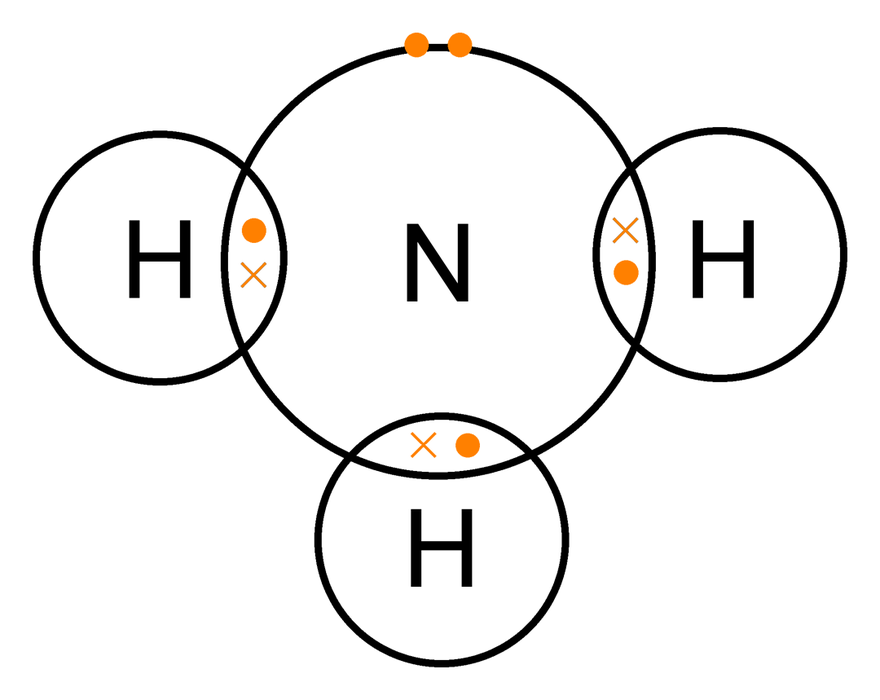
Dot-and-cross diagram of the ammonia molecule.
Credit: Benjah-bmm27 / Wikimedia Commons

License: Public domain
Whitespace trimmed and placed on white
What it is
Ammonia (CAS 7664-41-7) is a colourless gas at room temperature with a pungent, suffocating smell, and it also exists naturally in people and in the environment. [1,4,7] Dissolved in water it forms ammonium hydroxide, which can burn or irritate skin; the pure form is called anhydrous ammonia. [1]
What it does and why it is used
Ammonia's cleaning power makes it common in household and industrial cleaners. [1] Its strong smell gives early warning that it is present, although people may notice the odour less over time. [1]
Regulatory status and health context
Canada
Health Canada advises Canadians to read and follow product labels, ventilate while cleaning, keep household chemicals out of sight and reach of children, and never mix bleach with other cleaning products. [3]
United States
For workplaces, NIOSH recommends an exposure limit of 25 ppm averaged over a work shift and 35 ppm for short-term exposure; the OSHA permissible limit is 50 ppm, and 300 ppm is considered immediately dangerous to life or health. [4]
European Union
The EU Cosmetics Regulation restricts ammonia in cosmetics to 6% (as ammonia) and requires the label statement "Contains ammonia" above 2%. [6]
Environmental notes
The sources used for this review focus on human health and do not assess ammonia's environmental effects, so we do not summarize them here.
Quick facts
- CAS: 7664-41-7. [4]
- Where in the home: many household cleaners, including glass cleaners. [1,3]
- Biggest avoidable risk: mixing with bleach, which forms toxic gas. [1,3]
- Who is most vulnerable: children. [1]
- US workplace limit (NIOSH): 25 ppm over a shift. [4]
Sources
URLs were fetched on 2026-11-10 or 2026-11-11. Source publication dates differ from this draft's review date.
- New York State Department of Health: The facts about ammonia.
- MedlinePlus: Ammonium hydroxide poisoning.
- Health Canada: Reduce your risk from toxic gases: never mix bleach with other cleaning products.
- NIOSH Pocket Guide to Chemical Hazards: ammonia.
- NIOSH: Work-related asthma, exposures.
- EUR-Lex: Regulation (EC) No 1223/2009 on cosmetic products, Annex III.
- PubChem PUG REST: ammonia synonyms.