
Food and drinkWater, air and residues
Benzo[a]pyrene: a smoke-formed contaminant in grilled and smoked meat, regulated as a marker for cancer-causing PAHs
CAS 50-32-8.Also known as BaP, benzo(a)pyrene, 3,4-benzopyrene, polycyclic aromatic hydrocarbons, PAHs, and PAH4.
Editorial draft Last reviewed 11 November 2026 About 873 words
CC INDEX
How it works58/100 Moderate
Benzo[a]pyrene belongs to a family of combustion products, several of which are genotoxic carcinogens, and it turns up in charcoal-grilled and smoked foods. The EU sets legal limits for smoked meat, but human studies have not established a definitive link between PAHs from cooked meat and cancer, which keeps the score in the moderate band.
An editorial summary of this article’s cited evidence. It isn’t medical advice or a personal risk estimate.
Age index
What is the age index?Which age groups are more affected by this chemical’s possible health issues, based on this article’s sources.
- Pregnancy Unborn babies Not well studied
- Infants 0 to 1 Not well studied
- Young children 1 to 5 Not well studied
- Children 6 to 12 Not well studied
- Teens 13 to 19 Not well studied
- Adults 20 to 64 Moderate
- Older adults 65 and over Moderate
- Adults (moderate): Long-term exposure from grilled and smoked foods
- Older adults (moderate): Long-term exposure from grilled and smoked foods

Illustration of charcoal grilling and smoked meat. Fat dripping into flames creates smoke that carries PAHs onto food.
Credit: Chemical Century; AI-generated illustration
License: CC0 1.0
Illustration, not a photograph of a specific product. Resized and cropped for the web.
The smell of a backyard barbecue or a smoked brisket is part of summer for many families, and benzo[a]pyrene comes along with that smoke. It forms when fat drips onto flames and the smoke settles back on the meat, and it is also found in cigarette smoke and car exhaust. The concern is not about how you feel after one cookout but a slow, long-term one, because some compounds in this family can damage DNA and cause cancer, even though studies in people have not proven that grilled or smoked meat at normal intakes does so. Small changes at the grill, rather than giving it up, are what the evidence points to.
Everyday exposure: where you meet it and how much
Benzo[a]pyrene is one of the polycyclic aromatic hydrocarbons (PAHs), compounds formed mainly by incomplete combustion or heat-induced breakdown of organic matter. [2] When fat and juices from meat grilled over a heated surface or open fire drip onto the fire, flames and smoke form, and PAHs in the smoke stick to the meat. PAHs also form when meats are smoked. [1] They are found in other smoked foods, cigarette smoke and car exhaust. [1]
Food is a major route of exposure. EFSA notes PAHs in cereals, vegetable oils, coffee and home-cooked foods, usually where smoking, heating or drying is involved; grilling, roasting and smoking, particularly charcoal grilling and barbecuing, can lead to high concentrations. [2] In EU data, benzo[a]pyrene was present in about half of all food samples analysed. [2]
Known and suspected harms
Evidence labels are editorial summaries, not individual risk predictions: established means recognized under the stated conditions; probable means a likely contribution with uncertainty; possible means limited evidence; disputed means assessors disagree. These labels do not describe how common an effect is.
- Established — some PAHs are genotoxic and can cause cancer: EFSA states that a number of PAHs are genotoxic and can cause cancer. [2] In laboratory experiments PAHs change DNA, and rodents fed PAHs developed cancers including leukemia and tumours of the gastrointestinal tract and lungs, at doses thousands of times higher than a normal diet. [1]
- Established — charcoal grilling and smoking raise levels in food: EFSA identifies charcoal-grilled and barbecued foods as able to reach high concentrations. [2] EU law accepts that some traditionally smoked meats cannot meet the general limits without changing the product, and allows higher levels for local sale in certain member states. [3]
- Possible — cancer risk from PAHs in cooked meat at normal intakes: population studies have not established a definitive link between PAH exposure from cooked meats and cancer in humans. [1]
Reducing avoidable exposure and harm
EFSA notes that when barbecuing, exposure can be reduced by preventing fat from dripping into the flames. [2] The US National Cancer Institute suggests avoiding direct exposure of meat to an open flame or hot metal surface, avoiding long cooking at high temperatures, and removing charred portions. [1]
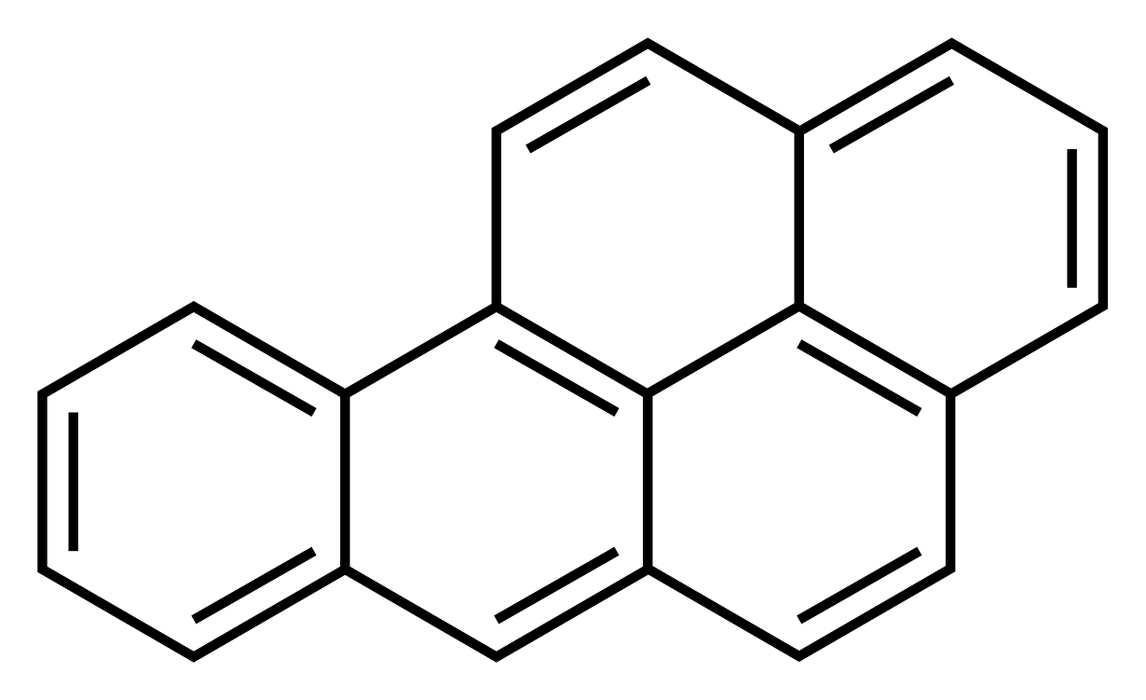
Skeletal structure of benzo[a]pyrene, a polycyclic aromatic hydrocarbon made of five fused rings.
Credit: Calvero / Wikimedia Commons

License: Public domain
Rendered from SVG to PNG, whitespace trimmed and placed on white
What it is
Benzo[a]pyrene (CAS 50-32-8) is a five-ring polycyclic aromatic hydrocarbon. [5] It has been used as an indicator for PAHs in food. In 2008 EFSA's contaminants panel concluded that benzo[a]pyrene alone is not a sufficient indicator, because other carcinogenic PAHs were found in about 30% of samples that tested negative for it. The panel recommended the sum of four PAHs (PAH4: benzo[a]pyrene, benz[a]anthracene, benzo[b]fluoranthene and chrysene) as a better indicator. [2]
What it does and why it is used
Benzo[a]pyrene is not added to food; it is a contaminant from smoke, heat and environmental sources. [1,2]
Regulatory status and health context
Canada
Health Canada's list of maximum levels includes PAHs in only one food: 3 µg/kg benzo[a]pyrene toxic equivalents in olive-pomace oil. We did not find a Canadian limit for PAHs in meat. [4]
United States
There are no federal guidelines on eating foods that contain HCAs and PAHs. [1]
European Union
Regulation (EU) 2023/915 sets maximum levels for smoked meat and smoked meat products of 2.0 µg/kg for benzo[a]pyrene and 12.0 µg/kg for the sum of PAH4. Certain member states may allow traditionally smoked meat produced and sold locally with up to 5.0 µg/kg benzo[a]pyrene and 30.0 µg/kg PAH4. [3]
Environmental notes
PAHs form from incomplete combustion and reach food from environmental sources as well as processing and cooking; EFSA also notes seafood from polluted waters as a source. [2]
Quick facts
- CAS: 50-32-8. [5]
- Found in: charcoal-grilled, barbecued and smoked foods, among others. [1,2]
- EU limit, smoked meat: 2.0 µg/kg benzo[a]pyrene; 12.0 µg/kg PAH4. [3]
- Indicator: EU limits use benzo[a]pyrene and the PAH4 sum. [2,3]
- Simple habit: keep fat from dripping into flames, and trim charred bits. [1,2]
Sources
All URLs were fetched on 2026-11-11. Source publication dates differ from this draft's review date.
- US National Cancer Institute: Chemicals in meat cooked at high temperatures and cancer risk.
- EFSA: Opinion on suitable indicators for the occurrence and toxicity of polycyclic aromatic hydrocarbons in food.
- EUR-Lex: Commission Regulation (EU) 2023/915 on maximum levels for certain contaminants in food.
- Health Canada: Maximum levels for chemical contaminants in foods.
- PubChem PUG REST: benzo[a]pyrene synonyms.