
Medicines and healthSkin and personal care
Benzoyl peroxide: a common acne treatment that irritates skin, bleaches fabric and rarely causes allergic reactions
CAS 94-36-0.Also known as dibenzoyl peroxide, benzoyl superoxide, benzoperoxide, and acne treatment.
Editorial draft Last reviewed 10 November 2026 About 854 words
CC INDEX
How it works30/100 Mild
Benzoyl peroxide is a well-studied acne treatment. Skin irritation is common but mild, serious allergic reactions are rare, and FDA judged the cancer risk from benzene found in some products to be very low. Exposure is deliberate, short-term and labelled.
An editorial summary of this article’s cited evidence. It isn’t medical advice or a personal risk estimate.
Age index
What is the age index?Which age groups are more affected by this chemical’s possible health issues, based on this article’s sources.
- Pregnancy Unborn babies Moderate
- Infants 0 to 1 Not well studied
- Young children 1 to 5 Not well studied
- Children 6 to 12 Not well studied
- Teens 13 to 19 Moderate
- Adults 20 to 64 Moderate
- Older adults 65 and over Not well studied
- Pregnancy (moderate): Ask a doctor first if pregnant or breastfeeding
- Teens (moderate): Main users; dryness and irritation are common
- Adults (moderate): Dryness and irritation; rare allergic reactions

Illustration of an acne gel and a towel. Benzoyl peroxide can bleach coloured fabrics and hair.
Credit: Chemical Century; AI-generated illustration
License: CC0 1.0
Illustration, not a photograph of a specific product. Resized and cropped for the web.
For a teenager facing a mirror before school, or an adult dealing with stubborn breakouts, benzoyl peroxide is often the first acne treatment that actually helps. The everyday downsides are usually more annoying than dangerous: dry, flaky or stinging skin in the first weeks, and bleached spots on a favourite towel, pillowcase or dark shirt. Rarely, someone has a serious allergic reaction, which is a reason to stop and get help right away if swelling or trouble breathing appears. Knowing these trade-offs in advance makes it easier to stick with a treatment that can take weeks to show results.
Everyday exposure: where you meet it and how much
Benzoyl peroxide is used to treat mild to moderate acne. It comes as cleansing liquids and bars, lotions, creams and gels, usually used once or twice a day. MedlinePlus advises starting once a day to see how your skin reacts, and notes that it may take 4 to 6 weeks to see results. [1] In Canada, non-prescription acne products may contain 2.5% to 5% benzoyl peroxide under Health Canada's acne therapy monograph. [2]
Known and suspected harms
Evidence labels are editorial summaries, not individual risk predictions: established means recognized under the stated conditions; probable means a likely contribution with uncertainty; possible means limited evidence; disputed means assessors disagree. These labels do not describe how common an effect is.
- Established — dryness, peeling, stinging and irritation: common side effects include dryness or peeling, a feeling of warmth, tingling and slight stinging. Burning, blistering, redness or swelling of the treated area, or a rash, need a call to a doctor. Irritation and dryness are more likely when another topical acne product is used at the same time. [1,2]
- Established — rare but serious allergic reactions: stop using it and get emergency help for hives, itching, throat tightness, difficulty breathing, feeling faint, or swelling of the eyes, face, lips or tongue. Health Canada requires an allergy alert on non-prescription products. [1,2] It is classified as able to cause an allergic skin reaction. [5]
- Established — bleaches hair and coloured fabrics: benzoyl peroxide can bleach hair and coloured or dyed fabrics. [1,2]
- Established — benzene contamination found in a small number of products: in March 2025, FDA tested 95 benzoyl peroxide acne products. More than 90% had undetectable or extremely low benzene, while six had elevated levels and some were recalled from stores. FDA said that even with daily use for decades, the cancer risk from the benzene found was very low. [3]
Reducing avoidable exposure and harm
Start with once-daily use, apply only to areas with acne, and avoid the eyes, lips, mouth and nostrils. [1,2] Use one topical acne product at a time if your skin becomes irritated, limit unnecessary sun exposure and use sunscreen. [2] Keep it away from hair and coloured fabrics, including clothing, towels and pillowcases. [1,2] Throw away products past their expiry date. [3] Ask a doctor first if you are pregnant, planning a pregnancy or breastfeeding. [1]
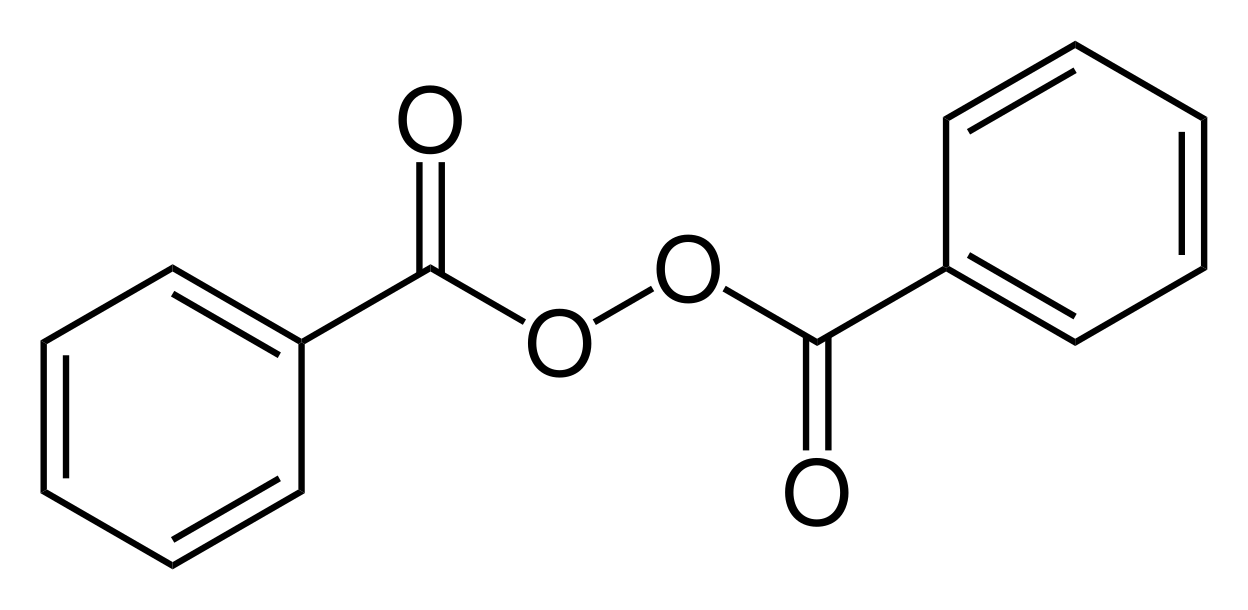
Chemical structure of benzoyl peroxide (dibenzoyl peroxide).
Credit: Bryan Derksen / Wikimedia Commons

License: Public domain
Rendered from SVG to PNG, whitespace trimmed and placed on white
What it is
Benzoyl peroxide, or dibenzoyl peroxide, is an organic peroxide: two benzoyl groups linked by an oxygen-oxygen bond. Its CAS number is 94-36-0. As a pure chemical it is classified as a fire hazard when heated. [5,6]
What it does and why it is used
Benzoyl peroxide is a topical acne medicine. [1,2] In the EU it is also allowed in professional artificial nail systems. [4]
Regulatory status and health context
Canada
Health Canada's acne therapy monograph lists benzoyl peroxide at 2.5% to 5% as a non-prescription drug ingredient. Required label statements include warnings to avoid the eyes, to stop use if severe irritation develops, and an allergy alert to get medical help right away for hives, swelling of the eyes and mouth, blistering or difficulty breathing. [2]
United States
Benzoyl peroxide is sold in over-the-counter and prescription acne products. [1] After its 2025 benzene testing, FDA reminded manufacturers that they must test for possible contaminants such as benzene, and cautioned that unvalidated third-party test methods can give inaccurate results. [3]
European Union
Annex III of the EU Cosmetic Products Regulation (entry 94) allows dibenzoyl peroxide in artificial nail systems at up to 0.7% after mixing, for professional use only, with warnings to avoid skin contact. [4]
Environmental notes
The sources used here do not assess benzoyl peroxide in consumer products as an environmental concern and do not provide data for a rating. [1–4]
Quick facts
- CAS: 94-36-0. [6]
- Use: mild to moderate acne. [1]
- Canada: 2.5% to 5% in non-prescription products. [2]
- Common effects: dryness, peeling and stinging. [1]
- Watch out for: bleached hair and coloured fabrics. [1]
Sources
All URLs were fetched on 2026-11-10. Source publication dates differ from this draft's review date.
- MedlinePlus: Benzoyl peroxide topical.
- Health Canada: Acne therapy monograph (2025).
- FDA: Limited number of voluntary recalls initiated after FDA testing of acne products for benzene (2025).
- EUR-Lex: Regulation (EC) No 1223/2009 on cosmetic products.
- PubChem: benzoyl peroxide, GHS classification.
- PubChem PUG REST: benzoyl peroxide synonyms.