
Water, air and residuesHousehold materials
Carbon monoxide: an invisible, odourless gas from fuel-burning appliances that can kill quickly
CAS 630-08-0.Also known as CO, carbonic oxide, carbon(II) oxide, and carbon monoxide poisoning.
Editorial draft Last reviewed 10 November 2026 About 938 words
CC INDEX
How it works74/100 High
Carbon monoxide poisoning is sudden, often fatal, and well documented, with hundreds of deaths a year in the US alone. Every home with a fuel-burning appliance, attached garage or generator has a potential source, and people cannot see or smell it. Detectors, venting and maintenance prevent most cases, which keeps the score out of the top band.
An editorial summary of this article’s cited evidence. It isn’t medical advice or a personal risk estimate.
Age index
What is the age index?Which age groups are more affected by this chemical’s possible health issues, based on this article’s sources.
- Pregnancy Unborn babies Not well studied
- Infants 0 to 1 Higher concern
- Young children 1 to 5 Moderate
- Children 6 to 12 Moderate
- Teens 13 to 19 Moderate
- Adults 20 to 64 Moderate
- Older adults 65 and over Higher concern
- Infants (higher concern): More likely to become ill, per CDC
- Older adults (higher concern): More likely to become ill, per CDC

Illustration of a home alarm near a sleeping area and fuel-burning appliances. Install carbon monoxide alarms near every sleeping area.
Credit: Chemical Century; AI-generated illustration
License: CC0 1.0
Illustration, not a photograph of a specific product. Resized and cropped for the web.
On a cold winter night, a furnace, a gas stove, a fireplace or a car warming up in an attached garage can all release carbon monoxide, a gas you cannot see or smell. Early poisoning often feels like the flu, with headache, dizziness, weakness and nausea, so it is easy to mistake for a passing bug. As exposure builds it can cause confusion and can kill quickly, and people with heart disease can feel chest pain even at lower levels. The good news is that working detectors, proper venting and regular appliance checks prevent most cases.
Everyday exposure: where you meet it and how much
Carbon monoxide (CO) forms whenever fuel is burned, in cars and trucks, small engines, stoves, lanterns, grills, fireplaces, gas ranges and furnaces. [1] Indoor sources include unvented kerosene and gas space heaters, leaking chimneys and furnaces, back-drafting from furnaces, water heaters, wood stoves and fireplaces, generators and other gasoline-powered equipment, car exhaust from attached garages and tobacco smoke. [3]
EPA reports that average levels in homes without gas stoves range from 0.5 to 5 ppm. Levels near properly adjusted gas stoves are often 5 to 15 ppm, and near poorly adjusted stoves may reach 30 ppm or more. [3] A blocked chimney, a running car in an attached garage or a generator used indoors can push levels far higher very quickly. [1,3]
Known and suspected harms
Evidence labels are editorial summaries, not individual risk predictions: established means recognized under the stated conditions; probable means a likely contribution with uncertainty; possible means limited evidence; disputed means assessors disagree. These labels do not describe how common an effect is.
- Established — sudden poisoning and death: breathing in a lot of CO can make you pass out or kill you. People who are asleep, drunk or under the influence of other substances can die before they have symptoms. In the US, more than 400 people die each year from unintentional CO poisoning not linked to fires, more than 100,000 visit an emergency department and more than 14,000 are hospitalized. [1]
- Established — flu-like symptoms such as headache, dizziness and nausea: the most common symptoms are headache, dizziness, weakness, upset stomach, vomiting, chest pain and confusion, often described as flu-like. [1] CO forms carboxyhemoglobin in the blood, which reduces the blood's ability to carry oxygen. [3]
- Established — chest pain and heart strain at low levels in people with heart disease: in controlled studies, people with coronary artery disease showed signs of reduced blood flow to the heart and earlier chest pain during exercise at low carboxyhemoglobin levels, and more irregular heartbeats at higher ones. Health Canada based its indoor guideline on these effects. [2] Infants, older people and people with heart disease, anemia or breathing problems are more likely to become ill. [1]
Reducing avoidable exposure and harm
Install battery-operated or battery-backup CO alarms near every sleeping area, check the batteries each spring and fall, and replace alarms as the manufacturer directs or every 5 years. [1] Have furnaces, water heaters and other gas, oil or coal appliances serviced every year, make sure they are vented properly, and have chimneys checked or cleaned yearly. [1] Never heat a home with a gas oven, never burn charcoal indoors, and never run a generator inside a home or garage; keep generators outdoors more than 20 feet (6 m) from windows, doors and vents. [1] Never run a car in an attached garage, even with the door open. [1]
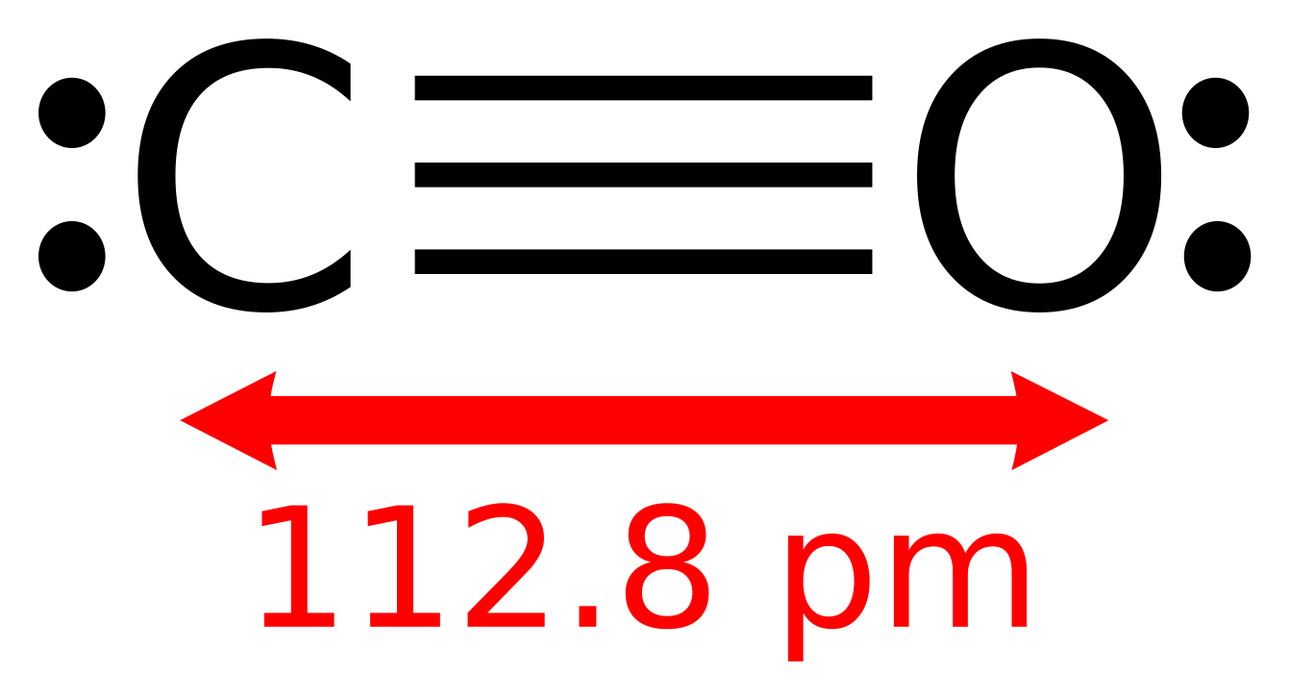
Carbon monoxide: one carbon atom triple-bonded to one oxygen atom.
Credit: It Is Me Here / Wikimedia Commons

License: Public domain
Rendered from SVG to PNG, whitespace trimmed and placed on white
What it is
Carbon monoxide is a tasteless, odourless and colourless gas, formula CO, usually formed by incomplete burning of organic materials. Its CAS number is 630-08-0. [2,6]
What it does and why it is used
In homes, carbon monoxide is not used on purpose; it is an unwanted by-product of burning fuel. [1–3] It is harmful because it forms carboxyhemoglobin in the blood, which reduces the body's oxygen intake. [3]
Regulatory status and health context
Canada
Health Canada's residential indoor air quality guideline sets maximum exposure limits of 25 ppm (28.6 mg/m³) averaged over 1 hour and 10 ppm (11.5 mg/m³) averaged over 24 hours, chosen to keep carboxyhemoglobin below 2% in blood. [2]
United States
EPA's national outdoor air quality standards for CO are 9 ppm over 8 hours and 35 ppm over 1 hour, each not to be exceeded more than once a year. [4] CDC recommends CO alarms in homes and yearly servicing of fuel-burning appliances. [1]
European Union
Directive 2008/50/EC on ambient air quality sets a limit value for carbon monoxide of 10 mg/m³ as the maximum daily 8-hour mean. [5]
Environmental notes
Outdoors, carbon monoxide is a regulated air pollutant in the US and the EU; vehicle exhaust from nearby roads and parking areas can also bring it indoors. [3–5]
Quick facts
- CAS: 630-08-0. [6]
- Senses: no colour, smell or taste. [2]
- US toll: more than 400 deaths a year from unintentional, non-fire CO poisoning. [1]
- Canada indoor limits: 10 ppm over 24 hours; 25 ppm over 1 hour. [2]
- Best protection: working CO alarms near sleeping areas and yearly appliance checks. [1]
Sources
All URLs were fetched on 2026-11-10. Source publication dates differ from this draft's review date.
- CDC: Carbon monoxide (CO) poisoning basics.
- Health Canada: Residential indoor air quality guideline, carbon monoxide.
- US EPA: Carbon monoxide's impact on indoor air quality.
- US EPA: NAAQS table.
- EUR-Lex: Directive 2008/50/EC on ambient air quality and cleaner air for Europe.
- PubChem PUG REST: carbon monoxide synonyms.