
Water, air and residuesFood and drink
Chlormequat: a grain growth regulator whose residues can turn up in oat cereals, with limits set in Canada and the US
CAS 999-81-5.Also known as chlormequat chloride, chlorocholine chloride, and (2-chloroethyl)trimethylammonium chloride.
Editorial draft Last reviewed 11 November 2026 About 861 words
CC INDEX
How it works26/100 Mild
Chlormequat is a plant growth regulator used on oats, wheat and barley, so low residues can reach grain foods. Animal studies at high doses show weight loss and nerve signs, but EPA classifies it as not likely to cause cancer and estimates dietary exposure below its level of concern, with children aged 1 to 2 the most exposed group at 76% of the chronic limit. The score is mild.
An editorial summary of this article’s cited evidence. It isn’t medical advice or a personal risk estimate.
Age index
What is the age index?Which age groups are more affected by this chemical’s possible health issues, based on this article’s sources.
- Pregnancy Unborn babies Lower concern
- Infants 0 to 1 Moderate
- Young children 1 to 5 Moderate
- Children 6 to 12 Lower concern
- Teens 13 to 19 Lower concern
- Adults 20 to 64 Lower concern
- Older adults 65 and over Lower concern
- Pregnancy (lower concern): No extra sensitivity in developmental animal studies
- Infants (moderate): Highest short-term dietary exposure, still below EPA's level of concern
- Young children (moderate): Highest long-term dietary exposure, still below EPA's level of concern

Illustration of oats and oat foods. Chlormequat keeps cereal stems shorter and sturdier so the crop does not fall over before harvest.
Credit: Chemical Century; AI-generated illustration
License: CC0 1.0
Illustration, not a photograph of a specific product. Resized and cropped for the web.
A bowl of oatmeal on a busy morning or a handful of oat cereal for a toddler is a comforting routine, and most parents never think about how the oats were grown. Chlormequat is a farm chemical that keeps cereal stems short and sturdy so crops don't flatten before harvest, and small residues can remain in grain foods. Animal studies at high doses showed weight loss and signs of nerve effects, but the US regulator classes it as not likely to cause cancer and estimates that dietary exposure, even for young children, stays below its level of concern. For families, it is something worth understanding rather than a reason to give up oats.
Everyday exposure: where you meet it and how much
Chlormequat chloride is a pesticide used as a plant growth regulator. [1] In small grains such as wheat, barley, oats and triticale, stems can bend over or break before harvest, which is called lodging; chlormequat reduces plant height to help prevent this. [1] Because it is applied to grain crops, low residues can remain in grain and in foods made from it, and EPA also sets limits for residues in meat, milk and eggs from animals that eat treated feed. [2]
EPA's 2026 assessment estimated that chronic dietary exposure is highest for children aged 1 to 2, at 76% of the chronic population-adjusted dose, which is below EPA's level of concern of 100%. Acute dietary exposure was highest for infants under 1, at 22% of the acute population-adjusted dose. [2]
Known and suspected harms
Evidence labels are editorial summaries, not individual risk predictions: established means recognized under the stated conditions; probable means a likely contribution with uncertainty; possible means limited evidence; disputed means assessors disagree. These labels do not describe how common an effect is.
- Established — body weight loss and nerve signs in animals at high doses: decreases in body weight and signs of neurotoxicity, such as unsteady movement, salivation and lower body temperature, were seen consistently in repeat-dose studies in rats, mice and dogs. Dogs appeared to be the most sensitive species. [3] EPA found no greater susceptibility in offspring than in adult animals in developmental and two-generation reproduction studies. [3]
- Established — not likely to cause cancer, per EPA: carcinogenicity studies in mice and rats showed no signs of carcinogenic potential, and chlormequat chloride was non-mutagenic in four genotoxicity studies. EPA classifies it as "Not Likely to be a Carcinogen to Humans." [3]
- Established — estimated dietary exposure below EPA's level of concern: based on its human health risk assessment, EPA found no dietary, residential or aggregate risks of concern. [1,2]
Reducing avoidable exposure and harm
The sources used here find exposure below regulatory levels of concern and do not give consumer advice for reducing chlormequat residues. [1,2] EPA sets a separate residue tolerance for each crop and animal product. [2]
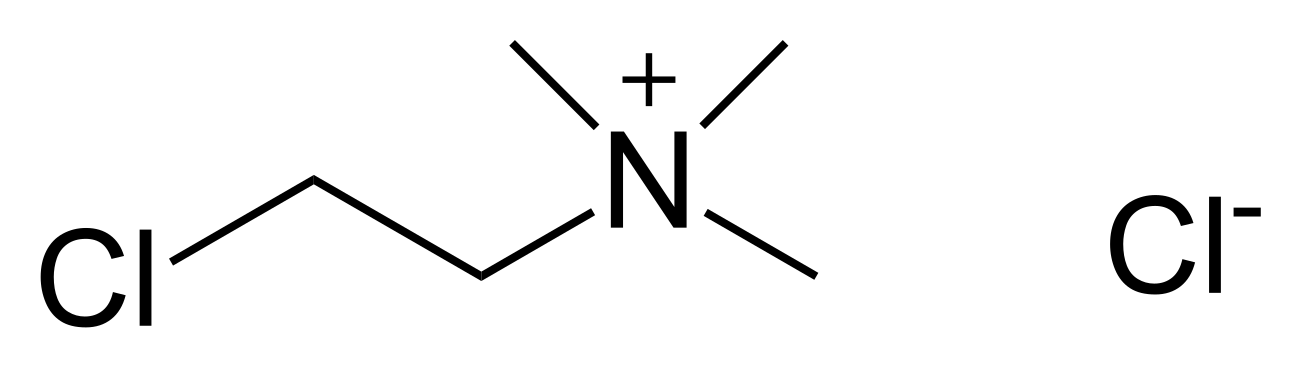
Chemical structure of chlormequat chloride, a quaternary ammonium plant growth regulator.
Credit: Ed (Edgar181) / Wikimedia Commons

License: Public domain
Rendered from SVG to PNG, whitespace trimmed and placed on white
What it is
Chlormequat chloride (CAS 999-81-5), chemically (2-chloroethyl)trimethylammonium chloride, is a plant growth regulator. [2,4] It is also called chlorocholine chloride. [4]
What it does and why it is used
Chlormequat controls plant size by blocking the hormones that stimulate growth before bloom. In the US it was registered for ornamental plants grown in greenhouses and nurseries before EPA proposed its first food uses on barley, oats, triticale and wheat. [1] Lodging can severely limit grain yield and harvestability and harm grain quality. [1]
Regulatory status and health context
Canada
EPA's 2026 rule says it harmonized several US tolerances with Canadian maximum residue limits, including 40 ppm for oat grain, 5 ppm for wheat grain and 8 ppm for barley grain. [2]
United States
EPA first set chlormequat chloride tolerances in 2018. [3] Its 2026 rule sets tolerances including 40 ppm in oat grain, 5 ppm in wheat grain, 8 ppm in barley grain, 0.5 ppm in milk and 0.2 ppm in cattle meat. [2] The international Codex limit for oat grain is lower, 4 ppm; EPA notes that Codex limits differ from US tolerances because of the US use pattern. [2]
European Union
The sources used for this review do not cover chlormequat's EU status, so we do not summarize it here.
Environmental notes
EPA's ecological risk assessment identified no risks of concern for aquatic invertebrates or aquatic and terrestrial plants, among other groups. EPA proposed mitigation measures to address potential risks to birds, reptiles, amphibians, mammals and land invertebrates, and to farm workers. [1]
Quick facts
- CAS: 999-81-5. [4]
- Type: plant growth regulator used on cereal grains. [1]
- US and Canada oat grain limit: 40 ppm. [2]
- Codex oat grain limit: 4 ppm. [2]
- EPA cancer classification: not likely to be a carcinogen to humans. [3]
Sources
All URLs were fetched on 2026-11-11. Source publication dates differ from this draft's review date.
- US EPA: EPA proposes to register new uses of pesticide chlormequat chloride.
- Federal Register: Chlormequat chloride; pesticide tolerances, June 30, 2026 (91 FR 39489).
- Federal Register: Chlormequat chloride; pesticide tolerances, April 25, 2018 (83 FR 17925).
- PubChem PUG REST: chlormequat chloride synonyms.