
Fragrance and flavourFood and drink
Coumarin: the sweet-smelling compound in cassia cinnamon, and why heavy daily use matters
CAS 91-64-5.Also known as 1,2-benzopyrone, 2H-chromen-2-one, cassia cinnamon coumarin, and tonka bean coumarin.
Editorial draft Last reviewed 10 November 2026 About 1072 words
CC INDEX
How it works33/100 Mild
Liver effects are documented in sensitive people at high intakes and are usually reversible. Ordinary use of cinnamon as a spice keeps most people below the tolerable daily intake, but frequent heavy use of cassia cinnamon and cinnamon supplements can exceed it. Food limits and cosmetic labelling rules already apply in the EU and Canada.
An editorial summary of this article’s cited evidence. It isn’t medical advice or a personal risk estimate.
Age index
What is the age index?Which age groups are more affected by this chemical’s possible health issues, based on this article’s sources.
- Pregnancy Unborn babies Not well studied
- Infants 0 to 1 Not well studied
- Young children 1 to 5 Higher concern
- Children 6 to 12 Moderate
- Teens 13 to 19 Not well studied
- Adults 20 to 64 Moderate
- Older adults 65 and over Not well studied
- Young children (higher concern): Small body weight: less cinnamon reaches the tolerable intake
- Children (moderate): Small body weight: less cinnamon reaches the tolerable intake
- Adults (moderate): Heavy cassia cinnamon or supplement use; liver disease

Illustration of cassia bark (left) and Ceylon quills (right). Cassia contains much more coumarin than Ceylon cinnamon.
Credit: Chemical Century; AI-generated illustration
License: CC0 1.0
Illustration, not a photograph of a specific product. Resized and cropped for the web.
A sprinkle of cinnamon on oatmeal or a slice of cinnamon toast is no cause for concern for most people, but coumarin explains why very heavy daily use deserves a second thought. This sweet-smelling compound is plentiful in cassia cinnamon and in some cinnamon supplements taken for health reasons. In a small group of sensitive people, large regular intakes have caused liver problems, which usually ease once the intake stops. It also turns up in perfumes and cosmetics, where it is a recognized cause of skin allergy for some people.
Everyday exposure: where you meet it and how much
Coumarin is a natural flavouring and fragrance substance found in many plants. It occurs in relatively high concentrations in the cinnamon varieties known as cassia cinnamon, and also in woodruff, tonka beans and melilot (sweet clover). Ceylon cinnamon contains only low levels. [1,2] Made synthetically, coumarin is used in cosmetics, where it smells of fresh hay, and in perfumes, air fresheners and other household products. [1,2]
ANSES estimates that around 40% of adults and 43% of children are exposed to coumarin through their diet, mainly from herbs and spices, sauces, pastries, cakes and sweet biscuits. People who take food supplements containing cinnamon or other coumarin-rich plants are the ones most at risk of exceeding the tolerable daily intake. [2]
Known and suspected harms
Evidence labels are editorial summaries, not individual risk predictions: established means recognized under the stated conditions; probable means a likely contribution with uncertainty; possible means limited evidence; disputed means assessors disagree. These labels do not describe how common an effect is.
- Established — liver injury in a small group of sensitive people at high intake: when coumarin was used as a medicine, even relatively low doses taken for a few weeks caused liver damage in a small group of especially sensitive people. Mild cases showed raised liver enzymes; severe cases showed liver inflammation with jaundice. The effects are usually reversible. BfR notes that no such cases of liver damage after eating cinnamon had been described in the scientific literature. [1]
- Established — adverse effects linked to cinnamon-based supplements: in reports collected by the French nutrivigilance scheme, cinnamon essential oils used in food supplements were responsible for most of the adverse effects that could be analysed (16 of 28), such as liver and digestive symptoms. [2]
- Established — a recognized fragrance allergen that must be named on cosmetic labels above set levels: coumarin is on the EU list of fragrance allergens that must appear in a cosmetic's ingredient list above 0.001% in leave-on products and 0.01% in rinse-off products. Canada uses the same list and thresholds. [5,6]
- Disputed — cancer risk in humans: very large doses given to rats and mice over long periods caused cancer. BfR states that there are no indications that coumarin triggers tumours in humans, and that an older concern about cancer from small intakes has proved unfounded. [1]
Reducing avoidable exposure and harm
The tolerable daily intake is 0.1 mg per kg of body weight. BfR calculates that a 60 kg adult reaches it with about 2 g of cassia cinnamon a day, and a 15 kg child with about 0.5 g. [1] If you use a lot of cinnamon every day, choose Ceylon cinnamon, which is low in coumarin; ground cassia and Ceylon are hard to tell apart unless the label says which. [1] ANSES advises keeping coumarin from food supplements below 4.8 mg a day for a 60 kg adult. People with a history of liver disease, or who take medicines that can affect the liver, should avoid cinnamon-rich foods and coumarin-containing supplements. [2] If you react to fragranced products, check ingredient lists for coumarin. [5]
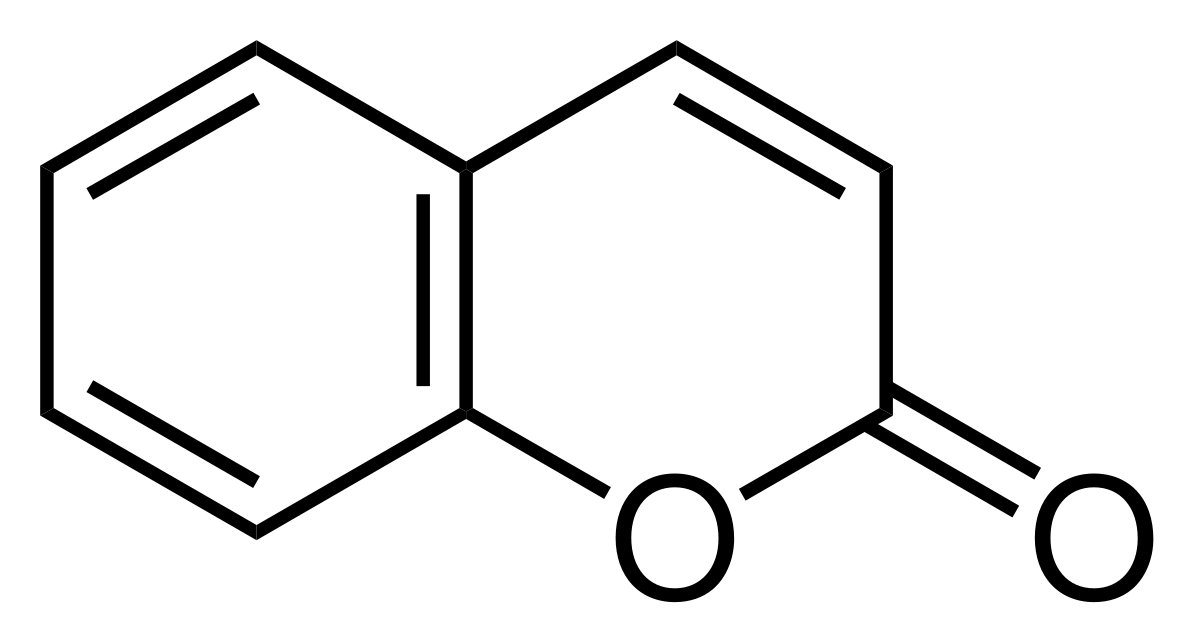
Chemical structure of coumarin (1,2-benzopyrone).
Credit: Calvero / Wikimedia Commons

License: Public domain
Rendered from SVG to PNG, whitespace trimmed and placed on white
What it is
Coumarin is the chemical 1,2-benzopyrone, formula C9H6O2. Its CAS number is 91-64-5. It is found in tonka beans and other natural sources and is also made synthetically. [4,7]
What it does and why it is used
Coumarin gives a sweet, hay-like smell. It is used as a fragrance ingredient in cosmetics and household products. Plant parts that contain it, such as cinnamon, flavour foods. Coumarin has also been used as a medicine to treat oedema. [1,2]
Regulatory status and health context
Canada
Since April 12, 2026, cosmetics sold in Canada must name coumarin in the ingredient list, rather than hiding it within "parfum", when it is present above 0.01% in rinse-off products or 0.001% in leave-on products. [5] We did not find a Canada-specific limit for coumarin in foods in the sources reviewed for this draft.
United States
FDA regulations treat food containing any added coumarin, either as such or as part of tonka beans or tonka extract, as adulterated. That rule is based on an order published in 1954. [4]
European Union
Regulation (EC) No 1334/2008 on flavourings bans adding coumarin to food as such. It sets maximum levels for coumarin that comes from flavouring ingredients such as cinnamon: 50 mg/kg in traditional or seasonal bakery ware that refers to cinnamon on the label, 20 mg/kg in breakfast cereals, 15 mg/kg in other fine bakery ware and 5 mg/kg in desserts. There is no limit for cinnamon sold as a spice. [1,3] Under Annex III of the EU Cosmetic Products Regulation (entry 77), coumarin must be listed on cosmetics above 0.001% in leave-on and 0.01% in rinse-off products. [6]
Environmental notes
The sources used here do not assess coumarin as an environmental concern and do not provide data for a rating. [1–3]
Quick facts
- CAS: 91-64-5. [7]
- Highest food source: cassia cinnamon; Ceylon cinnamon is low in coumarin. [1]
- Tolerable daily intake: 0.1 mg per kg of body weight. [1]
- Rule of thumb: about 2 g of cassia a day for a 60 kg adult, 0.5 g for a 15 kg child. [1]
- Labelling: named on cosmetics above 0.001% (leave-on) or 0.01% (rinse-off) in Canada and the EU. [5,6]
Sources
All URLs were fetched on 2026-11-10. Source publication dates differ from this draft's review date.
- BfR (German Federal Institute for Risk Assessment): FAQ on coumarin in cinnamon and other foods.
- ANSES: Beware of overconsumption of herbal supplements containing coumarin.
- EUR-Lex: Regulation (EC) No 1334/2008 on flavourings.
- eCFR: 21 CFR 189.130, coumarin.
- Health Canada: Industry guide for the labelling of cosmetics.
- EUR-Lex: Regulation (EC) No 1223/2009 on cosmetic products.
- PubChem PUG REST: coumarin synonyms.