
Water, air and residuesFood and drink
Deoxynivalenol: a mould toxin in wheat, pasta and breakfast cereals that is limited because children can eat too much of it
CAS 51481-10-8.Also known as DON, vomitoxin, and 4-deoxynivalenol.
Editorial draft Last reviewed 11 November 2026 About 823 words
CC INDEX
How it works46/100 Moderate
Deoxynivalenol is a common natural contaminant of wheat and other grains that survives processing. High levels cause vomiting and nausea, and EFSA found that average long-term intake in European children is above the tolerable daily intake, which led the EU to lower its limits in 2024. It is not carcinogenic, so the score stays in the moderate band.
An editorial summary of this article’s cited evidence. It isn’t medical advice or a personal risk estimate.
Age index
What is the age index?Which age groups are more affected by this chemical’s possible health issues, based on this article’s sources.
- Pregnancy Unborn babies Not well studied
- Infants 0 to 1 Higher concern
- Young children 1 to 5 Higher concern
- Children 6 to 12 Higher concern
- Teens 13 to 19 Moderate
- Adults 20 to 64 Moderate
- Older adults 65 and over Not well studied
- Infants (higher concern): Long-term intake above the tolerable daily intake (EFSA)
- Young children (higher concern): Eat more grain per kg of body weight; intake above the tolerable level
- Children (higher concern): Average long-term intake above the tolerable level (EFSA)
- Teens (moderate): Above the tolerable level only at high intakes
- Adults (moderate): Above the tolerable level only at high intakes

Illustration of wheat and wheat foods. The moulds that make deoxynivalenol grow on grain in the field, especially in cool, wet weather.
Credit: Chemical Century; AI-generated illustration
License: CC0 1.0
Illustration, not a photograph of a specific product. Resized and cropped for the web.
Toast for breakfast, a bowl of pasta for dinner and cereal for the kids: wheat and other grains are at the heart of family meals, and so, at low levels, is deoxynivalenol. This mould toxin forms on crops in the field, especially in cool, wet years, and cooking or baking does not destroy it. Eating food with high levels can bring on vomiting and nausea, which is where its nickname, vomitoxin, comes from. Day to day, the bigger question is children, who eat a lot of grain for their size, which is why European regulators lowered the limits for breakfast cereals, pasta and baby foods.
Everyday exposure: where you meet it and how much
Deoxynivalenol (DON), also called vomitoxin, is made by several Fusarium moulds that grow on wheat, corn, oats, barley and other grains, especially in cool, wet conditions. [1] Proper processing of wheat can lower DON levels in products such as flour but does not remove it completely. FDA notes it has been found in bread, noodles, beer, popcorn and other foods. [1]
Contamination happens in the field, and because DON resists heat, processing may not completely remove it from finished foods. [3] In a 2010–2011 Canadian survey of 943 samples, including breakfast cereals, infant cereals, wheat, corn and oat products, beer, wine, dried fruit and infant formula, 59% contained detectable DON, at levels from 1 to 2,060 ppb. DON was not found in wine or dried fruit. [3]
Known and suspected harms
Evidence labels are editorial summaries, not individual risk predictions: established means recognized under the stated conditions; probable means a likely contribution with uncertainty; possible means limited evidence; disputed means assessors disagree. These labels do not describe how common an effect is.
- Established — vomiting and nausea from high levels: eating foods with high levels of DON can cause vomiting, nausea and other symptoms. [1] The Canadian Food Inspection Agency notes that very high levels may cause immunosuppressive and gastrointestinal effects, and that DON is not carcinogenic. [3]
- Probable — children's long-term intake can exceed the tolerable daily intake: EFSA set a group tolerable daily intake of 1 µg/kg body weight for DON and related forms. Acute exposures were below its acute reference dose of 8 µg/kg per eating occasion, but estimated average long-term exposures were above the tolerable daily intake in infants, toddlers and other children, and at high exposures in adolescents and adults, indicating a potential health concern. [5]
- Established — not removed by cooking or baking: DON is heat resistant. [3]
Reducing avoidable exposure and harm
Most control happens before food reaches stores, through grain handling, milling and limits on finished products. [1,2,5] FDA says that at or below its advisory level DON does not appear to pose a danger to people who eat the food. [1] The sources used here do not give household advice for reducing DON.
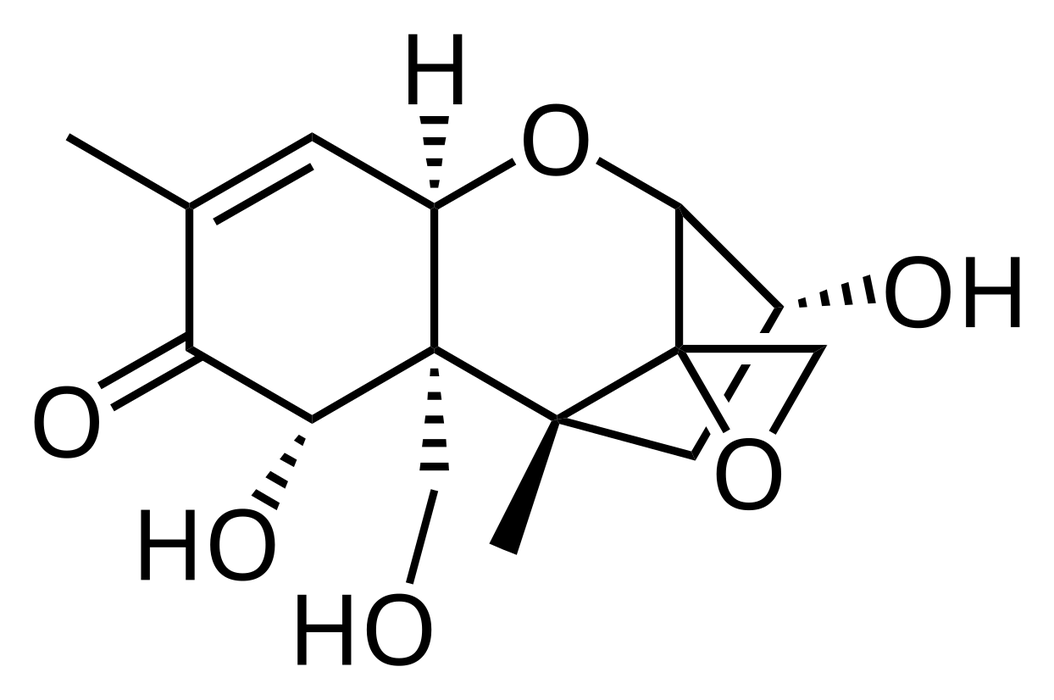
Chemical structure of deoxynivalenol (DON), a trichothecene mycotoxin.
Credit: Calvero / Wikimedia Commons

License: Public domain
Rendered from SVG to PNG, whitespace trimmed and placed on white
What it is
Deoxynivalenol (CAS 51481-10-8) is a mycotoxin, a toxic substance produced by moulds. [1,6] EFSA's assessment covers it together with 3-acetyl-DON, 15-acetyl-DON and DON-3-glucoside. [5]
What it does and why it is used
DON is a natural contaminant with no use in food. [1]
Regulatory status and health context
Canada
Health Canada lists maximum levels of 2.0 mg/kg DON in uncleaned soft wheat for non-staple foods and 1.0 mg/kg in uncleaned soft wheat for baby foods, both under review. [4] There are no Canadian maximum levels for DON in finished products; elevated results are reviewed case by case. [3]
United States
FDA's advisory level is 1 ppm DON in finished wheat products such as flour, bran and germ that people may eat. FDA does not set a level for wheat intended for milling, because milling practices can substantially reduce DON. [2]
European Union
Regulation (EU) 2024/1022, applying from July 1, 2024, lowered certain DON maximum levels. Examples: 600 µg/kg in dry pasta, 400 µg/kg in bakery wares, cereal snacks and breakfast cereals, and 150 µg/kg in baby food and processed cereal-based food for infants and young children. [5]
Environmental notes
The moulds that produce DON grow on grain crops in the field under normal weather, especially when it is cool and wet. [1]
Quick facts
- CAS: 51481-10-8. [6]
- Also called: vomitoxin. [1]
- EU limit, dry pasta: 600 µg/kg; breakfast cereals 400 µg/kg. [5]
- US advisory level: 1 ppm in finished wheat products. [2]
- EFSA tolerable daily intake: 1 µg/kg body weight. [5]
Sources
All URLs were fetched on 2026-11-11. Source publication dates differ from this draft's review date.
- FDA: Mycotoxins.
- FDA: Guidance, advisory levels for deoxynivalenol in finished wheat products for human consumption.
- Canadian Food Inspection Agency: 2010–2011 ochratoxin A and deoxynivalenol in selected foods.
- Health Canada: Maximum levels for chemical contaminants in foods.
- EUR-Lex: Commission Regulation (EU) 2024/1022 on maximum levels of deoxynivalenol in food.
- PubChem PUG REST: deoxynivalenol synonyms.