
Nutrients and supplementsFood and drink
Folic acid: the vitamin added to enriched pasta, flour and cereals that prevents birth defects, with an upper limit for supplements
CAS 59-30-3.Also known as folate, vitamin B9, pteroylglutamic acid, and folacin.
Editorial draft Last reviewed 11 November 2026 About 936 words
CC INDEX
How it works24/100 Mild
Folic acid added to enriched pasta, flour and cereals has a clear public health benefit, because it prevents neural tube defects. Risks come from high supplemental doses above the upper limit, which can mask vitamin B12 deficiency and may affect some cancers, so the score is low in the mild band.
An editorial summary of this article’s cited evidence. It isn’t medical advice or a personal risk estimate.
Age index
What is the age index?Which age groups are more affected by this chemical’s possible health issues, based on this article’s sources.
- Pregnancy Unborn babies Lower concern
- Infants 0 to 1 Moderate
- Young children 1 to 5 Moderate
- Children 6 to 12 Moderate
- Teens 13 to 19 Moderate
- Adults 20 to 64 Moderate
- Older adults 65 and over Moderate
- Pregnancy (lower concern): Prevents birth defects; recommended before and in early pregnancy
- Infants (moderate): Lower upper limit for supplements
- Young children (moderate): Lower upper limit for supplements
- Adults (moderate): High-dose supplements can mask vitamin B12 deficiency
- Older adults (moderate): High-dose supplements can mask vitamin B12 deficiency

Illustration of enriched grain foods and natural folate sources. Folic acid is added to enriched pasta and flour; spinach and oranges contain natural folate.
Credit: Chemical Century; AI-generated illustration
License: CC0 1.0
Illustration, not a photograph of a specific product. Resized and cropped for the web.
For anyone planning a pregnancy, folic acid is one of the most reassuring stories in nutrition: added to enriched pasta, flour, bread and many breakfast cereals, it helps prevent serious birth defects of the brain and spine. Most people get it without thinking, simply by eating everyday grain foods. The caution is about high-dose supplements, which can hide a vitamin B12 deficiency so that it goes unnoticed for longer, and may possibly speed the growth of some existing cancers. Getting the amount right, rather than avoiding it, is what matters.
Everyday exposure: where you meet it and how much
Folate is a B vitamin found naturally in many foods; folic acid is the form used in fortified foods and most dietary supplements. [2] In the US, folic acid is added to enriched bread, flour, cornmeal, pasta and rice, fortified breakfast cereals, and fortified corn masa flour. [2] Since 1998 FDA has required it in enriched bread, flour, cornmeal, pasta, rice and other grain products. [2] In Canada, folic acid has been required since 1998 in all white flour, enriched pasta and cornmeal products. [4]
Natural sources of folate include beef liver, vegetables such as asparagus, Brussels sprouts and dark leafy greens, fruits and juices such as oranges, and nuts, beans and peas. [2]
Known and suspected harms
Evidence labels are editorial summaries, not individual risk predictions: established means recognized under the stated conditions; probable means a likely contribution with uncertainty; possible means limited evidence; disputed means assessors disagree. These labels do not describe how common an effect is.
- Established — prevents neural tube defects: folic acid taken before and during early pregnancy helps prevent neural tube defects such as spina bifida and anencephaly. [1,2] In the US, the number of babies born with neural tube defects has fallen since fortification began. [2] In Canada, rates have declined significantly since 1998. [4]
- Established — high doses can hide vitamin B12 deficiency: large amounts of folate supplements can correct the anemia caused by vitamin B12 deficiency without correcting the nerve damage, which can become permanent. [2]
- Possible — high doses may speed some existing cancers: taking high doses after cancer, especially colorectal cancer, begins might speed its progression, and high doses might increase colorectal cancer risk in some people. More research is needed. [2]
Reducing avoidable exposure and harm
Folate naturally present in food is not harmful. [2] The US upper limit for folate from supplements and fortified foods is 1,000 mcg a day for adults, and lower for children (for example 300 mcg at ages 1 to 3). [2] Women who could become pregnant are advised to get 400 mcg of folic acid daily, from supplements, fortified foods or both. [1,2] Folate supplements can interact with some medicines, including methotrexate and certain anti-seizure drugs, so tell your health care providers about supplements you take. [2]
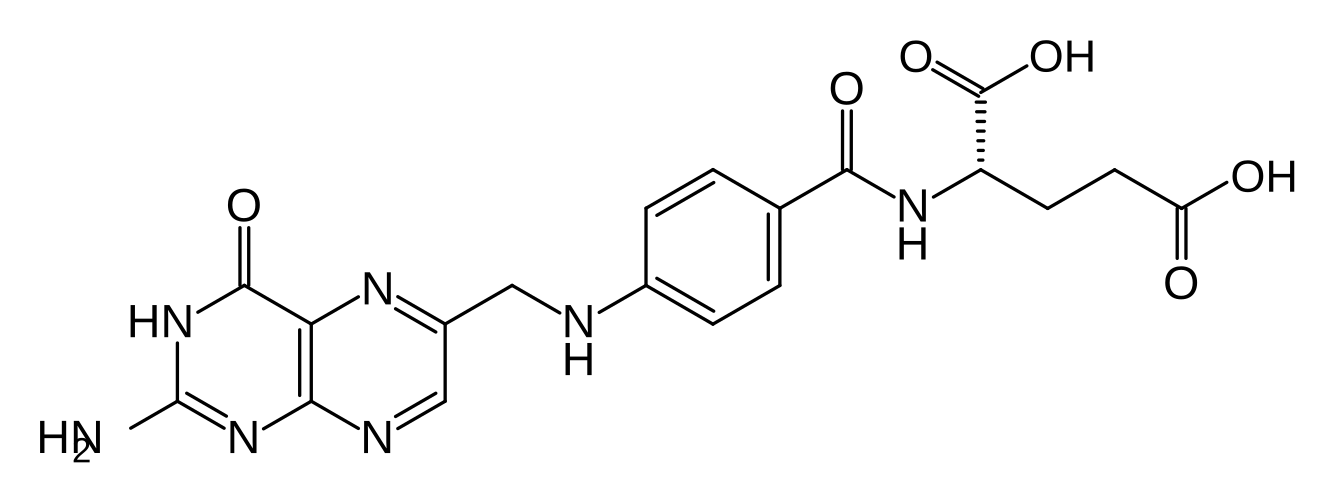
Skeletal formula of folic acid, the synthetic form of folate used in fortified foods and most supplements.
Credit: Qohelet12 / Wikimedia Commons

License: CC0
Rendered from SVG to PNG, whitespace trimmed and placed on white
What it is
Folic acid (CAS 59-30-3), also called pteroylglutamic acid, is a type of folate (vitamin B9). [1,8] It is the only type of folate shown in studies to help prevent neural tube defects. [1]
What it does and why it is used
The body needs folate to make DNA and for cells to divide. [2] Folic acid is added to grain foods so that people who eat them, including women early in pregnancy, get more of it. [2,4]
Regulatory status and health context
Canada
Since 1998 Canada has required folic acid in white flour, enriched pasta and cornmeal. [4] The Food and Drug Regulations require white flour to contain 0.15 mg of folic acid per 100 g. [5] The Public Health Agency of Canada recommends that all women who could become pregnant take a multivitamin with 0.4 mg of folic acid daily. [4]
United States
The standard of identity for enriched macaroni products requires, per pound, not less than 0.9 mg and not more than 1.2 mg of folic acid, along with thiamin, riboflavin, niacin and iron. [3] The US Public Health Service recommends 400 mcg of folic acid daily for anyone who could become pregnant. [1]
European Union
Folic acid is on the list of vitamins permitted in food supplements under Directive 2002/46/EC. [7] In 2023 EFSA kept its upper levels for folate, such as 1,000 micrograms a day for adults, and set a new upper level of 200 micrograms a day for infants aged 4 to 11 months. EFSA judged it unlikely that the upper levels are exceeded in Europe except by regular users of high-dose folic acid supplements. [6] We did not verify an EU-wide requirement to fortify flour or pasta.
Environmental notes
The sources used here do not assess folic acid as an environmental concern. [1–7]
Quick facts
- CAS: 59-30-3. [8]
- Added to: enriched pasta, flour, bread, cornmeal, rice and many breakfast cereals. [2,4]
- US enriched pasta: 0.9 to 1.2 mg folic acid per pound. [3]
- Adult upper limit (supplements and fortified foods): 1,000 mcg a day. [2,6]
- Key benefit: prevents neural tube defects. [1]
Sources
All URLs were fetched on 2026-11-11. Source publication dates differ from this draft's review date.
- CDC: About folic acid.
- NIH Office of Dietary Supplements: Folate, fact sheet for consumers.
- eCFR: 21 CFR 139.115, enriched macaroni products.
- Public Health Agency of Canada: Folic acid use among pregnant women in Canada.
- Justice Laws Website: Food and Drug Regulations, Division 13 (white flour).
- EFSA: Dietary reference values, topic page.
- EUR-Lex: Directive 2002/46/EC on food supplements.
- PubChem PUG REST: folic acid synonyms.