
Skin and personal care Makeup and colour
Formaldehyde and releasers: cosmetic allergy versus inhalation hazards
CAS 50-00-0. Also known as methanal, formalin, and formaldehyde-releasing preservatives.
Editorial draft Last reviewed 8 November 2026 About 1135 words
Everyday exposure: where you meet it and how much
Formaldehyde can be encountered in two importantly different cosmetic situations: low-level release from certain preservatives, and airborne release during some heated hair-smoothing treatments. FDA lists formaldehyde-releasing ingredients including DMDM hydantoin, diazolidinyl urea, imidazolidinyl urea, bronopol and sodium hydroxymethylglycinate. That list identifies ingredients to investigate, not proof that every shampoo contains them or that every jurisdiction permits all of them. [3,7]
Hair-smoothing exposure may involve applying a solution and then heating the hair, releasing formaldehyde into the air. Both clients and salon workers can inhale the gas, particularly with inadequate ventilation. A worker performing repeated treatments has a different exposure pattern from someone briefly using a rinse-off cosmetic. Ingredient concentration, release and airborne dose must not be treated as the same measurement. [2,3]
Known and suspected harms
These labels are editorial summaries, not formal GRADE ratings: Established means recognized under specified conditions; Probable means a likely contribution with uncertainty; Possible means limited or suggestive evidence; Disputed identifies differing interpretations. The exposure route is essential to interpreting each claim.
- Established — skin sensitization and allergic dermatitis: repeated contact with formaldehyde-related ingredients can cause sensitization, and exposure can trigger reactions in susceptible people. EU labelling changes specifically seek better protection for consumers already sensitized to formaldehyde. A low release concentration can matter to someone allergic even when it does not establish a cancer risk. [3,5,7]
- Established — irritation from airborne exposure: formaldehyde gas can irritate eyes, nose and lungs. FDA describes reported symptoms during hair-smoothing exposure, including eye irritation, cough, wheeze and other reactions. Exposure duration and concentration affect potential risk. The possibility of symptoms should not be dismissed because a product was used in a salon. [3]
- Established carcinogenic hazard, with exposure-specific interpretation: NCI describes evidence from highly exposed workers linking formaldehyde to myeloid leukemia and rare cancers of the nasal and nearby upper-airway regions. FDA also identifies IARC's human-carcinogen classification. This is not a measured cancer-risk estimate for trace release from an ordinary cosmetic preservative. [3,4]
- Possible but not quantified here — long-term cancer risk from a particular cosmetic use: the selected sources do not provide a defensible risk-per-treatment or risk-per-bottle number. The absence of such a number does not remove the recognized inhalation hazard; it means personal exposure cannot be calculated from an ingredient list alone. [3,4]
Reducing exposure and protecting at-risk groups
Read ingredients and ask a salon professional whether a smoothing product contains formaldehyde-related substances. FDA identifies formaldehyde, formalin and methylene glycol as names to look for in that context. Ask about ventilation and product safety information rather than assuming a marketing claim settles the question. If a provider cannot identify the product or its formaldehyde-related ingredients, that uncertainty is relevant to your decision. [3]
People with diagnosed sensitivity should avoid their identified triggers and ask a clinician about appropriate ingredient avoidance. FDA cautions that terms such as “hypoallergenic” or “for sensitive skin” have no governing US federal standard or definition guaranteeing an allergy-free product. For breathing symptoms during a treatment, stop the exposure and seek appropriate medical help rather than treating irritation as proof the product is working. [3,7]
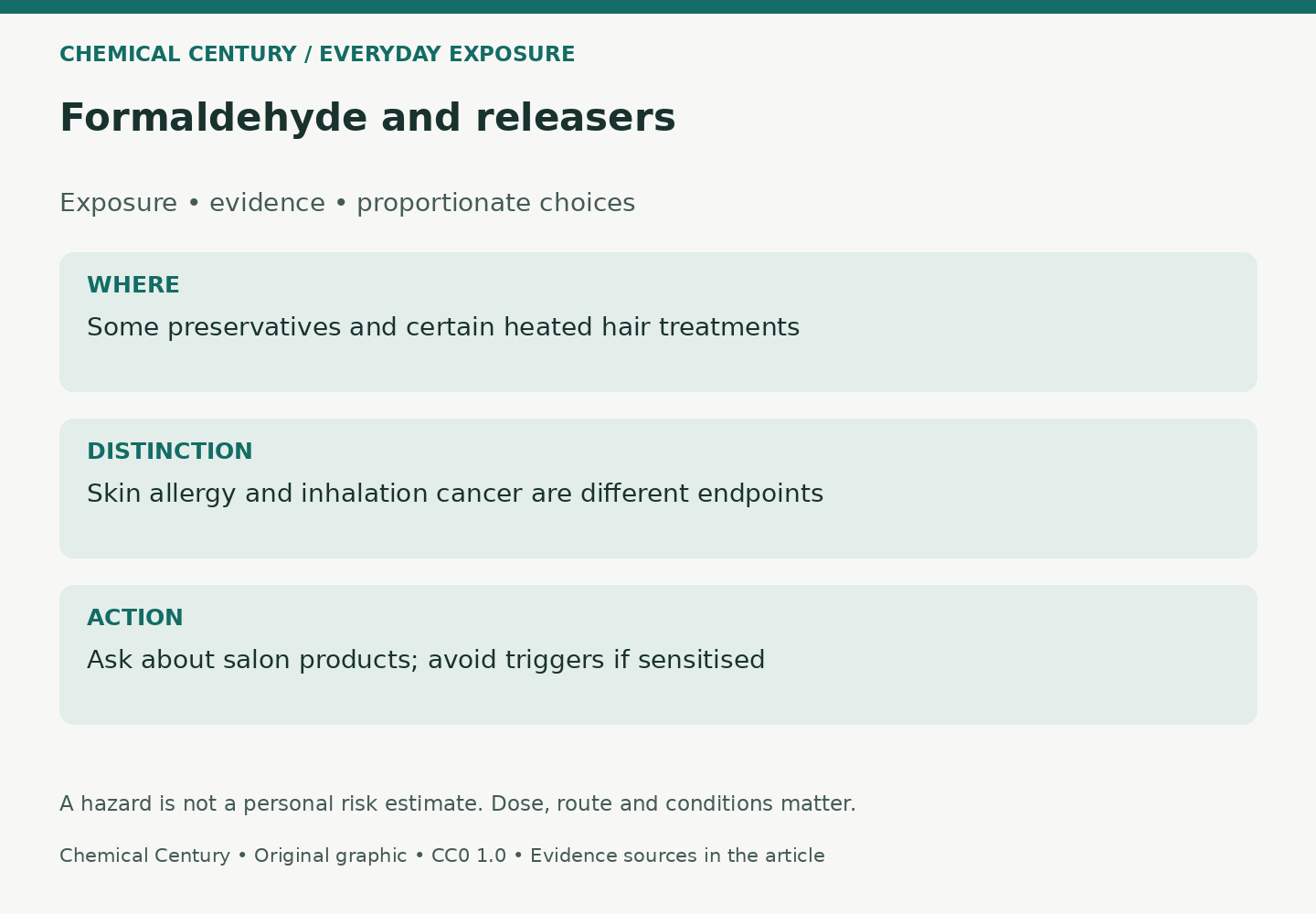
Exposure and evidence guide; not a numerical risk estimate.
Credit: Chemical Century; original graphic
License: CC0 1.0
Data: Data: the sources listed for this article.
What it is
Formaldehyde is a specific chemical, also called methanal, with PubChem-verified CAS 50-00-0. Formalin is a formaldehyde-containing solution rather than another name for every preservative that can release the gas. The front-matter CAS therefore identifies formaldehyde, not DMDM hydantoin, a commercial hair-treatment mixture or the entire releaser category. [3,6,7]
A releasing preservative gradually generates formaldehyde to help perform its preserving function. The preservative's own concentration and the amount of free or released formaldehyde are different quantities. EU rules specifically refer to the total formaldehyde released, including when a product uses more than one releaser. Measuring one ingredient name does not automatically establish the total release. [5]
What it does and why it is used
Certain releasers preserve a product by limiting microbial growth. Their presence therefore has a practical purpose, even when allergy precautions, limits or substitution are appropriate. Hair-smoothing products are a separate application with heating-related airborne exposure. Combining those uses into one undifferentiated claim about “preservatives and cancer” would lose the most important exposure distinction. [3,5]
Formaldehyde also has non-cosmetic sources, including some building materials and combustion emissions. NCI discusses these broader inhalation pathways. A cosmetic article should not imply that eliminating one product removes every source, or that detecting exposure automatically identifies the responsible product. [4]
Regulatory status and health context
Canada
The Cosmetic Ingredient Hotlist restricts formaldehyde by application: it is not permitted in aerosols, and non-aerosol products releasing vapours during intended use have a 0.01% limit. The entry separately lists 0.1% for oral products and 0.2% as a preservative in non-oral products, alongside specific nail-hardener conditions. Those categories are not interchangeable, and the higher number should not be used to justify a heated vapour-releasing treatment. [1,2]
United States
FDA warns about heated hair-smoothing products, ingredients and ventilation, and describes case-by-case safety and labelling evaluation. Its allergen guidance identifies formaldehyde releasers and recommends ingredient checking. These fetched warnings do not themselves establish that every releasing preservative has been federally banned or that FDA approved an individual product. This batch did not verify a finalized new nationwide formaldehyde hair-product prohibition; no completed ban is asserted. [3,7]
European Union
Regulation 2022/1181 states that formaldehyde itself is prohibited as a cosmetic ingredient, while certain authorized preservatives can release it under their applicable conditions. The rule lowers the threshold for the warning “releases formaldehyde” to total release exceeding 0.001%—10 ppm. This is a labelling trigger intended to protect sensitized users, not a universal no-effect threshold or a cancer boundary. [5]
The original transition allowed older-compliant products to be placed on the market until July 2024 and made available until July 2026. A November 2026 article must not describe the old 500 ppm warning threshold as the continuing new-product standard. Ingredient-specific permissions remain separate from the warning requirement. [5]
Environmental notes
The selected sources do not supply a comparative ecological assessment of these preservatives and their replacements. No environmental ranking is assigned. Allergy precautions and occupational inhalation controls should not be converted into unsupported claims about every environmental exposure.
Quick facts
- Lead: formaldehyde, CAS 50-00-0. [6]
- Established concerns: sensitization, irritation and carcinogenic hazard under relevant exposure conditions. [3–5]
- Key distinction: skin exposure from preservatives versus inhalation during heated treatments.
- Important gap: personal dose and cancer risk from a particular product. [3,4]
Sources
Fetched 2026-11-08 unless a previously fetched archived source is explicitly identified. Regulations are reported with their scope and dates; this draft is not legal advice.
- Health Canada: Cosmetic Ingredient Hotlist.
- Health Canada: Cosmetic ingredient safety, formaldehyde section.
- FDA: Hair smoothing products releasing formaldehyde.
- NCI: Formaldehyde and cancer.
- EU Regulation 2022/1181.
- PubChem PUG REST: formaldehyde synonyms.
- FDA: Allergens in cosmetics, including formaldehyde releasers.