
Water, air and residuesFood and drink
Glyphosate: a widely used weed killer and a split verdict on cancer
CAS 1071-83-6.Also known as N-(phosphonomethyl)glycine, glyphosate residues, and weed killer residue.
Editorial draft Last reviewed 10 November 2026 About 1057 words
CC INDEX
How it works34/100 Mild
IARC classes glyphosate as probably carcinogenic, mainly from studies of farm and other heavy users. Health Canada, EPA and the EU's assessors do not consider it a cancer risk at expected exposures. Food residues are usually within legal limits, and the EU has flagged data gaps and risks to wildlife.
An editorial summary of this article’s cited evidence. It isn’t medical advice or a personal risk estimate.
Age index
What is the age index?Which age groups are more affected by this chemical’s possible health issues, based on this article’s sources.
- Pregnancy Unborn babies Not well studied
- Infants 0 to 1 Lower concern
- Young children 1 to 5 Lower concern
- Children 6 to 12 Lower concern
- Teens 13 to 19 Lower concern
- Adults 20 to 64 Moderate
- Older adults 65 and over Lower concern
- Adults (moderate): People who spray it at work or in gardens have higher exposure
- Regulators find food residues within limits for the general population; the cancer question is disputed.

Illustration of grain and pulse crops. Glyphosate residues in food are measured against legal limits set for each crop.
Credit: Chemical Century; AI-generated illustration
License: CC0 1.0
Illustration, not a photograph of a specific product. Resized and cropped for the web.
Glyphosate is the weed killer many people picture when they think of farm fields, park lawns or the spray bottle in a garden shed. Most of us meet it only as small residues in food, while farmers, landscapers and keen gardeners who spray it can have much higher, more direct exposure. The worry people carry is cancer, especially lymphoma, and here the experts are split: one international agency calls it probably carcinogenic, based mainly on studies of farm and other heavy users, while Canadian, US and European assessors do not consider it a cancer risk at expected exposures. Following the label exactly, including any protective clothing, and keeping a measured view of the debate are the practical takeaways.
Everyday exposure: where you meet it and how much
Glyphosate is a broad-spectrum herbicide and the most widely used herbicide in Canada. It is used on many farm crops and in forests, pastures, rights-of-way, recreational areas and residential settings. Most people meet it as small residues in food and, less often, in drinking water. People who spray it at work or in their gardens can have much higher, direct exposure. [2,5]
Residues are generally low. The Canadian Food Inspection Agency's testing in 2015 to 2017 found that 99.4% of samples complied with Canada's maximum residue limits. Health Canada found that the small share above the limits did not pose a health risk. Canadian limits are set well below levels that could pose a health concern. In the United States, EPA reports that FDA testing has not found residues above allowable limits. [2,5]
Known and suspected harms
Evidence labels are editorial summaries, not individual risk predictions: established means recognized under the stated conditions; probable means a likely contribution with uncertainty; possible means limited evidence; disputed means assessors disagree. These labels do not describe how common an effect is.
- Disputed — causes cancer (non-Hodgkin lymphoma) in people: in March 2015 IARC classified glyphosate as "probably carcinogenic to humans" (Group 2A). It cited limited human evidence for non-Hodgkin lymphoma and sufficient evidence in experimental animals. IARC's classification is a cancer hazard identification, not an estimate of risk at real exposure levels. EPA concluded in 2017 that glyphosate is "not likely to be carcinogenic to humans". Health Canada concluded it is not expected to pose risks of concern when used according to the label, and the European Chemicals Agency concluded in 2022 that it does not meet the criteria to be classified as carcinogenic. A large US study of farmers and pesticide applicators did not find an association, although IARC disputes how much weight that study should carry. [1–4]
- Possible — harm to wild mammals and other non-target species from some uses: EFSA's 2023 peer review found no critical areas of concern. It did identify a high long-term risk to mammals in 12 of the 23 proposed uses. EPA notes that ecological risks are mainly to non-target plants near where it is applied. [2,3]
Reducing avoidable exposure and harm
For food, regulators in Canada, the US and the EU have not found dietary risks of concern, so there is no need to drop particular foods; a varied diet spreads any exposure. If you use a glyphosate product at home, follow the label exactly, including any protective clothing and re-entry instructions; Health Canada's 2017 re-evaluation added label information on safe use. If you rely on a private well near treated land and are concerned, ask your local health unit about testing. [2,3,5]
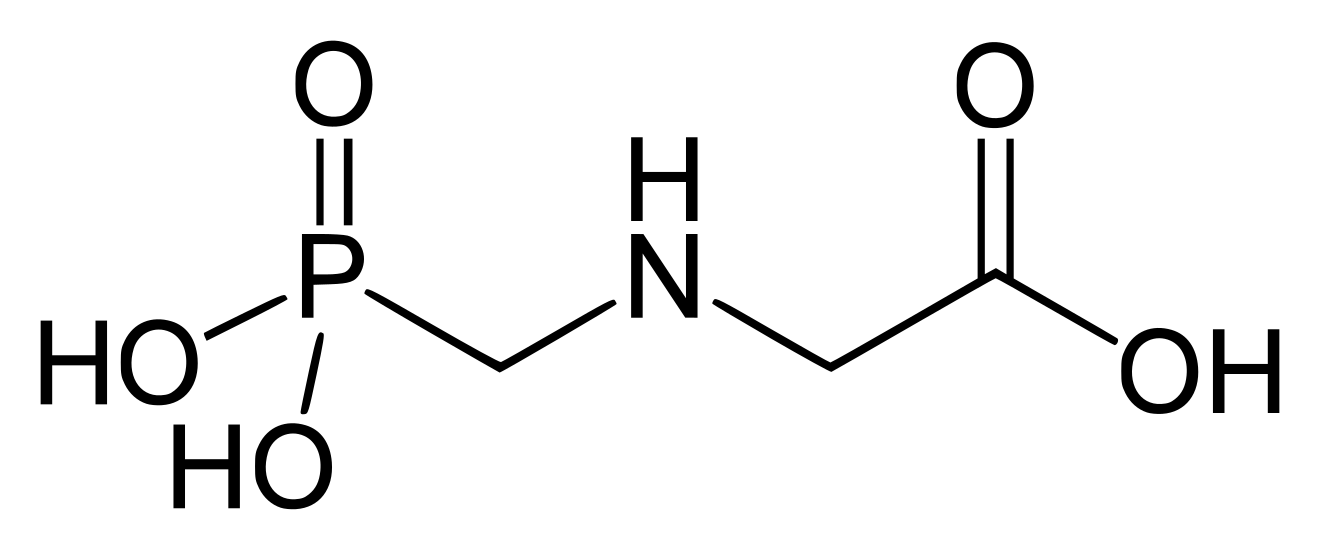
Glyphosate structural formula.
Credit: Yikrazuul / Wikimedia Commons

License: Public domain
Wikimedia-provided PNG rendering of the SVG; whitespace trimmed, no content edits
What it is
Glyphosate's chemical name is N-(phosphonomethyl)glycine, a derivative of the amino acid glycine. Its CAS number is 1071-83-6. Products sold to users are formulations that contain other ingredients as well, and EFSA noted that the toxicity of one co-formulant still needed data. [3,7]
What it does and why it is used
EPA explains that glyphosate targets a growth enzyme in plants. It is used to control weeds in a wide range of crops and in non-crop sites, and to control invasive weeds and toxic plants such as poison ivy. EPA describes it as an important tool for habitat maintenance and restoration. [2,5]
Regulatory status and health context
Canada
Health Canada's 2017 re-evaluation concluded that glyphosate products used according to the label are not expected to pose risks of concern to human health or the environment. In 2019, after a review of objections by 20 of its scientists not involved in the original decision, Health Canada said the decision would stand. It added that no pesticide regulator in the world considered glyphosate a cancer risk at current exposure levels. Canada's drinking water guideline for glyphosate is a maximum of 0.28 mg/L. [4–6]
United States
EPA's 2017 assessment did not identify risks of concern from glyphosate when used according to the label. That covered diet, drinking water, home use and farmworkers. EPA is updating its human health risk assessment, with completion expected in late 2026, to include more recent studies. [2]
European Union
EFSA's 2023 peer review found no critical areas of concern for people, animals or the environment, and noted that the European Chemicals Agency in 2022 did not classify glyphosate as carcinogenic. EFSA listed issues that could not be finalised, including the consumer dietary risk assessment and risks to aquatic plants, and said available information did not allow firm conclusions on biodiversity. [3]
Environmental notes
EPA says ecological risks are mainly to non-target plants near treated areas. EFSA flagged a high long-term risk to mammals in 12 of the 23 proposed EU uses, and said biodiversity risks are complex and depend on many factors. [2,3]
Quick facts
- CAS: 1071-83-6. [7]
- Type: broad-spectrum herbicide. [2]
- IARC (2015): Group 2A, "probably carcinogenic to humans". [1]
- EPA (2017): "not likely to be carcinogenic to humans"; updated assessment expected in late 2026. [2]
- Canada drinking water: maximum 0.28 mg/L. [6]
- Canadian residue compliance, 2015 to 2017: 99.4%. [5]
Sources
All URLs were fetched on 2026-11-10. Source publication dates differ from this draft's review date.
- IARC: Media centre questions and answers on glyphosate.
- US EPA: Glyphosate.
- EFSA: Glyphosate: no critical areas of concern; data gaps identified (2023).
- Health Canada: Statement from Health Canada on glyphosate (2019).
- Health Canada: Glyphosate fact sheet.
- Health Canada: Guidelines for Canadian Drinking Water Quality, summary table.
- PubChem PUG REST: glyphosate synonyms.