
Food and drinkWater, air and residues
Heterocyclic amines: cancer-linked compounds that form when beef and other meats are cooked at high heat
CAS 105650-23-5.Also known as HCAs, PhIP, 2-amino-1-methyl-6-phenylimidazo[4,5-b]pyridine, MeIQx, MeIQ, and IQ.
Editorial draft Last reviewed 11 November 2026 About 1002 words
CC INDEX
How it works45/100 Moderate
Heterocyclic amines damage DNA and cause cancer in animals, and four of them are listed by the US National Toxicology Program as reasonably anticipated human carcinogens. Exposure is common wherever meat is grilled or pan fried, but studies in people have not established a definitive link, and no country sets limits, so the score sits in the middle band.
An editorial summary of this article’s cited evidence. It isn’t medical advice or a personal risk estimate.
Age index
What is the age index?Which age groups are more affected by this chemical’s possible health issues, based on this article’s sources.
- Pregnancy Unborn babies Not well studied
- Infants 0 to 1 Not well studied
- Young children 1 to 5 Not well studied
- Children 6 to 12 Not well studied
- Teens 13 to 19 Not well studied
- Adults 20 to 64 Moderate
- Older adults 65 and over Moderate
- Adults (moderate): Long-term, regular eating of well-done meat
- Older adults (moderate): Long-term, regular eating of well-done meat

Illustration of high-heat and low-heat ways to cook beef. Grilling and pan frying form more heterocyclic amines than stewing.
Credit: Chemical Century; AI-generated illustration
License: CC0 1.0
Illustration, not a photograph of a specific product. Resized and cropped for the web.
A steak seared in a hot pan, burgers on the grill, chicken crisped until it is charred at the edges: heterocyclic amines form in meat cooked this way, and they are part of many family dinners. The concern is not a single well-done burger but long-term cancer risk. These compounds damage DNA and cause cancer in laboratory animals at very high doses, and some studies hint at higher risk in people who eat a lot of well-done meat, though a definite link has not been shown. Cooking methods make a big difference, so small changes in the kitchen can lower exposure without giving up meat.
Everyday exposure: where you meet it and how much
Heterocyclic amines (HCAs) are not added to food. They form when muscle meat, including beef, pork, fish or poultry, is cooked at high temperatures, for example by pan frying or grilling directly over an open flame. [1] They form when amino acids, sugars and creatine or creatinine in muscle react at high heat. [1] HCAs are not found in significant amounts in foods other than meat cooked at high temperatures. [1]
How much forms depends on the type of meat, the cooking method and how well done it is. Meats cooked above about 300 °F (about 150 °C), as in grilling or pan frying, or cooked for a long time tend to form more HCAs; well-done, grilled or barbecued chicken and steak have high concentrations. [1] Frying or grilling produces more HCAs than indirect-heat methods such as stewing, steaming or poaching. [2] Dietary intake of total HCAs has been estimated at less than 1 to 17 nanograms per kilogram of body weight per day. [2]
Known and suspected harms
Evidence labels are editorial summaries, not individual risk predictions: established means recognized under the stated conditions; probable means a likely contribution with uncertainty; possible means limited evidence; disputed means assessors disagree. These labels do not describe how common an effect is.
- Established — cancer in laboratory animals at very high doses: in laboratory experiments HCAs are mutagenic, meaning they change DNA in ways that may increase cancer risk. [1] Rodents fed diets supplemented with HCAs developed tumours of the breast, colon, liver, skin, lung, prostate and other organs, but the doses were equivalent to thousands of times what a person would eat in a normal diet. [1] The US National Toxicology Program lists four HCAs (MeIQ, MeIQx, IQ and PhIP) as reasonably anticipated to be human carcinogens, based on animal studies and supporting genotoxicity data. [2]
- Possible — higher cancer risk in people who eat a lot of well-done meat: population studies have not established a definitive link between HCA exposure from cooked meat and cancer in humans, partly because exposure is hard to measure. Some studies have found associations with colorectal, pancreatic and prostate cancer, while others found none. [1] IARC classed red meat as probably carcinogenic (Group 2A) and processed meat as carcinogenic (Group 1), but did not conclude that HCAs and PAHs were associated with cancer incidence. [1,3]
- Established — cooking method changes how much forms: formation varies with temperature, time, method and doneness. [1,2]
Reducing avoidable exposure and harm
The US National Cancer Institute lists several ways to lower exposure: avoid direct exposure of meat to an open flame or a hot metal surface and avoid long cooking times, especially at high temperatures; microwave meat first so it spends less time on high heat; turn meat over often rather than leaving it on the heat; and cut off charred portions and skip gravy made from meat drippings. [1] Stewing, steaming and poaching form fewer HCAs than frying or grilling. [2]
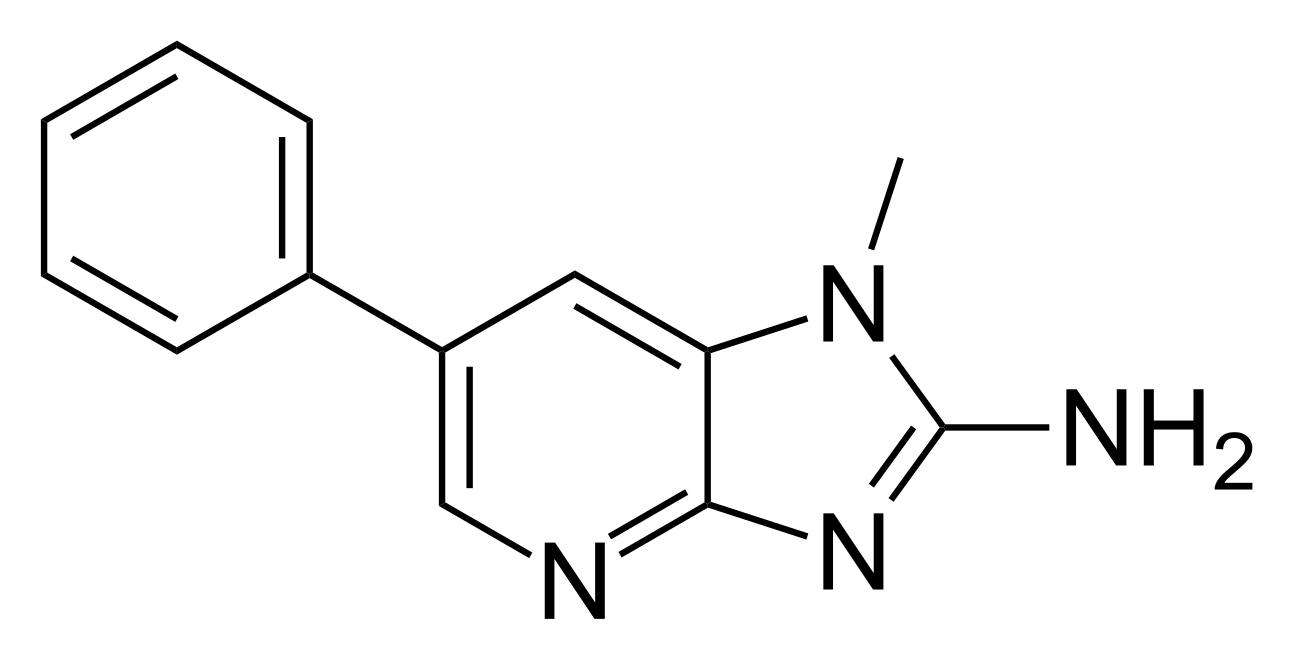
Chemical structure of PhIP (2-amino-1-methyl-6-phenylimidazo[4,5-b]pyridine), one of the most studied heterocyclic amines.
Credit: Ed (Edgar181) / Wikimedia Commons

License: Public domain
Rendered from SVG to PNG, whitespace trimmed and placed on white
What it is
Heterocyclic amines are a group of compounds formed during the cooking of meat by condensation of creatinine with amino acids. [2] Well-studied examples include PhIP (CAS 105650-23-5), MeIQx, MeIQ and IQ. [2,4] They form as by-products of the browning (Maillard) reaction. [2]
What it does and why it is used
HCAs have no known commercial uses; they are made only in small quantities for research. [2] In the body they become able to damage DNA only after specific enzymes activate them, and the activity of these enzymes can differ between people. [1]
Regulatory status and health context
Canada
We did not find a Canadian maximum level for heterocyclic amines in food. [1,2]
United States
There are no federal guidelines on eating foods that contain HCAs and PAHs. [1] The National Toxicology Program's Report on Carcinogens lists MeIQ, MeIQx, IQ and PhIP as reasonably anticipated to be human carcinogens. [2]
European Union
We did not find an EU maximum level for heterocyclic amines in food. The WHO's cancer agency, IARC, has classified processed meat as Group 1 and red meat as Group 2A. [3]
International
WHO notes that red meat means mammalian muscle meat such as beef, veal, pork and lamb, and processed meat means meat transformed by salting, curing, fermentation, smoking or other processes. [3]
Environmental notes
The sources used here do not assess heterocyclic amines as an environmental concern. Besides cooked meat, HCAs have been detected in processed food flavourings, beer, wine and cigarette smoke. [2]
Quick facts
- Forms in: beef, pork, poultry and fish cooked at high heat. [1]
- Example compound: PhIP, CAS 105650-23-5. [2,4]
- US listing: four HCAs are reasonably anticipated human carcinogens. [2]
- Estimated intake: less than 1 to 17 ng per kg of body weight per day. [2]
- Simple habit: turn meat often and trim charred parts. [1]
Sources
All URLs were fetched on 2026-11-11. Source publication dates differ from this draft's review date.
- US National Cancer Institute: Chemicals in meat cooked at high temperatures and cancer risk.
- US National Toxicology Program: Report on Carcinogens profile, heterocyclic amines (selected).
- WHO: Carcinogenicity of the consumption of red meat and processed meat, questions and answers.
- PubChem PUG REST: PhIP synonyms.