
Skin and personal careMedicines and health
Hydroquinone: a skin-lightening drug that belongs under medical supervision, not in unapproved creams
CAS 123-31-9.Also known as benzene-1,4-diol, 1,4-benzenediol, 1,4-dihydroxybenzene, and quinol.
Editorial draft Last reviewed 10 November 2026 About 863 words
CC INDEX
How it works56/100 Moderate
Disfiguring and sometimes permanent skin damage from hydroquinone creams is well documented, and unauthorized products can also contain mercury or potent steroids. Exposure is limited to people who choose these products. Regulators in Canada, the US and the EU restrict hydroquinone to prescription or professional uses, yet keep finding illegal products for sale.
An editorial summary of this article’s cited evidence. It isn’t medical advice or a personal risk estimate.
Age index
What is the age index?Which age groups are more affected by this chemical’s possible health issues, based on this article’s sources.
- Pregnancy Unborn babies Higher concern
- Infants 0 to 1 Not well studied
- Young children 1 to 5 Higher concern
- Children 6 to 12 Higher concern
- Teens 13 to 19 Not well studied
- Adults 20 to 64 Moderate
- Older adults 65 and over Not well studied
- Pregnancy (higher concern): Not recommended in pregnancy or breastfeeding (Health Canada)
- Young children (higher concern): Not recommended for children (Health Canada)
- Children (higher concern): Not recommended for children (Health Canada)
- Adults (moderate): Skin damage from unsupervised or unauthorized creams

Illustration of a skin cream under scrutiny. Check that lightening products are authorized before use.
Credit: Chemical Century; AI-generated illustration
License: CC0 1.0
Illustration, not a photograph of a specific product. Resized and cropped for the web.
People with dark spots, uneven tone or melasma often feel self-conscious, and that can make a cream promising brighter skin very tempting. Hydroquinone can help under a clinician's care, but unsupervised or long-term use can cause burning, rashes, blistering and, in some cases, a blue-black darkening of the skin that may be permanent, the opposite of what people hoped for. Unauthorized lightening creams sold online or in some shops can also hide mercury or strong steroids. Getting advice before starting is the best way to protect both skin and confidence.
Everyday exposure: where you meet it and how much
Most people meet hydroquinone in creams and gels sold to lighten, whiten, fade or bleach skin, or to treat dark spots. [1,2] In Canada, products with more than 2% hydroquinone for use on the skin need a prescription. [2] In the US, no over-the-counter skin-lightening product is approved, and the only approved hydroquinone drug is a prescription product for short-term treatment of melasma on the face. [1]
Despite these rules, unauthorized products continue to be sold. Health Canada has seized skin-lightening products whose labels show prescription drugs, including hydroquinone above 2%. [2]
Known and suspected harms
Evidence labels are editorial summaries, not individual risk predictions: established means recognized under the stated conditions; probable means a likely contribution with uncertainty; possible means limited evidence; disputed means assessors disagree. These labels do not describe how common an effect is.
- Established — ochronosis, a blue-black skin discolouration that may be permanent: FDA has received reports of ochronosis from hydroquinone skin-lightening products and warns that it may be permanent. Health Canada notes that hydroquinone can cause blue or black discolouration, or white patches, that can be disfiguring. [1,2]
- Established — rashes, swelling, burning and blistering: FDA has received reports of skin rashes and facial swelling. Health Canada lists redness, dryness, cracking, burning, stinging, peeling, itching, sun sensitivity, sunburn, blisters and scarring. [1,2]
- Possible — cancer with long-term use: in laboratory animals, hydroquinone has been associated with cancer after long-term exposure, and Health Canada says products above 2% may possibly cause cancer. PubChem's summary of hazard classifications lists hydroquinone as suspected of causing cancer. [2,4]
- Established — hidden mercury or steroids in unauthorized lightening products: unauthorized products may contain unacceptable levels of mercury, which can cause rashes, scarring and, when absorbed, kidney and brain damage. Some also contain potent corticosteroids that can weaken the skin with prolonged use and, if too much is absorbed, suppress the adrenal glands. [2]
Reducing avoidable exposure and harm
Do not use over-the-counter skin-lightening products that contain hydroquinone, or any lightening product that is not authorized. [1,2] In Canada, look for an eight-digit Drug Identification Number (DIN) or Natural Product Number (NPN) on the label. [2] Talk to a health care professional about dark spots or melasma, and use prescription hydroquinone only under their supervision. [1,2] Health Canada does not recommend hydroquinone for children or for people who are pregnant or breastfeeding. [2]
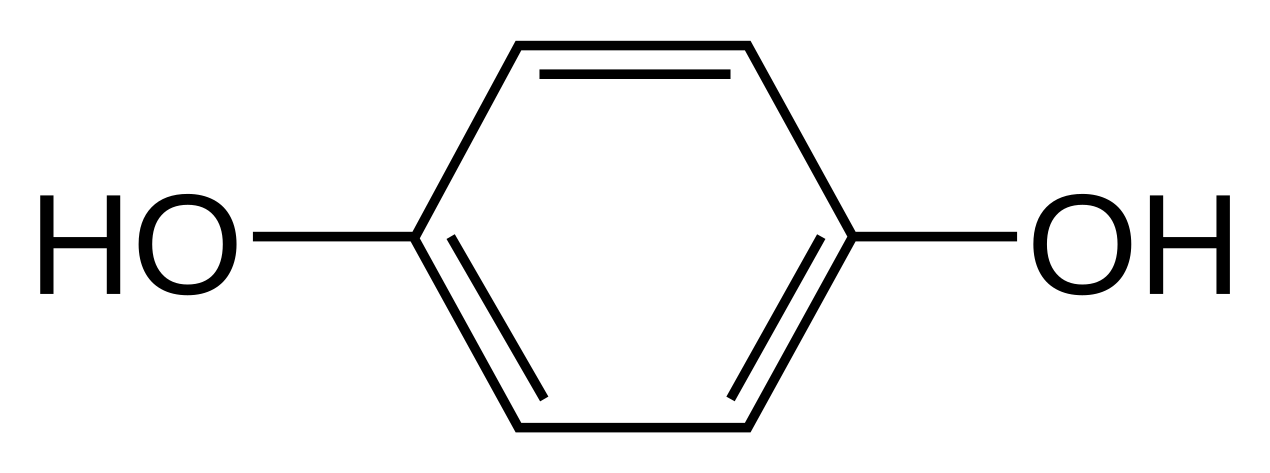
Chemical structure of hydroquinone (benzene-1,4-diol).
Credit: NEUROtiker / Wikimedia Commons

License: Public domain
Rendered from SVG to PNG, whitespace trimmed and placed on white
What it is
Hydroquinone is benzene-1,4-diol, a benzene ring carrying two hydroxyl groups on opposite sides. Its CAS number is 123-31-9. [5]
What it does and why it is used
Applied to the skin, hydroquinone lightens areas darkened by sun exposure, skin damage, pregnancy, medicines or age. [2] Outside skin care, the EU has allowed small amounts in professional artificial nail systems. [3]
Regulatory status and health context
Canada
Since June 30, 2019, products for use on the skin with more than 2% hydroquinone need a prescription, and several such products previously sold over the counter have been recalled. Health Canada says hydroquinone should not be used by people taking medicines that make the skin more sensitive to light and should be used with caution by people who have had cancer. [2]
United States
Since the CARES Act reforms, over-the-counter skin-lightening products containing hydroquinone are treated as new drugs and are misbranded without an approved application. In April 2022, FDA sent warning letters to 12 companies selling them and advised consumers not to use them. [1]
European Union
In the EU Cosmetic Products Regulation as adopted in 2009, hydroquinone appears in Annex III (entry 14) only for an oxidizing hair-dye use and for professional artificial nail systems at up to 0.02% after mixing. It is not a permitted skin-lightening cosmetic ingredient. [3]
Environmental notes
The sources used here do not assess hydroquinone in consumer products as an environmental concern and do not provide data for a rating. [1–3]
Quick facts
- CAS: 123-31-9. [5]
- Canada: above 2% for skin use is prescription-only. [2]
- US: no approved over-the-counter skin-lightening products. [1]
- Key harm: ochronosis, a discolouration that may be permanent. [1]
- Hidden extras: unauthorized products may contain mercury or potent steroids. [2]
Sources
All URLs were fetched on 2026-11-10. Source publication dates differ from this draft's review date.
- FDA: FDA works to protect consumers from potentially harmful OTC skin lightening products (2022).
- Health Canada: Unauthorized skin lightening health products may pose serious health risks (2020).
- EUR-Lex: Regulation (EC) No 1223/2009 on cosmetic products.
- PubChem: hydroquinone, GHS classification.
- PubChem PUG REST: hydroquinone synonyms.