
Water, air and residuesFood and drink
Inorganic arsenic: a natural contaminant that rice takes up more than other grains, with limits for infant rice cereal
CAS 7440-38-2.Also known as arsenic, arsenite, arsenate, As(III), As(V), and arsenic in rice.
Editorial draft Last reviewed 11 November 2026 About 959 words
CC INDEX
How it works68/100 High
Long-term exposure to inorganic arsenic is linked to several cancers, cardiovascular disease and harm to children's brain development. Rice contains more of it than other foods, and infants eat about three times more rice cereal relative to body weight than adults, so Canada, the US and the EU set limits. Levels in food are usually low, but the hazard is well established, placing the score in the high band.
An editorial summary of this article’s cited evidence. It isn’t medical advice or a personal risk estimate.
Age index
What is the age index?Which age groups are more affected by this chemical’s possible health issues, based on this article’s sources.
- Pregnancy Unborn babies Higher concern
- Infants 0 to 1 Higher concern
- Young children 1 to 5 Higher concern
- Children 6 to 12 Higher concern
- Teens 13 to 19 Moderate
- Adults 20 to 64 Moderate
- Older adults 65 and over Moderate
- Pregnancy (higher concern): Fetuses especially vulnerable during brain development
- Infants (higher concern): Eat much more rice cereal for their size
- Young children (higher concern): Developing brain; early-life exposure
- Children (higher concern): Developing brain; early-life exposure
- Adults (moderate): Long-term exposure linked to some cancers
- Older adults (moderate): Long-term exposure linked to some cancers

Illustration of rice, oats and infant rice cereal. Rice and rice products tend to contain more inorganic arsenic than other foods.
Credit: Chemical Century; AI-generated illustration
License: CC0 1.0
Illustration, not a photograph of a specific product. Resized and cropped for the web.
Rice is a daily staple for many families, and rice cereal has long been a first solid food for babies, so it can be unsettling to learn that rice absorbs more arsenic from soil and water than other grains. The worry is not sudden illness from a meal: years of exposure are linked to some cancers, heart disease and effects on children's brain development. Babies eat far more rice cereal for their size than adults do, which is why Canada, the US and the EU set limits for infant rice products. Eating a variety of foods rather than relying on any single one, and testing private well water, are the practical ways to keep exposure down.
Everyday exposure: where you meet it and how much
Arsenic occurs naturally in the environment and also comes from human activity. [4] It can enter food from soil and water where crops are grown, from past use of arsenic pesticides, from pollution, and from processing water. [1] According to WHO and CDC, as cited by FDA, the most common source of high levels of inorganic arsenic is contaminated drinking water. [1]
FDA sampling shows rice and rice products have higher levels of inorganic arsenic than other foods. [4] Rice intake, mainly through infant rice cereal, is about three times greater for infants than for adults relative to body weight. [4] Industry has made progress: in 2018, 76% of infant rice cereal samples were at or below FDA's action level, compared with 47% in 2014 and 36% in 2011 to 2013. [3]
Known and suspected harms
Evidence labels are editorial summaries, not individual risk predictions: established means recognized under the stated conditions; probable means a likely contribution with uncertainty; possible means limited evidence; disputed means assessors disagree. These labels do not describe how common an effect is.
- Established — skin, bladder and lung cancers with long-term exposure: in adults, long-term exposure to inorganic arsenic has been associated with skin disorders, higher risks of skin, bladder and lung cancers, and cardiovascular disease. [1] Inorganic arsenic is the primary toxic form. [4] Very high short-term exposure can cause nausea, vomiting, bruising, and numbness or burning in the hands and feet. [1]
- Established — effects on brain development in early life: high exposure during active brain development is associated with learning disabilities, behaviour difficulties and lower IQ, and fetuses, infants and children are especially vulnerable. [1] Epidemiologic data show early-life exposure can lower children's performance on some developmental tests. [4]
- Established — infants eat more rice relative to body weight: this is why FDA prioritized infant rice cereal. [4]
Reducing avoidable exposure and harm
FDA advises eating a variety of nutrient-dense foods across and within the food groups, which supports nutrition and limits exposure to a contaminant from any one food. [1] People who drink private well water should follow their local testing guidelines for arsenic. [1] Finding arsenic in a food does not by itself mean the food should be avoided. [1]
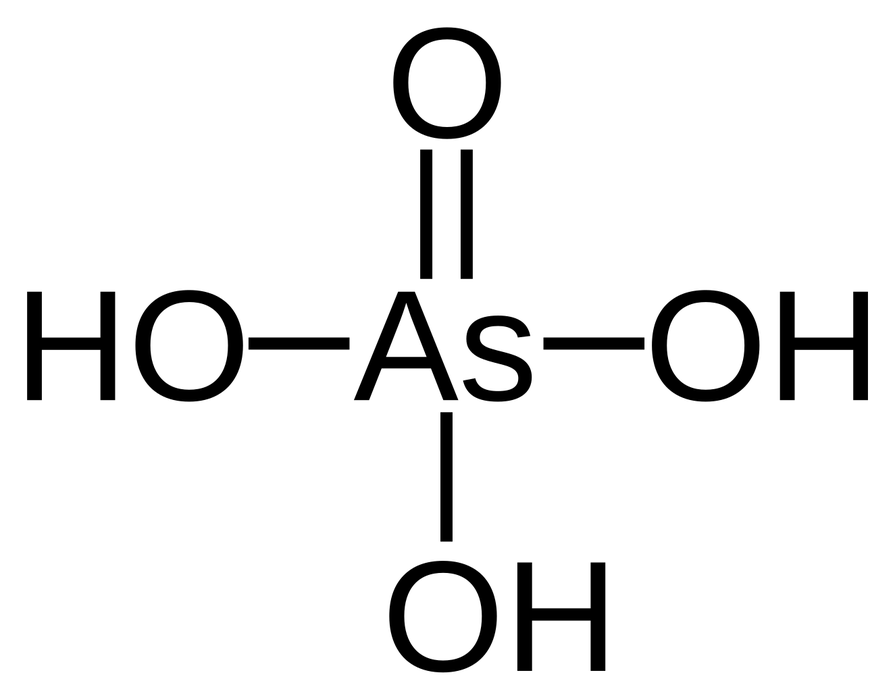
Chemical structure of arsenic acid, the parent acid of arsenate, one of the two inorganic arsenic forms measured in food.
Credit: Andel Früh / Wikimedia Commons

License: Public domain
Rendered from SVG to PNG, whitespace trimmed and placed on white
What it is
Arsenic (CAS 7440-38-2) is an element. [7] In food it occurs as inorganic arsenic or organic arsenic; "organic" here means arsenic bound to carbon and has nothing to do with organic farming. [1] Inorganic arsenic is measured as the sum of arsenite, As(III), and arsenate, As(V). [5,6]
What it does and why it is used
Inorganic arsenic in rice is a contaminant, not an ingredient. FDA has no regulations authorizing arsenic as a food or colour additive. [1]
Regulatory status and health context
Canada
Canada's List of Contaminants sets maximum levels for inorganic arsenic of 0.35 ppm in husked (brown) rice, 0.2 ppm in polished (white) rice, and 0.1 ppm in rice-based foods intended specifically for infants and young children, with further limits for fruit juices. [5]
United States
FDA's 2020 guidance sets an action level of 100 parts per billion (100 µg/kg) for inorganic arsenic in infant rice cereals, covering white, brown, organic and conventional rice cereals. Guidance is not legally binding, but FDA uses the level when deciding whether a product is adulterated. [2,3] FDA also has a 2023 action level for inorganic arsenic in apple juice. [1]
European Union
Regulation (EU) 2023/915 sets maximum levels for inorganic arsenic of 0.15 mg/kg in polished white rice, 0.25 mg/kg in parboiled and husked rice and in rice flour, 0.30 mg/kg in rice waffles, wafers, crackers, cakes, flakes and popped breakfast rice, and 0.10 mg/kg in rice destined for food for infants and young children. [6]
Environmental notes
Arsenic levels are higher in certain soils and rocks and where arsenic pesticides were once used, and pollution from mining and coal-fired power plants can add to them. [1]
Quick facts
- CAS (arsenic): 7440-38-2. [7]
- Main food source: rice and rice products; contaminated water is the most common source of high exposure. [1,4]
- US infant rice cereal action level: 100 ppb. [2]
- Canada and EU, infant rice foods: 0.1 ppm (0.10 mg/kg). [5,6]
- Simple habit: eat a variety of grains and other foods. [1]
Sources
All URLs were fetched on 2026-11-11. Source publication dates differ from this draft's review date.
- FDA: Arsenic in food.
- FDA: Guidance for industry, action level for inorganic arsenic in rice cereals for infants.
- FDA: FDA issues final guidance on action level for inorganic arsenic in infant rice cereals.
- Federal Register (2020): Inorganic arsenic in rice cereals for infants, action level guidance notice.
- Health Canada: List of contaminants and other adulterating substances in foods.
- EUR-Lex: Commission Regulation (EU) 2023/915 on maximum levels for certain contaminants in food.
- PubChem PUG REST: arsenic synonyms.