
Fragrance and flavourSkin and personal care
Limonene: the citrus-scented compound that is a common skin allergen once it oxidizes
CAS 5989-27-5.Also known as d-limonene, (R)-limonene, dipentene, p-mentha-1,8-diene, and citrus terpene.
Editorial draft Last reviewed 10 November 2026 About 1040 words
CC INDEX
How it works26/100 Mild
Limonene is widely used and is accepted as safe to eat as a flavouring. Its main established harm is allergic skin reactions in sensitized people, which oxidation in air makes more likely. That is why the EU and Canada require it to be named on cosmetic labels and the EU limits how oxidized it may be.
An editorial summary of this article’s cited evidence. It isn’t medical advice or a personal risk estimate.
Age index
What is the age index?Which age groups are more affected by this chemical’s possible health issues, based on this article’s sources.
- Pregnancy Unborn babies Not well studied
- Infants 0 to 1 Not well studied
- Young children 1 to 5 Moderate
- Children 6 to 12 Not well studied
- Teens 13 to 19 Not well studied
- Adults 20 to 64 Moderate
- Older adults 65 and over Not well studied
- Young children (moderate): Swallowed concentrated oils can enter the airways
- Adults (moderate): Allergic skin reactions once sensitized

Illustration of citrus fruit and a citrus oil. Limonene occurs naturally in citrus and is used for its lemon-like scent and flavour.
Credit: Chemical Century; AI-generated illustration
License: CC0 1.0
Illustration, not a photograph of a specific product. Resized and cropped for the web.
The fresh lemony smell of a kitchen cleaner, a hand soap or a scented candle often comes from limonene, which occurs naturally in citrus peel. It is safe to eat as a flavouring, but on skin it can become a problem over time, especially once it has reacted with air. Some people develop an itchy, red allergic rash that flares wherever scented products touch their skin, and concentrated products can irritate the skin and eyes. Pet owners should also know that some limonene flea products can harm animals, especially cats.
Everyday exposure: where you meet it and how much
Limonene occurs naturally in citrus and other fruits, vegetables, meats and spices. It is used in many foods and drinks, and in soaps and perfumes, for its lemon-like flavour and smell. It is also the active ingredient in some pesticide products, such as flea and tick treatments for pets, insect sprays and repellents. [1]
On a cosmetic label in Canada or the EU, limonene appears by name when it is above 0.001% in a leave-on product or 0.01% in a rinse-off product. [2,3] In the US, it may be included within the single word "fragrance". [4]
Known and suspected harms
Evidence labels are editorial summaries, not individual risk predictions: established means recognized under the stated conditions; probable means a likely contribution with uncertainty; possible means limited evidence; disputed means assessors disagree. These labels do not describe how common an effect is.
- Established — allergic skin reactions, especially to oxidized limonene: limonene is classified as able to cause an allergic skin reaction. [7] The EU treats fragrance substances that turn into known contact allergens through air oxidation the same way as fragrance allergens, and it requires limonene used in cosmetics to have a peroxide value below 20 mmol/L, a measure of how oxidized it is. [2]
- Established — skin and eye irritation from concentrated products: limonene is classified as a skin irritant. [7] EPA notes skin irritation and sensitization as concerns for people using limonene pesticide products, and eye irritation if a product gets into the eye and is not washed out. [1]
- Possible — airway irritation from products formed when limonene reacts with indoor ozone: terpenes such as limonene react indoors with ozone, forming products such as formaldehyde and fine particles that have been hypothesized to irritate the eyes and airways. Lawrence Berkeley National Laboratory notes that other indoor sources of formaldehyde usually far exceed the amount made this way. [6]
- Established — harmful to pets, especially cats, in some flea products: EPA reports adverse reactions in a small percentage of animals treated with limonene products, especially cats, with kittens and young cats most sensitive. Labels prohibit use on weanling kittens and warn against using undiluted product on pets. [1]
Reducing avoidable exposure and harm
If you have a fragrance allergy, check cosmetic ingredient lists for limonene; in the US, choose fragrance-free products, and note that "unscented" products can still contain masking fragrance. [3,4] Keep fragranced products closed when not in use, because air oxidation can turn fragrance substances such as limonene into stronger contact allergens. [2] Indoors, limiting both ozone and heavy use of limonene-containing products reduces the irritating by-products they can form together. [6] Use pet products exactly as labelled and never use undiluted products on cats or kittens. [1] Swallowing concentrated limonene oils can be dangerous because they can enter the airways; keep them away from children. [7]
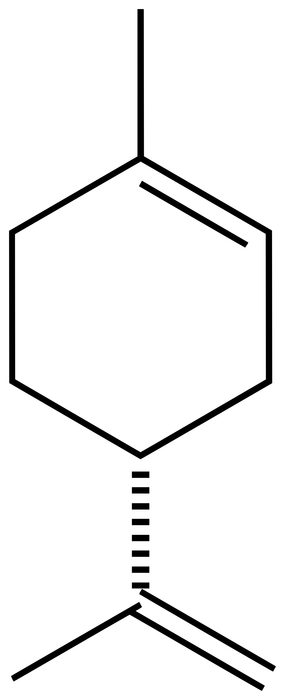
Skeletal formula of (R)-limonene, also called d-limonene.
Credit: Benjah-bmm27 and Karlhahn / Wikimedia Commons

License: Public domain
Rendered from SVG to PNG, whitespace trimmed and placed on white
What it is
Limonene is a monoterpene, a small hydrocarbon made by plants. It exists in two mirror-image forms: d-limonene ((R)-limonene, CAS 5989-27-5) and l-limonene. A mixture of the two is called dipentene. [2,7]
What it does and why it is used
Limonene gives a fresh, lemon-like smell and taste. It is used as a flavouring in foods and drinks and as a fragrance ingredient in soaps, perfumes and other products. It is also used as an active ingredient in some insecticides and animal repellents. [1]
Regulatory status and health context
Canada
Limonene is one of the 24 fragrance allergens that cosmetics sold in Canada have had to name in their ingredient lists since April 12, 2026, when present above 0.01% in rinse-off or 0.001% in leave-on products. [3]
United States
FDA lists limonene (d-, l- and dl-) among synthetic flavouring substances generally recognized as safe. [5] EPA has said that dietary exposure to limonene is not a concern and that limonene is not considered a human carcinogen, developmental toxicant or mutagen. Kidney disease and kidney tumours seen in a long-term rat study arose through a mechanism specific to that species. [1] For cosmetics, FDA allows fragrance ingredients to be listed as "fragrance" and lacks the same authority to require allergen labelling that it has for food. [4]
European Union
Commission Regulation (EU) 2023/1545 expanded the list of fragrance allergens that must be named on cosmetics. Limonene must be listed above 0.001% in leave-on and 0.01% in rinse-off products, and its peroxide value must be below 20 mmol/L. Non-compliant products may be placed on the market until 31 July 2026 and made available until 31 July 2028. [2]
Environmental notes
Limonene is classified as very toxic to aquatic life. [7] It is a volatile organic compound that can take part in indoor air chemistry with ozone. [6]
Quick facts
- CAS (d-limonene): 5989-27-5. [7]
- Found in: citrus and other fruits, vegetables and spices; used in foods, soaps and perfumes. [1]
- Main concern: allergic skin reactions; oxidation makes limonene a stronger allergen. [2,7]
- Labelling: named on cosmetics above 0.001% (leave-on) or 0.01% (rinse-off) in Canada and the EU. [2,3]
- Food use (US): generally recognized as safe as a flavouring. [5]
Sources
All URLs were fetched on 2026-11-10. Source publication dates differ from this draft's review date.
- US EPA: Limonene, reregistration eligibility decision fact sheet (1994).
- EUR-Lex: Commission Regulation (EU) 2023/1545 on labelling of fragrance allergens in cosmetics.
- Health Canada: Industry guide for the labelling of cosmetics.
- FDA: Fragrances in cosmetics.
- eCFR: 21 CFR 182.60, synthetic flavoring substances and adjuvants.
- Lawrence Berkeley National Laboratory, Indoor Air Quality Scientific Findings: VOCs from indoor chemical reactions.
- PubChem: d-limonene, GHS classification.