
Fragrance and flavourSkin and personal care
Linalool: the lavender scent most skin tolerates, until it has been sitting in air
CAS 78-70-6.Also known as linalol, linalyl alcohol, and 3,7-dimethylocta-1,6-dien-3-ol.
Editorial draft Last reviewed 11 November 2026 About 755 words
CC INDEX
How it works32/100 Mild
Allergy to oxidized linalool is well documented in patch-test studies, but the effect is a skin rash rather than serious illness, and only a minority of people react. Exposure through scented products is very common. Labelling rules help sensitized people avoid it, so the score sits in the mild band.
An editorial summary of this article’s cited evidence. It isn’t medical advice or a personal risk estimate.
Age index
What is the age index?Which age groups are more affected by this chemical’s possible health issues, based on this article’s sources.
- Pregnancy Unborn babies Not well studied
- Infants 0 to 1 Moderate
- Young children 1 to 5 Moderate
- Children 6 to 12 Moderate
- Teens 13 to 19 Moderate
- Adults 20 to 64 Moderate
- Older adults 65 and over Moderate
- FDA notes that anyone can develop allergies at any age; risk depends on repeated skin contact with scented products, not on age.

Illustration of scented plants and toiletries. Linalool is a main component of lavender oil and is widely used in fragrances.
Credit: Chemical Century; AI-generated illustration
License: CC0 1.0
Illustration, not a photograph of a specific product. Resized and cropped for the web.
The soft floral note in lavender, and in many soaps, lotions, shampoos and perfumes, often comes from linalool. Fresh linalool rarely causes problems, but when it sits exposed to air it slowly changes into substances that can trigger an itchy, red skin allergy in some people. Once someone is allergic, a favourite hand cream or a scented essential oil can mean flare-ups that come and go until the cause is found. EU labelling rules, and new Canadian rules that follow the EU list, mean linalool is now named on many cosmetic labels, making it easier for people who react to spot it and choose something else.
Everyday exposure: where you meet it and how much
Linalool and linalyl acetate are the main components of lavender oil. [1] Fragrance ingredients like these are widely used in cosmetic products, including perfumes, creams, shampoos and deodorants. [2] The EU's scientific committee on consumer safety also noted a trend toward adding fragrance to other consumer products, such as children's toys, toilet paper and nappies. [1] Linalool is also permitted in the US as a synthetic flavouring substance. [6]
Known and suspected harms
Evidence labels are editorial summaries, not individual risk predictions: established means recognized under the stated conditions; probable means a likely contribution with uncertainty; possible means limited evidence; disputed means assessors disagree. These labels do not describe how common an effect is.
- Established — skin allergy from air-oxidized linalool: linalool reacts with air (autoxidation), and the main allergens formed are hydroperoxides. [1] In patch-test studies of consecutive dermatitis patients, oxidized linalool gave positive reactions in from under 1% to about 7% of those tested, depending on the test concentration. [1] Lavender oil oxidizes the same way, and air exposure of lavender oil increased its ability to sensitize in experiments. [1]
- Established — fresh linalool rarely causes allergy: the SCCS noted that the non-oxidized forms of these fragrance terpenes rarely cause allergic reactions. [1]
- Established — what a reaction looks like: allergic reactions to cosmetics most often appear as itchy, red rashes, known as allergic contact dermatitis; symptoms can also include hives, flaking skin and swelling. [5]
Reducing avoidable exposure and harm
If you know or suspect a fragrance allergy, read ingredient lists and avoid the ingredients you react to; terms like "hypoallergenic" or "fragrance-free" are not a guarantee. [5] In the EU and Canada, linalool and other listed fragrance allergens must be named on cosmetic labels above set levels, rather than hidden under "parfum". [2,3,4]
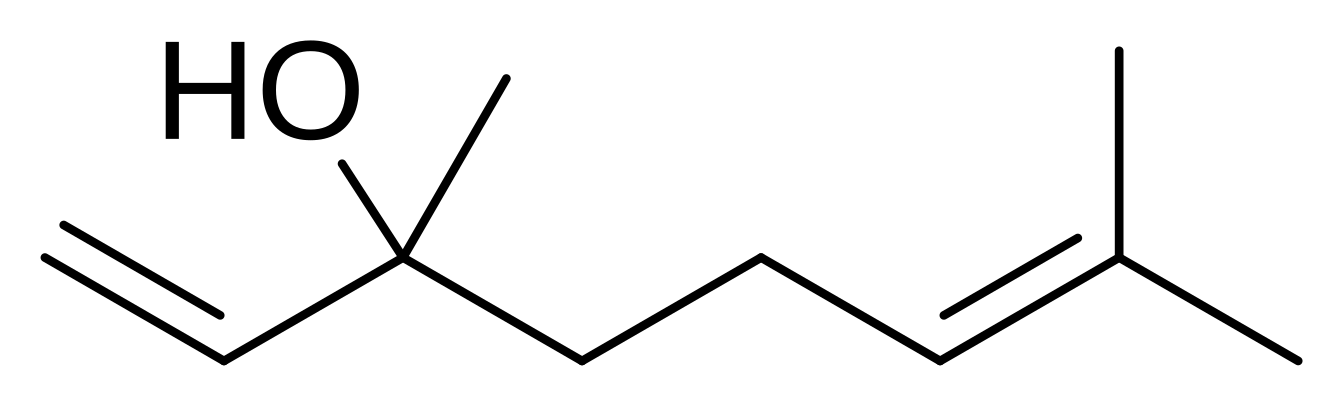
Skeletal structure of linalool.
Credit: Ed (Edgar181) / Wikimedia Commons

License: Public domain
Rendered from SVG to PNG, whitespace trimmed and placed on white
What it is
Linalool (CAS 78-70-6), chemically 3,7-dimethylocta-1,6-dien-3-ol, is a fragrance terpene; it is also called linalol. [3,7]
What it does and why it is used
Linalool gives a floral, lavender-like scent to perfumed products and is used as a flavouring substance. [1,6]
Regulatory status and health context
Canada
Canada's Cosmetic Regulations were amended so that certain fragrance allergens must be listed individually on labels when present above 0.001% in leave-on or 0.01% in rinse-off products, starting April 12, 2026, with the list expanding for new products from August 1, 2026. Health Canada says the requirements align with the EU list. [4]
United States
Linalool is listed among synthetic flavouring substances generally recognized as safe for their intended use. [6] US cosmetic labels may group fragrance ingredients as "fragrance" without naming them. [5]
European Union
Linalool is a labelled fragrance allergen under Annex III of the Cosmetics Regulation: it must appear in the ingredient list above 0.001% in leave-on and 0.01% in rinse-off products. [3] A 2023 amendment added more allergens to the list; non-compliant products may no longer be placed on the EU market since July 31, 2026. [2]
Environmental notes
The sources used for this review focus on skin allergy and do not assess linalool's environmental effects, so we do not summarize them here.
Quick facts
- CAS: 78-70-6. [7]
- Found in: lavender oil and many scented cosmetics. [1,2]
- Main concern: skin allergy, mainly from oxidized linalool. [1]
- Label threshold (EU, Canada): above 0.001% leave-on, 0.01% rinse-off. [3,4]
Sources
URLs were fetched on 2026-11-10 or 2026-11-11. Source publication dates differ from this draft's review date.
- European Commission, Scientific Committee on Consumer Safety: Opinion on fragrance allergens in cosmetic products (SCCS/1459/11).
- European Commission: Fragrance allergens labelling.
- EUR-Lex: Regulation (EC) No 1223/2009 on cosmetic products, Annex III.
- Health Canada: Cosmetic advertising, labelling and ingredients.
- US FDA: Allergens in cosmetics.
- eCFR: 21 CFR 182.60, synthetic flavoring substances and adjuvants.
- PubChem PUG REST: linalool synonyms.