
Plastics & packagingFood and drink
Melamine: a plastic-making chemical that is safe in tableware at normal use, and dangerous when used to adulterate food
CAS 108-78-1.Also known as 2,4,6-triamino-1,3,5-triazine, 1,3,5-triazine-2,4,6-triamine, cyanuramide, melamine-formaldehyde resin, and melamine tableware.
Editorial draft Last reviewed 10 November 2026 About 971 words
CC INDEX
How it works36/100 Mild
Melamine can cause serious kidney harm and deaths when food is deliberately adulterated with it, as happened with infant formula and pet food. Everyday exposure from tableware and background traces is far below the levels regulators consider safe, and limits are in place in Canada, the US and the EU.
An editorial summary of this article’s cited evidence. It isn’t medical advice or a personal risk estimate.
Age index
What is the age index?Which age groups are more affected by this chemical’s possible health issues, based on this article’s sources.
- Pregnancy Unborn babies Not well studied
- Infants 0 to 1 Higher concern
- Young children 1 to 5 Moderate
- Children 6 to 12 Moderate
- Teens 13 to 19 Lower concern
- Adults 20 to 64 Lower concern
- Older adults 65 and over Lower concern
- Infants (higher concern): May be more sensitive; harmed by adulterated formula
- Young children (moderate): Food-contact exposure could approach the tolerable intake (EFSA)

Illustration of plastic tableware and a ceramic bowl. Heat food in microwave-safe ceramic, then serve it on melamine tableware if you like.
Credit: Chemical Century; AI-generated illustration
License: CC0 1.0
Illustration, not a photograph of a specific product. Resized and cropped for the web.
Hard, colourful plastic plates and bowls are a staple at picnics and in households with small children, because they don't shatter when dropped. In normal use only tiny amounts of melamine move into food, far below the levels regulators consider safe, though more can move when acidic foods are heated in these dishes, so it is best to heat food in something else and serve it on melamine afterwards. The real dangers came when melamine was deliberately added to infant formula and pet food, causing kidney stones, kidney failure and deaths. That history explains the strict limits, not a hazard from your everyday dinnerware.
Everyday exposure: where you meet it and how much
Melamine is an industrial chemical. In the US it is approved for making some cooking utensils, plates, plastic products, paper, paperboard and industrial coatings. [1] Hard plastic tableware is made from melamine-formaldehyde resin, and a small amount of left-over melamine can migrate very slowly into food. [1] Very low background levels can also occur in food because of melamine's industrial uses, for example in fertilizers and pesticides. [3]
FDA found no migration into most foods. In tests, the only measured migration was from 3 of 19 plates and cups into acidic foods held at 160 °F (about 71 °C) for two hours. Adjusted to real use, such as cold orange juice in a cup for 15 minutes, migration would be less than 10 parts per billion, which is 250 times lower than the level FDA considers acceptable in foods other than infant formula. [1]
Known and suspected harms
Evidence labels are editorial summaries, not individual risk predictions: established means recognized under the stated conditions; probable means a likely contribution with uncertainty; possible means limited evidence; disputed means assessors disagree. These labels do not describe how common an effect is.
- Established — kidney stones and kidney failure from contaminated food: significant exposure to melamine may cause bladder and kidney stones, which can lead to acute or chronic kidney failure and, in rare cases, death. [3] Signs of melamine poisoning include irritability, blood in the urine, little or no urine, signs of kidney infection and high blood pressure. [1] In China, infants who drank milk-based formula containing high levels of melamine suffered mild to severe effects, mainly on kidney function. High levels in food are thought to come from adulteration intended to make protein content look higher. [3]
- Established — more migration from tableware when acidic food is heated in it: when highly acidic foods are heated to high temperatures, such as 160 °F or more, the amount of melamine that migrates out of the plastic can increase. [1]
- Established — infants may be more sensitive: Health Canada notes that evidence on vulnerable groups is limited, but that newborns and infants might be expected to be more sensitive. Its limit for infant formula is lower than for other foods. [3]
Reducing avoidable exposure and harm
Do not heat food or drinks in melamine tableware in the microwave. Heat food in microwave-safe ceramic or other cookware labelled microwave-safe, then serve it on melamine tableware if you wish. [1] Buy infant formula only from authorized sources; Health Canada cautions against buying infant formula made in China from websites or other unapproved sources. [3] Low background levels in food are not expected to build up in the body and are removed quickly. [3]
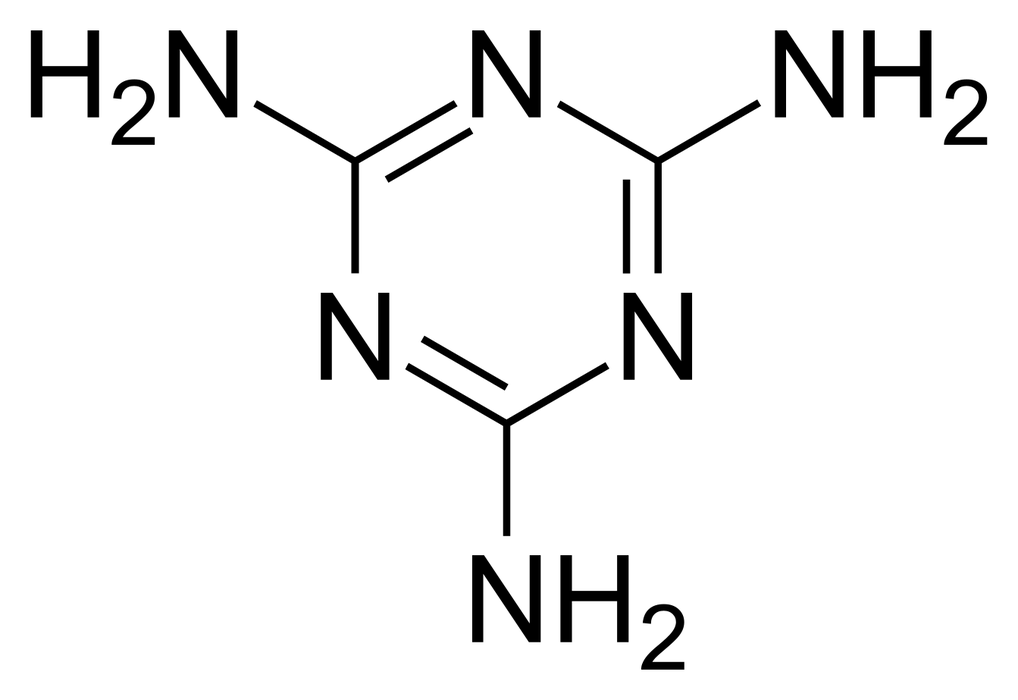
Chemical structure of melamine (1,3,5-triazine-2,4,6-triamine).
Credit: Emeldir / Wikimedia Commons

License: Public domain
Rendered from SVG to PNG, whitespace trimmed and placed on white
What it is
Melamine is 2,4,6-triamino-1,3,5-triazine, a synthetic chemical that does not occur naturally. Its CAS number is 108-78-1. [3–5]
What it does and why it is used
Melamine is used to make resins and foams, including the melamine-formaldehyde resin in hard plastic tableware, and has uses in cleaning products, fertilizers and pesticides. [1,3] It is not allowed to be added to food. [3]
Regulatory status and health context
Canada
Canada does not allow melamine as a food ingredient. Health Canada has set interim maximum levels for melamine and cyanuric acid combined in foods made with milk or milk-derived ingredients: 0.5 ppm in infant formula and sole-source nutrition products, and 2.5 ppm in other such foods. These are based on the WHO tolerable daily intake of 0.2 mg per kg of body weight. [3]
United States
FDA has concluded that melamine, alone or with related compounds, is acceptable at up to 2,500 parts per billion (2.5 ppm) in foods other than infant formula. Its interim safety and risk assessments date from 2007 and 2008. [1,2] FDA advises against heating foods in melamine tableware in the microwave but says foods and drinks may be served on it. [1]
European Union
Commission Regulation (EU) No 1282/2011 cut the specific migration limit for melamine from plastic food-contact materials to 2.5 mg per kg of food. It followed EFSA's 2010 opinion setting a tolerable daily intake of 0.2 mg per kg of body weight, which found that children's exposure from food-contact materials could be in the range of that intake. [4]
Environmental notes
The sources used here do not assess melamine as an environmental concern and do not provide data for a rating. [1–4]
Quick facts
- CAS: 108-78-1. [5]
- Tolerable daily intake: 0.2 mg per kg of body weight (WHO and EFSA). [3,4]
- EU migration limit from plastics: 2.5 mg per kg of food. [4]
- Canada: 0.5 ppm in infant formula; 2.5 ppm in other milk-based foods. [3]
- Simple habit: do not microwave food in melamine tableware. [1]
Sources
All URLs were fetched on 2026-11-10. Source publication dates differ from this draft's review date.
- FDA: Melamine in tableware, questions and answers.
- FDA: Melamine (risk assessment and methods).
- Health Canada: Questions and answers, melamine.
- EUR-Lex: Commission Regulation (EU) No 1282/2011 amending Regulation (EU) No 10/2011 on plastic food-contact materials.
- PubChem PUG REST: melamine synonyms.