
Food and drinkFragrance and flavour
Monosodium glutamate (MSG): a savoury flavour with a reputation bigger than its evidence
CAS 142-47-2.Also known as MSG, sodium glutamate, E621, E 621, and glutamate.
Editorial draft Last reviewed 10 November 2026 About 941 words
CC INDEX
How it works18/100 Low
Regulators in Canada and the US consider MSG safe at normal use. Reported symptoms are mild and short-lived and have not been reproduced consistently in controlled studies. EFSA's lower safe-intake figure and its note that some groups may exceed it keep the score from being minimal.
An editorial summary of this article’s cited evidence. It isn’t medical advice or a personal risk estimate.
Age index
What is the age index?Which age groups are more affected by this chemical’s possible health issues, based on this article’s sources.
- Pregnancy Unborn babies Not well studied
- Infants 0 to 1 Not well studied
- Young children 1 to 5 Moderate
- Children 6 to 12 Moderate
- Teens 13 to 19 Not well studied
- Adults 20 to 64 Lower concern
- Older adults 65 and over Not well studied
- Young children (moderate): Some toddlers could exceed EFSA's safe level
- Children (moderate): Some children could exceed EFSA's safe level
- Adults (lower concern): Mild, short-lived symptoms after large doses without food

Illustration of glutamate in food. Tomatoes, aged cheese and broths contain natural glutamate; added MSG is the same glutamate as a sodium salt.
Credit: Chemical Century; AI-generated illustration
License: CC0 1.0
Illustration, not a photograph of a specific product. Resized and cropped for the web.
MSG gives a savoury depth to soups, snack seasonings, sauces and takeout dishes, and many people blame it for feeling unwell after a restaurant meal. Some sensitive people who take a large amount on an empty stomach may have short-lived symptoms such as headache, flushing, tingling or drowsiness. But when researchers have tested people who believe they are sensitive, they have not been able to trigger reactions consistently. For most people, MSG in normal meals is far less of a worry than its reputation suggests.
Everyday exposure: where you meet it and how much
Monosodium glutamate, or MSG, is added to give foods a savoury, "meaty" taste. You will find it in some soups and broths, snack seasonings, sauces, processed meats, seasoning mixes and restaurant dishes. In Europe it is listed as E 621. [1,3]
Most of the glutamate you eat is not from added MSG. FDA says an average adult takes in about 13 g of glutamate a day from the protein in food, compared with about 0.55 g a day from added MSG. Tomatoes, aged cheeses, soy sauce and broths are naturally rich in free glutamate, which is chemically the same as the glutamate in MSG. A typical serving of food with added MSG contains less than 0.5 g. [1,3]
Known and suspected harms
Evidence labels are editorial summaries, not individual risk predictions: established means recognized under the stated conditions; probable means a likely contribution with uncertainty; possible means limited evidence; disputed means assessors disagree. These labels do not describe how common an effect is.
- Possible — short-lived symptoms in some sensitive people after large doses without food: an independent scientific review for FDA found that some sensitive people who take 3 g or more of MSG without food may have mild, short-term symptoms such as headache, numbness, flushing, tingling, palpitations and drowsiness. Health Canada describes similar temporary reactions after 3 to 5 g on an empty stomach. [1,2]
- Disputed — MSG in normal meals causes a recognisable reaction: many people describe themselves as sensitive to MSG. However, FDA notes that in studies giving such people MSG or a placebo, scientists have not been able to trigger reactions consistently. FDA could not confirm that MSG caused the symptoms people reported to it. [1]
- Possible — high total intake exceeding the EU safe level in some groups: EFSA set a group acceptable daily intake of 30 mg per kg of body weight a day for glutamates added to food. It estimated that some people with diets high in these additives, and some toddlers and children, could exceed it. [3]
Reducing avoidable exposure and harm
If you think MSG affects you, check ingredient lists for "monosodium glutamate", and eat seasoned foods with a meal rather than on an empty stomach. Health Canada suggests not adding MSG to prepared foods that already contain it; at home, about 5 mL (1 teaspoon) per kilogram of food is a general upper guide. It also describes "no MSG" claims as misleading, because soy sauce, yeast extracts and hydrolysed vegetable protein are other added sources of glutamate. [1,2]
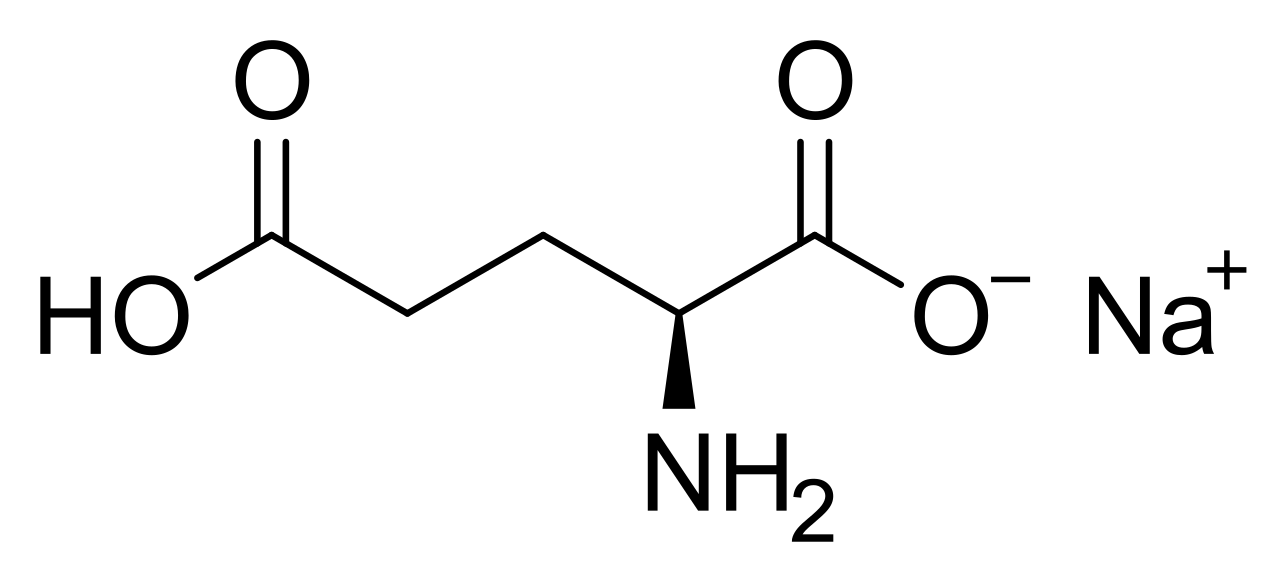
Monosodium glutamate structural formula.
Credit: Benrr101 / Wikimedia Commons

License: Public domain
Wikimedia-provided PNG rendering of the SVG; whitespace trimmed, no content edits
What it is
MSG is the sodium salt of glutamic acid, one of the common amino acids that make up proteins. Its CAS number is 142-47-2. Glutamate was first isolated from a seaweed broth in 1908. Today MSG is made by fermenting starch, sugar beets, sugar cane or molasses, a process FDA compares with making yogurt, vinegar or wine. [1,4]
What it does and why it is used
Glutamate is responsible for umami, the savoury taste. Added MSG strengthens that taste in soups, sauces, snacks and seasoning blends, and EFSA notes it is added to a wide range of foods for this reason. Glutamate has nothing to do with gluten. [1,3]
Regulatory status and health context
Canada
Health Canada says studies worldwide have found that MSG does not pose a health hazard. MSG is not regulated as a food additive in Canada, but it must be declared in the list of ingredients, even when it is part of a flavouring preparation or spice mix. [2]
United States
FDA considers adding MSG to foods "generally recognized as safe". Added MSG must be declared on the label as "monosodium glutamate", and foods with ingredients naturally containing free glutamate, such as hydrolysed vegetable protein or yeast extract, cannot claim "No MSG" or "No added MSG". [1]
European Union
Glutamic acid and its salts (E 620 to E 625) are authorised food additives in the EU, generally up to 10 g per kg of food. In its 2017 review EFSA set the group acceptable daily intake of 30 mg per kg of body weight. It recommended reviewing maximum levels for some food categories, including soups and broths, sauces, meat products, seasonings and food supplements. [3]
Environmental notes
The sources used here do not identify MSG in food as an environmental concern and do not give data to rate it. [1–3]
Quick facts
- CAS: 142-47-2. [4]
- EU number: E 621. [3]
- Purpose: flavour enhancer that adds savoury (umami) taste. [1,3]
- Typical added amount: under 0.5 g in a serving. [1]
- EU group safe intake: 30 mg per kg of body weight a day. [3]
- Label: added MSG must be named in the ingredient list. [1,2]
Sources
All URLs were fetched on 2026-11-10. Source publication dates differ from this draft's review date.