
Makeup and colourSkin and personal care
p-Phenylenediamine: the hair-dye ingredient behind many allergic reactions, and why the patch test matters
CAS 106-50-3.Also known as PPD, paraphenylenediamine, para-phenylenediamine, 1,4-benzenediamine, and 1,4-diaminobenzene.
Editorial draft Last reviewed 11 November 2026 About 950 words
CC INDEX
How it works56/100 Moderate
PPD is a well-documented cause of allergic reactions to hair dye, and black henna tattoos can cause dangerous skin reactions and sensitization. Hair-dye use is common, but most users do not react, and FDA says it has no reliable evidence linking hair dyes on the market today to cancer. Mandatory warnings and patch-test instructions in Canada, the US and the EU add oversight, so the score sits in the moderate band.
An editorial summary of this article’s cited evidence. It isn’t medical advice or a personal risk estimate.
Age index
What is the age index?Which age groups are more affected by this chemical’s possible health issues, based on this article’s sources.
- Pregnancy Unborn babies Not well studied
- Infants 0 to 1 Not well studied
- Young children 1 to 5 Moderate
- Children 6 to 12 Moderate
- Teens 13 to 19 Moderate
- Adults 20 to 64 Moderate
- Older adults 65 and over Moderate
- Risk depends on contact with hair dye or black henna and on past sensitization, not on age; people can become allergic at any age.

Illustration of home hair colouring. Hair dyes can contain p-phenylenediamine; wearing gloves and doing a patch test before each use reduce risk.
Credit: Chemical Century; AI-generated illustration
License: CC0 1.0
Illustration, not a photograph of a specific product. Resized and cropped for the web.
Colouring hair at home or at the salon is a routine pleasure for many people, and permanent hair dyes can contain p-phenylenediamine, or PPD. Most people use these dyes without trouble, but PPD is the hair-dye ingredient most prominently linked to allergic reactions, which can mean an itchy, irritated scalp or a swollen face, sometimes after years of colouring without a problem. Temporary 'black henna' tattoos can put PPD straight onto the skin and may make a later hair-dye allergy more likely. A small patch test before every colouring, and saying no to black henna, are simple habits that help prevent painful surprises.
Everyday exposure: where you meet it and how much
Most hair dyes belong to a group FDA calls coal-tar hair dyes, a historical name for synthetic dyes now mostly made from petroleum; they include permanent, semi-permanent and temporary dyes. [1] Among their ingredients, p-phenylenediamine (PPD) has been implicated most prominently in allergic reactions. [1] FDA's list of common cosmetic allergens names PPD among chemicals in hair dyes and black henna tattoos. [3]
Products marketed as "black henna" for temporary tattoos often contain a coal-tar hair dye with PPD to darken the stain, and some artists use a PPD-containing hair dye alone. [2] NIOSH lists hair dyes among exposures linked to work-related asthma in cosmetology. [7]
Known and suspected harms
Evidence labels are editorial summaries, not individual risk predictions: established means recognized under the stated conditions; probable means a likely contribution with uncertainty; possible means limited evidence; disputed means assessors disagree. These labels do not describe how common an effect is.
- Established — allergic skin reactions and sensitization from hair dye: some coal-tar hair dyes can cause allergic reactions or sensitization that may lead to skin irritation and hair loss. People can become sensitive with repeated exposure, and formulas change, so a reaction is possible even after dyeing without problems in the past. [1] Allergic reactions to cosmetics can include hives, itchy skin, rash, flaking, facial swelling and, rarely, anaphylaxis. [3]
- Established — dangerous skin reactions from black henna tattoos: PPD in black henna can cause dangerous skin reactions in some people, and FDA has received reports of skin injuries from these products. [2] Black henna tattoos may also increase the risk of a later allergy to hair dyes. [1]
- Established — cross-sensitization: people sensitized to PPD may also react to some textile dyes, ballpoint pen inks, rubber and latex products, certain local anesthetics, sulfa drugs and para-aminobenzoic acid. [1]
- Established — eye injury and blindness if used on eyelashes or eyebrows: hair dyes have caused eye injuries, including blindness, when used near the eyes. [1,4]
- Established — no reliable cancer link for current dyes, per FDA: some hair dyes were found to cause cancer in animals in the 1980s and were reformulated; FDA says it does not have reliable evidence linking coal-tar hair dyes on the market today to cancer. [1]
Reducing avoidable exposure and harm
Do a patch test on the skin before every hair-colouring, even if you have used the product before; a reaction can still happen after a negative test. [1,5] Wear gloves, follow the timing on the label, rinse the scalp well, and never dye eyebrows or eyelashes. [1] Do not dye over an irritated, sunburned or damaged scalp, wait at least 14 days after bleaching, relaxing or perming, and keep hair dyes out of reach of children. [1] If you have reacted before, check ingredient lists for PPD. [1] Avoid black henna tattoos; by US law, PPD is not permitted in cosmetics meant to be applied to the skin. [2]
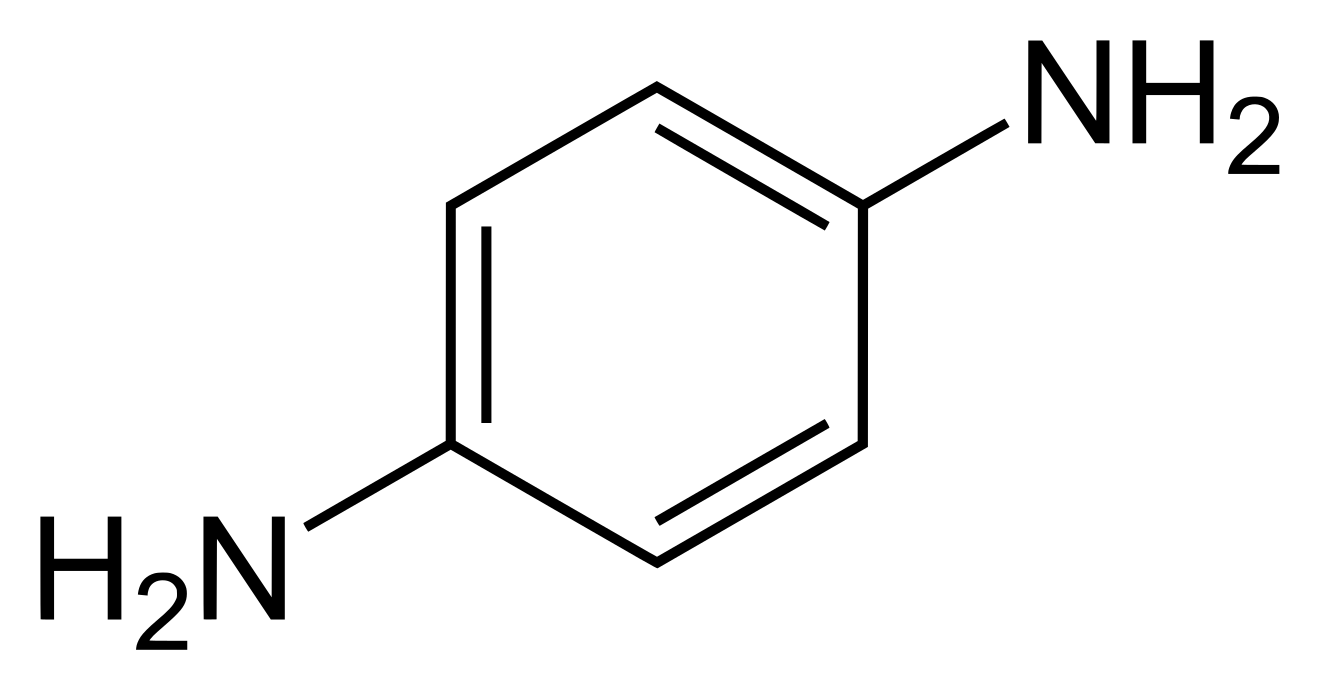
Structure of p-phenylenediamine.
Credit: RicHard-59 / Wikimedia Commons

License: Public domain
Rendered from SVG to PNG, whitespace trimmed and placed on white
What it is
p-Phenylenediamine (CAS 106-50-3), also written paraphenylenediamine or 1,4-benzenediamine, is a coal-tar hair-dye ingredient. [1,6,8]
What it does and why it is used
The EU lists PPD as an oxidizing colouring agent for hair dyeing, the type of chemistry used in permanent dyes. [6]
Regulatory status and health context
Canada
A hair dye containing paraphenylenediamine must carry a caution that it may cause skin irritation and must not be used on eyelashes or eyebrows because it may cause blindness, and must include patch-test instructions to be repeated before each application. [4] Health Canada says its review of current data shows no hazard from the proper use of hair dyes. [5]
United States
Coal-tar hair dyes do not need FDA approval, and FDA cannot act against them for harmful ingredients as long as the label carries a caution statement and patch-test directions; they may not be used on eyebrows or eyelashes. [1] PPD is not permitted in cosmetics intended for the skin. [2]
European Union
PPD is restricted to oxidizing hair dyes under the Cosmetics Regulation, with label warnings including "Can cause an allergic reaction", "Contains phenylenediamines" and "Do not use to dye eyelashes or eyebrows"; products for professional use must also say "Wear suitable gloves". [6]
Environmental notes
The sources used for this review focus on skin allergy and do not assess PPD's environmental effects, so we do not summarize them here.
Quick facts
- CAS: 106-50-3. [8]
- Where: hair dyes; "black henna" temporary tattoos. [1,2]
- Main concern: allergic reactions, which can develop after years of use. [1]
- Key safety step: patch test before every use. [1,4,5]
Sources
URLs were fetched on 2026-11-10 or 2026-11-11. Source publication dates differ from this draft's review date.
- US FDA: Hair dyes.
- US FDA: Temporary tattoos, henna/mehndi and "black henna" fact sheet.
- US FDA: Allergens in cosmetics.
- Justice Laws: Cosmetic Regulations, section 22.
- Health Canada: Hair dyes.
- EUR-Lex: Regulation (EC) No 1223/2009 on cosmetic products, Annex III.
- NIOSH: Work-related asthma, exposures.
- PubChem PUG REST: p-phenylenediamine synonyms.