
Skin and personal care Makeup and colour
Parabens: preservatives, hormone signals and substance-specific risks
Also known as methylparaben, propylparaben, and butylparaben.
Editorial draft Last reviewed 8 November 2026 About 1142 words
Everyday exposure: where you meet it and how much
Parabens are preservatives used in some moisturizers, makeup, hair-care and shaving products, as well as certain foods and medicines. Names such as methylparaben and propylparaben often appear together on a cosmetic ingredient list. FDA explains that combinations can protect against a broader range of microorganisms. A general product category does not establish which paraben is present in a particular package. [1–3]
Exposure varies with concentration, product quantity, frequency and whether the product is swallowed, rinsed away or left on the skin. Health Canada's ingredient guidance describes cosmetic use generally at concentrations of 0.5% or less, but that is not a measured concentration for every moisturizer. Its newer assessment discussion distinguishes particular parabens and product types rather than assigning the whole family one exposure estimate. [1,2]
Known and suspected harms
The labels here are editorial summaries, not formal GRADE ratings: Established means recognized under stated conditions; Probable means a likely contribution with uncertainty; Possible means limited or suggestive evidence; Disputed identifies differing interpretations. A biological signal is not automatically an established clinical effect in users.
- Possible — hormone-related human effects: Health Canada describes weak estrogen-mimicking activity in laboratory studies and reproductive-development findings for some, but not all, parabens in animals. Its ingredient guidance says there is no clear evidence of similar human effects at current cosmetic-use levels. Laboratory activity warrants assessment; it does not establish that every preserved lotion disrupts a person's hormones. [2]
- Possible, substance- and product-specific effects: Canada's draft assessment identifies concerns involving spleen, thyroid, stomach lining, development or reproduction in specified scenarios. It singles out methylparaben and propylparaben in certain natural health products, and butylparaben and isobutylparaben in some cosmetics, natural health products or nonprescription drugs. These findings should not be generalized to every paraben in every formulation. [1]
- Disputed or unsupported blanket claim — cosmetic parabens cause breast cancer: FDA says it does not have information showing that parabens as used in cosmetics affect human health. The selected assessments do not establish a causal breast-cancer effect from ordinary cosmetic use. That uncertainty is different from proving that all doses and uses are harmless. [2,3]
It is particularly important not to turn a draft assessment into a final legal verdict. Health Canada's consumer page identifies its conclusions as proposed, and a separate government notice records delay in finalizing the Parabens Group decision. The scope and maturity of the evidence are part of the story. [1,7]
Reducing exposure and protecting at-risk groups
If avoiding a particular paraben is your goal, read the full ingredient name rather than assuming every preservative is chemically identical. Ask about alternatives suitable for the actual use, especially when a product is a medicine or intended for a young child. EU restrictions distinguish infant nappy-area products from general cosmetics, illustrating why the application matters. [3,4]
Do not remove preservatives from a formulation or assume an inadequately preserved homemade replacement is safer. Preservatives help prevent harmful bacteria and mould; replacing one ingredient requires maintaining that protection. A “paraben-free” claim answers an ingredient question, not whether the entire product is non-irritating, well preserved or appropriate for every user. [3]
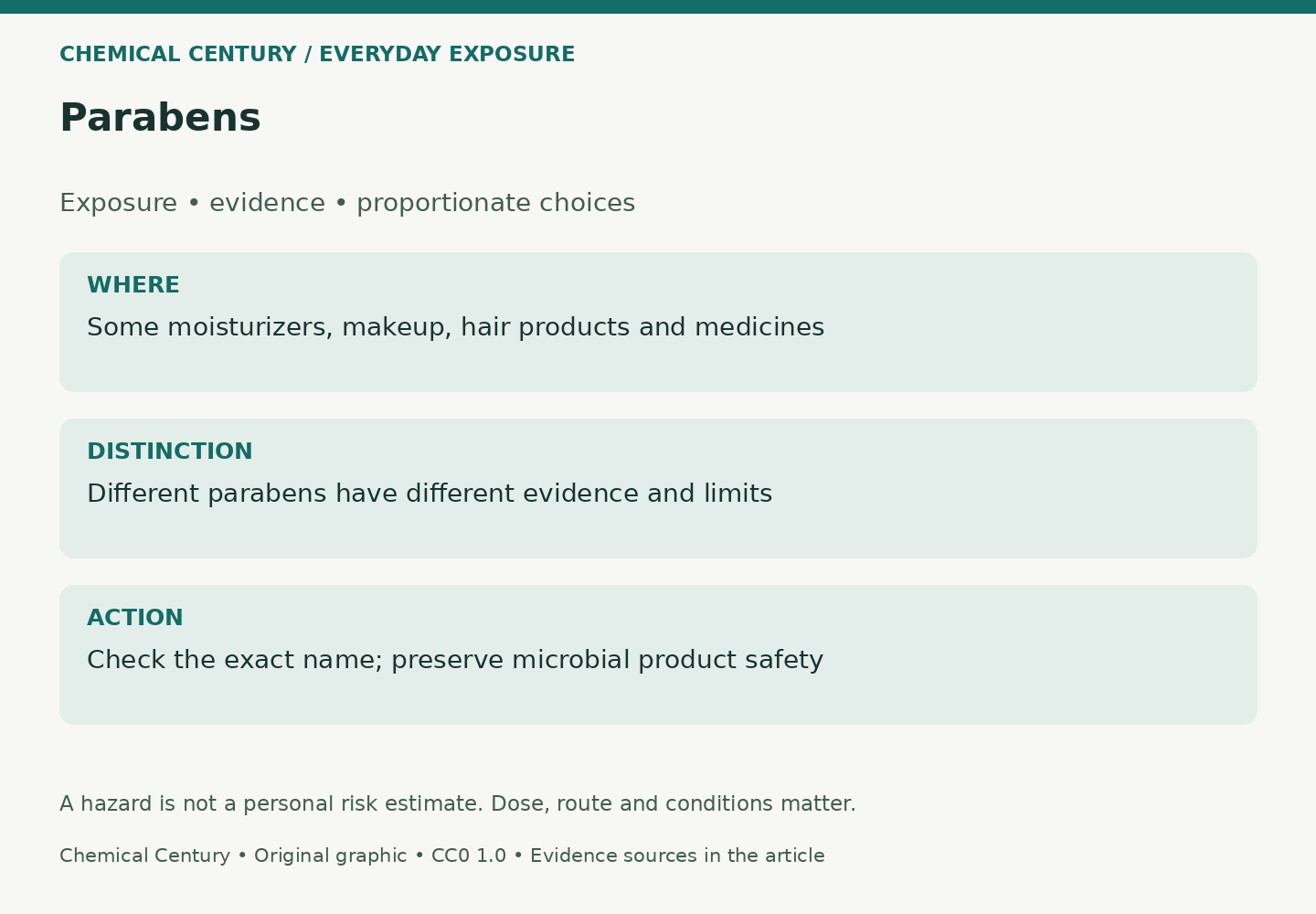
Exposure and evidence guide; not a numerical risk estimate.
Credit: Chemical Century; original graphic
License: CC0 1.0
Data: Data: the sources listed for this article.
What it is
There is no single CAS number for the paraben family. For this article, PubChem verifies 99-76-3 for methylparaben and 94-13-3 for propylparaben. Butylparaben and its branched isomers are not alternative names for methylparaben. Different molecular identities can have different evidence and regulatory conditions. [1,4–6]
The names are useful because an article about a family can otherwise create false equivalence. Canada's assessment discussion does not identify the same concern for every member, and EU regulations treat several longer-chain or branched parabens differently from permitted ones. A class label should help navigation without replacing substance-specific safety work. [1,4]
What it does and why it is used
Parabens inhibit microbial growth in products that may otherwise spoil. FDA describes protection of both the product and the consumer, with more than one paraben or preservative type often used together. The benefit is real even when a particular paraben needs tighter conditions or replacement. Safety assessment must consider both chemical exposure and the consequences of inadequate preservation. [3]
Parabens may also occur naturally in certain foods, according to Health Canada. Natural occurrence does not establish the safety of any industrial dose; equally, synthetic manufacture does not by itself demonstrate a harmful effect. The relevant assessment concerns the substance, exposure route and amount. [1,2]
Regulatory status and health context
Canada
Health Canada's public assessment discussion remains explicitly draft in the fetched material. It proposes concerns for specified substance/product combinations while saying assessed food-additive uses and natural food occurrence do not pose a health risk. It also identifies restrictions in natural health products and food-preservative uses. A June 2026 government delay notice lists the Parabens Group; a planned decision date should not be mistaken for proof a final decision was published. [1,7]
United States
FDA's cosmetic guidance says most cosmetic ingredients, apart from specified colour additives, do not require premarket FDA approval. Cosmetics nevertheless must be safe and properly labelled, and FDA can act against unlawful products. The agency continues to review paraben evidence and does not report information establishing human-health effects from their cosmetic use. Lack of premarket approval is therefore not equivalent to either a ban or individualized safety certification. [3]
European Union
Regulation 1004/2014 distinguishes authorized parabens and conditions. It limits the combined concentration of butylparaben and propylparaben to 0.14% expressed as acid, and prohibits their use in leave-on products designed for the nappy area of children under three. It also describes earlier prohibitions for specified other parabens, including isobutylparaben and isopropylparaben. “Europe banned parabens” is consequently too broad. [4]
The regulation's explanation discusses additional uncertainty for very young infants' nappy-area exposure and maintains other mixture conditions. These provisions are protective risk-management choices for defined uses, not proof that every adult exposure produces an endocrine disease. The exact current formula and applicable legal entries still need checking for product compliance. [4]
Environmental notes
Canada's draft assessment discussion does not identify environmental harm at assessed exposure levels for the parabens considered. That limited conclusion is not a claim that every preservative alternative has a better ecological footprint or that release at any concentration is harmless. [1]
Quick facts
- Family, not one molecule: no universal CAS assigned.
- Verified examples: methylparaben and propylparaben. [5,6]
- Possible concern: endocrine-related effects and specified exposure scenarios. [1,2]
- Important benefit: prevention of harmful microbial growth. [3]
Sources
Fetched 2026-11-08 unless a previously fetched archived source is explicitly identified. Regulations are reported with their scope and dates; this draft is not legal advice.