
Food and drinkWater, air and residues
Patulin: a mould toxin from damaged apples that is limited in apple juice and baby foods
CAS 149-29-1.Also known as clavacin, clavatin, expansine, and claviformin.
Editorial draft Last reviewed 11 November 2026 About 867 words
CC INDEX
How it works33/100 Mild
Patulin is a natural mould toxin found mainly in juice and products made from damaged apples. It affects the immune and nervous systems in animals, but there is no clear evidence it causes cancer, and Canada, the US and the EU all set a 50 ppb limit in apple juice, with tighter EU limits for infant foods. Surveys find levels in Canadian apple juice are not a health risk, so the score is mild.
An editorial summary of this article’s cited evidence. It isn’t medical advice or a personal risk estimate.
Age index
What is the age index?Which age groups are more affected by this chemical’s possible health issues, based on this article’s sources.
- Pregnancy Unborn babies Not well studied
- Infants 0 to 1 Moderate
- Young children 1 to 5 Moderate
- Children 6 to 12 Lower concern
- Teens 13 to 19 Lower concern
- Adults 20 to 64 Lower concern
- Older adults 65 and over Lower concern
- Infants (moderate): Tighter EU limits for infant foods
- Young children (moderate): Tighter EU limits for young children's foods
- Children (lower concern): No risk found in Canadian apple juice

Illustration of apple juice and apples. Patulin forms mainly in mould-damaged fruit, which is why sorting out damaged apples matters for juice.
Credit: Chemical Century; AI-generated illustration
License: CC0 1.0
Illustration, not a photograph of a specific product. Resized and cropped for the web.
Apple juice in a sippy cup, homemade applesauce, a glass of fresh cider at a fall market: patulin is a mould toxin that can sneak into these when bruised or rotting apples end up in the press. In animals it has affected the immune and nervous systems, though there is no clear evidence that it causes cancer. Because young children drink a lot of juice for their size, regulators limit how much patulin juice and baby foods may contain, and Canadian surveys have found levels that are not a health risk. At home, leaving damaged or mouldy apples out of juice and sauce follows the same common-sense logic.
Everyday exposure: where you meet it and how much
Patulin is a mycotoxin produced by Penicillium, Aspergillus and Byssochlamys moulds that grow on fruit, grains and cheese; the best-known example is patulin in juice or cider made from apples. [1] It occurs mainly in mould-damaged fruit. Mould does not always mean patulin is present, but it signals that it may be, and internal mould from insect damage can put patulin in fruit that looks undamaged from outside. [3] Washing fruit or removing mouldy tissue just before pressing will not necessarily remove all patulin. [3]
In the past, patulin was found at high levels in some apple juice products sold in or imported into the US. [2] A Canadian survey of apple juice products in 2008–2009 concluded that patulin levels did not present a risk to the health of children or the general population. [5]
Known and suspected harms
Evidence labels are editorial summaries, not individual risk predictions: established means recognized under the stated conditions; probable means a likely contribution with uncertainty; possible means limited evidence; disputed means assessors disagree. These labels do not describe how common an effect is.
- Established — immune and nerve effects in animals: patulin has been shown to cause immunotoxic effects and is neurotoxic in animals. [3] JECFA set a provisional maximum tolerable daily intake of 0.4 µg/kg body weight, using a 100-fold safety factor below the intake found harmless in long-term animal studies. [3]
- Disputed — cancer: there is no clear evidence that patulin is carcinogenic. IARC concluded that its carcinogenicity to humans could not be evaluated and that evidence in animals was inadequate. [3]
- Established — comes mainly from mould-damaged fruit: fruit condition at harvest, handling and storage all affect how likely patulin is to form. [3]
Reducing avoidable exposure and harm
The main controls are in the juice industry: harvesting and storing fruit well and removing damaged or mouldy fruit before pressing. [1,3] Thermal processing alone is not enough to make a product free of patulin. [3] At home, you can follow the same logic by not using rotten apples for juice or sauce; the sources used here do not give specific household advice.
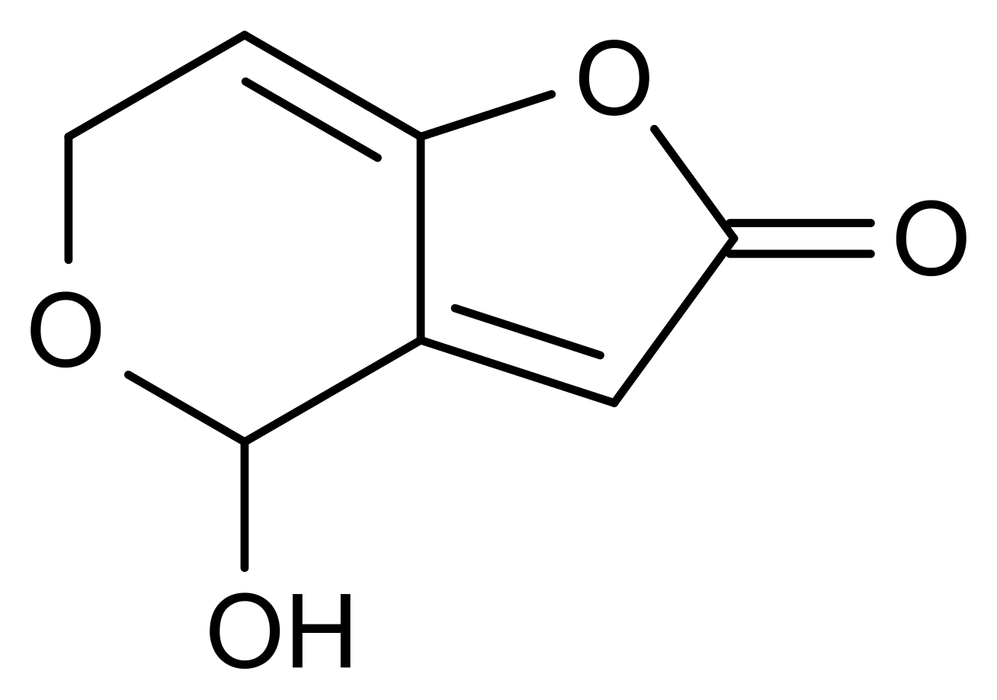
Chemical structure of patulin, a mycotoxin made by several moulds.
Credit: Sir Boris / Wikimedia Commons

License: Public domain
Rendered from SVG to PNG, whitespace trimmed and placed on white
What it is
Patulin (CAS 149-29-1) is a mycotoxin, a toxic substance produced by moulds. [1,7] FDA describes it as a toxic substance produced by moulds that may grow on apples. [2]
What it does and why it is used
Patulin is a natural contaminant with no use in food. [1,2]
Regulatory status and health context
Canada
Canada's maximum level for patulin is 50 ppb in apple juice and unfermented apple cider. [4]
United States
Under FDA Compliance Policy Guide 510.150, FDA may recommend legal action or import detention when apple juice, apple juice concentrate or the apple juice component of a food has patulin at or above 50 micrograms per kilogram (50 ppb), measured as single-strength juice and confirmed by analysis. [2]
European Union
Regulation (EU) 2023/915 sets patulin maximum levels of 50 µg/kg in fruit juices and nectars, and in cider and other fermented drinks from apples; 25 µg/kg in solid apple products such as apple compote and puree; and 10 µg/kg in apple juice and solid apple products for infants and young children and in baby food. [6]
International
The Codex code of practice for preventing patulin in apple juice was adopted in 2003. [3]
Environmental notes
The moulds that make patulin can be on fruit while it is still on the tree but generally do not grow until after harvest, unless fruit is diseased, damaged by insects or gathered from the ground. [3]
Quick facts
- CAS: 149-29-1. [7]
- Main source: juice and products from mould-damaged apples. [1,3]
- Limit in apple juice: 50 ppb in Canada, the US and the EU. [2,4,6]
- EU infant foods: 10 µg/kg. [6]
- JECFA tolerable intake: 0.4 µg/kg body weight per day. [3]
Sources
All URLs were fetched on 2026-11-11. Source publication dates differ from this draft's review date.
- FDA: Mycotoxins.
- FDA: Compliance Policy Guide Sec. 510.150, apple juice and apple juice products, adulteration with patulin.
- Codex Alimentarius: Code of practice for the prevention and reduction of patulin contamination in apple juice (CXC 50-2003).
- Health Canada: List of contaminants and other adulterating substances in foods.
- Canadian Food Inspection Agency: 2008–2009 patulin in apple juice products.
- EUR-Lex: Commission Regulation (EU) 2023/915 on maximum levels for certain contaminants in food.
- PubChem PUG REST: patulin synonyms.