
Cleaning and laundrySkin and personal care
Quaternary ammonium compounds: the germ-killers in wipes and sprays, and why more is not always better
CAS 8001-54-5.Also known as quats, benzalkonium chloride, alkyl dimethyl benzyl ammonium chloride, ADBAC, didecyl dimethyl ammonium chloride, and DDAC.
Editorial draft Last reviewed 11 November 2026 About 1082 words
CC INDEX
How it works40/100 Mild
Quats are widely used and irritating, and swallowing concentrated products can be dangerous, but EPA does not consider them carcinogenic and regulators do not classify them as reproductive toxicants. Evidence on work-related asthma is mixed but recurring. Exposure is common, and products are regulated as pesticides, drugs or cosmetics depending on use, which keeps the score at the top of the mild band.
An editorial summary of this article’s cited evidence. It isn’t medical advice or a personal risk estimate.
Age index
What is the age index?Which age groups are more affected by this chemical’s possible health issues, based on this article’s sources.
- Pregnancy Unborn babies Not well studied
- Infants 0 to 1 Moderate
- Young children 1 to 5 Moderate
- Children 6 to 12 Moderate
- Teens 13 to 19 Moderate
- Adults 20 to 64 Moderate
- Older adults 65 and over Moderate
- US EPA concluded children are not more sensitive than adults, though hand-to-mouth habits can raise their exposure; adults who use quats daily at work report the most breathing and skin problems.

Illustration of surface disinfection. Quats are common active ingredients in disinfecting wipes and sprays.
Credit: Chemical Century; AI-generated illustration
License: CC0 1.0
Illustration, not a photograph of a specific product. Resized and cropped for the web.
Disinfecting wipes in the kitchen drawer, sprays in the bathroom, sanitizers at the gym: many of them rely on quats, a family of germ-killing chemicals that has become part of daily routines. Used as labelled they do a useful job, but they are not needed for everyday cleaning, where soap and water work well. Heavy use can irritate the skin, eyes and airways, and people who use these products all day at work, such as cleaners and health care staff, have reported asthma and skin allergies. For families, the practical points are to keep disinfectants for when they are needed, to let adults rather than children do the wiping, and to rinse surfaces that touch food.
Everyday exposure: where you meet it and how much
Quaternary ammonium compounds, or quats, are used in disinfectants, sanitizers, wipes and sprays, and are active ingredients in more than 2,000 pesticide products. [1] Two common groups are alkyl dimethyl benzyl ammonium chloride (ADBAC), also called benzalkonium chloride, and didecyl dimethyl ammonium chloride (DDAC). [1] Quats are also used in lotions, antiseptics and nasal sprays, which are regulated as drugs or cosmetics rather than pesticides. [1]
People can be exposed at work, at home or at school: on the skin when handling disinfectant wipes or touching a wet surface, and by breathing in droplets when a product is sprayed nearby. [1] In a study of 43 volunteers on a college campus, 35 had at least one type of quat in their blood. [1] NIOSH lists quats, such as benzalkonium chloride, among cleaning-product exposures linked to work-related asthma in cleaning services and health care. [2]
Known and suspected harms
Evidence labels are editorial summaries, not individual risk predictions: established means recognized under the stated conditions; probable means a likely contribution with uncertainty; possible means limited evidence; disputed means assessors disagree. These labels do not describe how common an effect is.
- Established — skin, eye and airway irritation: breathing in quats can cause irritation, coughing, shortness of breath and headache; on the skin they can cause irritation, rash and burning; and depending on concentration they can irritate or damage the eyes. [1]
- Established — poisoning if a concentrated product is swallowed: swallowing quats can cause burning, nausea and vomiting, and concentrated products can be fatal. In one incident, five older people accidentally swallowed a 10% product and one died. [1]
- Probable — asthma and skin allergy with frequent work use: several studies found asthma was more common in workers who used cleaning products containing quats, and some nurses developed asthma or worse symptoms after working with them. [1] However, an analysis of the Nurses' Health Study II did not find that nurses who developed asthma used quats more often. [1] Regulators do not consider quats skin sensitizers, but sensitization has been reported in workers, and one patch-test study found 5.5% of participants reacted. [1]
- Established — not likely to cause cancer, per US EPA: EPA classified ADBAC as not likely to cause cancer in humans and DDAC as non-carcinogenic in humans. [1]
- Disputed — reproductive effects: regulators that evaluated ADBAC and DDAC do not consider them reproductive or developmental toxicants. A few mouse studies reported fewer pregnancies at doses that also made the mice sick, but other researchers criticized their methods, and no human studies are available. [1]
Reducing avoidable exposure and harm
NPIC advises not overusing disinfectants, which are not meant for routine cleaning, and using soap and water instead. Follow the label, avoid touching wet surfaces, wash hands after use, consider gloves, and ventilate with fresh air during and after use. [1] Antimicrobial surface products are pesticides and should never be used on people, and children should not apply disinfectants, including wipes. [1] After disinfecting surfaces that touch food, rinse them with drinkable water. [1] Health Canada notes that disinfectants can irritate the eyes and skin, so wash hands after use and keep products out of children's reach. [4]
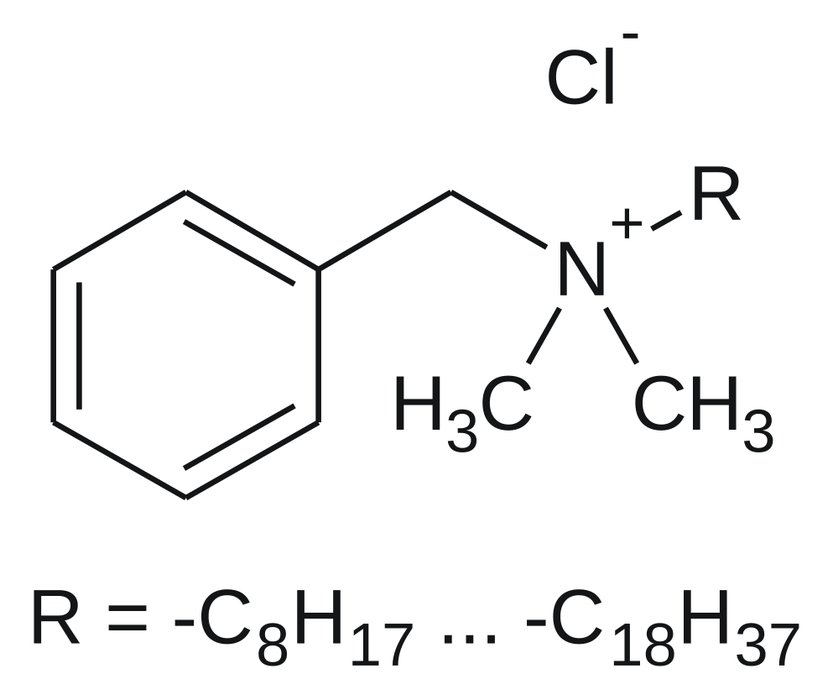
Structure of benzalkonium chloride, a common quaternary ammonium compound; R is a carbon chain of varying length.
Credit: Paginazero / Wikimedia Commons

License: Public domain
Rendered from SVG to PNG, whitespace trimmed and placed on white
What it is
Quats are a large family of positively charged nitrogen compounds. ADBAC (benzalkonium chloride) and DDAC are the groups covered by NPIC's fact sheet. [1] PubChem lists CAS 8001-54-5 for benzalkonium chloride. [6]
What it does and why it is used
Quats kill or control germs on hard surfaces and some products are used to kill algae, barnacles and mussels. [1] Benzalkonium chloride is also one of three active ingredients still under FDA review for leave-on consumer hand sanitizers. [3]
Regulatory status and health context
Canada
Hard-surface disinfectants authorized in Canada carry a Drug Identification Number (DIN) on the label, with directions for use, precautionary statements and first-aid instructions. [4]
United States
Quat disinfectants are regulated as pesticides by EPA, while quat-containing lotions, antiseptics and nasal sprays are regulated by FDA. [1] In its 2019 final rule on consumer antiseptic rubs, FDA deferred a decision on benzalkonium chloride, along with ethyl and isopropyl alcohol, to allow time for new safety and effectiveness data. [3]
European Union
When benzalkonium chloride is used in cosmetics for purposes other than preserving the product, the EU Cosmetics Regulation limits it, for example to 3% in rinse-off hair products, and requires the warning "Avoid contact with eyes". [5]
Environmental notes
ADBAC and DDAC are expected to biodegrade, but how fast depends on the compound and conditions, and they bind tightly to soil and sediment. [1] Quats are toxic to fish and highly toxic to aquatic invertebrates; ADBAC has been found in river water downstream of wastewater treatment and pharmaceutical plants. [1]
Quick facts
- Common types: ADBAC (benzalkonium chloride) and DDAC. [1]
- Where: disinfectant wipes and sprays, sanitizers, some lotions and nasal sprays. [1]
- Main concerns: irritation; asthma and skin allergy with heavy work use; poisoning if concentrate is swallowed. [1]
- Cancer: EPA says not likely (ADBAC) or non-carcinogenic (DDAC). [1]
- Everyday tip: soap and water for routine cleaning. [1]
Sources
URLs were fetched on 2026-11-10 or 2026-11-11. Source publication dates differ from this draft's review date.
- National Pesticide Information Center: Quaternary ammonium compounds (ADBAC and DDAC) fact sheet.
- NIOSH: Work-related asthma, exposures.
- Federal Register: Safety and effectiveness of consumer antiseptic rubs, April 12, 2019.
- Health Canada: Protect yourself and your family from poisonings when using hand sanitizers, disinfectants, cleaning products and bleaches.
- EUR-Lex: Regulation (EC) No 1223/2009 on cosmetic products, Annex III.
- PubChem PUG REST: benzalkonium chloride synonyms.