
Skin and personal care Cleaning and laundry
SLS and SLES: irritation, cleansing and the contaminant distinction
CAS 151-21-3. Also known as sodium lauryl sulfate, sodium dodecyl sulfate, sodium laureth sulfate, SLS, and SLES.
Editorial draft Last reviewed 8 November 2026 About 1139 words
Everyday exposure: where you meet it and how much
Sodium lauryl sulfate, or SLS, is a cleansing and foaming ingredient. Health Canada lists shampoos, bath products, shaving creams and skin cleansers among common rinse-off uses, with some other cosmetic applications as well. Sodium laureth sulfate, or SLES, is a related ethoxylated material, not merely another spelling of SLS. A product's ingredient list helps distinguish them; its foam does not measure concentration or irritation potential. [1,5,6]
The amount contacting skin, duration, formulation and rinsing conditions matter. A rinse-off shampoo is not the same exposure as leaving a concentrated raw ingredient on the skin. Health Canada's safety explanation explicitly distinguishes rinse-off use from prolonged contact. The selected sources do not establish a single “normal dose per shower,” so none is invented here. [1]
Known and suspected harms
These labels are editorial summaries, not formal GRADE ratings: Established means recognized under stated conditions; Probable means a likely contribution with uncertainty; Possible means limited or suggestive evidence; Disputed identifies differing interpretations. Chemical identity and exposure conditions are part of each statement.
- Established — skin and eye irritation from sufficiently high SLS exposure: Health Canada recognizes this effect in some individuals and emphasizes following label instructions. This is a reason to formulate and use products appropriately, not evidence that every shampoo damages everyone's skin. Irritation is also not automatically an allergy or a systemic disease. [1]
- Probable carcinogenic hazard of a possible contaminant, not proof that SLS causes cancer: FDA describes 1,4-dioxane as a potential human carcinogen. It cites animal evidence underlying NTP's “reasonably anticipated” and EPA's “likely” classifications, while human epidemiological evidence is inadequate. These statements concern 1,4-dioxane, not a demonstration that ordinary SLS or SLES use causes human cancer. [2]
- Possible exposure concern requiring quality control: some ethoxylated cosmetic ingredients can contain residual 1,4-dioxane from manufacturing. An ingredient list does not reveal its measured concentration. FDA describes declining levels with improved processing and international assessments supporting acceptable margins at trace levels. It would be misleading to treat potential contamination as a measured hazardous dose in every product. [2]
- Unsupported/disputed blanket claim — all sulfates in cosmetics are carcinogenic: the selected authoritative guidance does not establish that claim. Health Canada describes no undue safety risk from SLS when used as directed, while FDA separates the contaminant hazard from product-level risk assessment. [1,2]
Reducing exposure and protecting at-risk groups
Follow directions, rinse products intended for rinsing and avoid repurposing concentrated materials. If a product repeatedly causes irritation, stop using that product and seek appropriate advice rather than concluding that all ingredients with similar names are interchangeable. Health Canada's distinction between high-level irritation and intended use is more useful than a universal “toxic” or “safe” label. [1]
A person choosing a sulfate-free product should still assess the complete formulation. The label states an ingredient choice, not a guarantee that no alternative ingredient can irritate. For contamination questions, manufacturer quality controls and testing are more informative than guessing the dioxane concentration from the number of syllables in an ingredient name. FDA recommends manufacturing measures, including vacuum stripping, to reduce dioxane. [1,2]
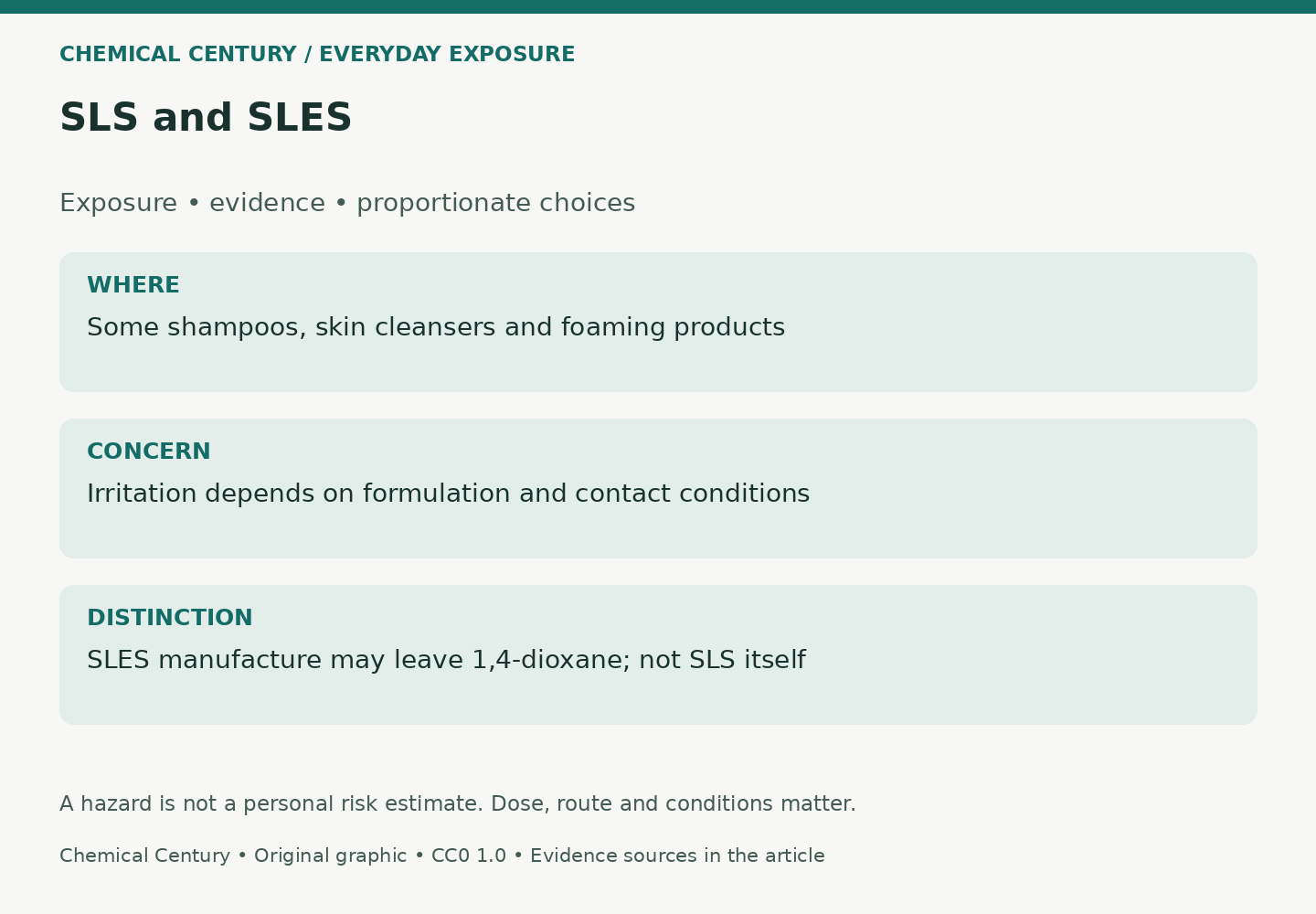
Exposure and evidence guide; not a numerical risk estimate.
Credit: Chemical Century; original graphic
License: CC0 1.0
Data: Data: the sources listed for this article.
What it is
PubChem verifies 151-21-3 for sodium dodecyl sulfate, another name for SLS. SLES includes an ethoxylated portion; PubChem returns multiple records and synonyms under the sodium laureth sulfate name. This article therefore does not assign a single supposedly universal SLES CAS number to every commercial mixture. The front-matter CAS identifies the lead substance SLS only. [5,6]
That distinction also matters for the contaminant discussion. SLS and SLES are not 1,4-dioxane. A manufacturing byproduct may require control even when it is not an intentionally added ingredient, but its possible presence does not change the identity of the main surfactant. FDA describes dioxane as an impurity that may occur in certain ingredients, not a substance intentionally added to cosmetic formulations. [2]
What it does and why it is used
SLS helps cleanse and create foam in the product types Health Canada describes. A useful function does not prevent irritation at sufficient exposure. Conversely, an irritation hazard from a concentrated ingredient does not establish that a diluted finished product is unsuitable for everyone. Product safety assessment must consider the formulation and intended conditions, not just a raw-material hazard description. [1,3]
The same principle applies when comparing rinse-off and leave-on products. Health Canada's discussion cites an expert review supporting rinse-off SLS use while recommending lower concentrations for prolonged skin contact. It reports a 1% recommendation for that latter context. This is the cited review's recommendation, not a newly verified universal legal limit in three jurisdictions. [1]
Regulatory status and health context
Canada
Health Canada considers SLS acceptable when used as directed and says there is no evidence of undue consumer risk under those conditions. Its broader cosmetic framework prohibits products that may injure users under normal use and requires ingredient notification. Its dioxane discussion reports that evaluated cosmetic exposures were considered safe and that unacceptable impurity levels could trigger removal from sale. Those conclusions do not authorize uncontrolled contamination. [1]
United States
FDA's dioxane page explains that the agency has not itself completed an independent cosmetic-contaminant risk assessment, and summarizes international evaluations instead. It cites an SCCS assessment considering trace dioxane at 10 ppm or less safe for consumers. That figure is not a universal FDA regulation or a measured concentration for all American shampoos. FDA recommends purification and monitors information and product levels. [2]
Most cosmetic ingredients do not require individual FDA premarket approval, but cosmetics still must be safe and properly labelled. A manufacturer cannot turn that framework into a claim that FDA approved every formulation or certified its contaminant concentration. [4]
European Union
The European Commission's cosmetics framework requires product safety assessment and compliance with the applicable ingredient restrictions. Colourants, preservatives and UV filters have explicit authorization provisions; ordinary cleansing ingredients should not be confused with those positive lists. Health Canada's SLS discussion describes acceptance in Europe, but this batch did not verify a current SLS-specific numerical statutory limit. No such number is asserted here. [1,3]
Environmental notes
The selected sources focus on cosmetic exposure, irritation and manufacturing impurities. They do not provide enough data to rank SLS and every alternative surfactant by aquatic impact or life-cycle footprint. “Sulfate-free” therefore is not assigned an environmental score here.
Quick facts
- Lead: SLS/sodium dodecyl sulfate, CAS 151-21-3. [5]
- Related, not identical: SLES. [6]
- Established concern: irritation at sufficient SLS exposure. [1]
- Separate issue: potential manufacturing residual 1,4-dioxane. [2]
Sources
Fetched 2026-11-08 unless a previously fetched archived source is explicitly identified. Regulations are reported with their scope and dates; this draft is not legal advice.
- Health Canada: Cosmetic ingredient safety, SLS/PEG sections.
- FDA: 1,4-dioxane manufacturing byproduct.
- European Commission: Cosmetics legislation.
- FDA: Cosmetic regulation explained in paraben guidance.
- PubChem PUG REST: sodium dodecyl sulfate synonyms.
- PubChem PUG REST: sodium laureth sulfate synonyms.