
Sodium benzoate: an acidic-food preservative and the benzene question
CAS 532-32-1.Also known as E211, E 211, benzoate of soda, and benzoic acid sodium salt.
Editorial draft Last reviewed 10 November 2026 About 849 words
CC INDEX
How it works28/100 Mild
Sodium benzoate is a permitted, widely used preservative with set limits. Benzene formation with vitamin C is a real chemistry issue, but FDA found it at low levels in most drinks tested and saw no safety concern after reformulation. Behaviour effects are only possible and were tested together with food colours.
An editorial summary of this article’s cited evidence. It isn’t medical advice or a personal risk estimate.
Age index
What is the age index?Which age groups are more affected by this chemical’s possible health issues, based on this article’s sources.
- Pregnancy Unborn babies Not well studied
- Infants 0 to 1 Not well studied
- Young children 1 to 5 Moderate
- Children 6 to 12 Moderate
- Teens 13 to 19 Not well studied
- Adults 20 to 64 Lower concern
- Older adults 65 and over Not well studied
- Young children (moderate): Possible hyperactivity when combined with colours
- Children (moderate): Possible hyperactivity when combined with colours

Illustration of acidic foods and drinks where benzoate preservatives are often used. Only the ingredient list shows whether a product contains one.
Credit: Chemical Century; AI-generated illustration
License: CC0 1.0
Illustration, not a photograph of a specific product. Resized and cropped for the web.
Sodium benzoate keeps soft drinks, pickles, sauces, salad dressings and jams from spoiling, so it is common in fridges and pantries. Most people never notice it, and regulators allow it within set limits. Two questions come up: in some drinks that also contain vitamin C, small amounts of benzene can form, and research suggests some children may be a bit more hyperactive when it is combined with certain food colours. Both concerns have been studied, and the US regulator found low benzene levels in most drinks tested and no safety concern after products were reformulated.
Everyday exposure: where you meet it and how much
Sodium benzoate is a preservative that works best in acidic foods. You are most likely to meet it in soft drinks and fruit drinks, pickles, sauces, dressings, jams and some syrups. On labels it may appear as sodium benzoate or, in Europe, as E 211. [1,3,4]
Amounts are capped. In the United States it may be used at up to 0.1% of a food. Canada allows benzoates in specified foods, generally up to 1,000 ppm (0.1%) calculated as benzoic acid. In the EU, maximum levels are set food category by food category. Your total intake depends mainly on how many preserved drinks and condiments you have. [2–4]
Known and suspected harms
Evidence labels are editorial summaries, not individual risk predictions: established means recognized under the stated conditions; probable means a likely contribution with uncertainty; possible means limited evidence; disputed means assessors disagree. These labels do not describe how common an effect is.
- Established — benzene can form in some drinks that also contain vitamin C: FDA explains that benzoate and ascorbic acid (vitamin C) can react to form small amounts of benzene, especially with heat and light. In FDA testing of about 200 drinks, most had little or none. Ten were above the drinking-water limit of 5 parts per billion, and those products were reformulated, with later tests below 1.5 ppb. FDA did not consider the levels found a safety concern. Benzene can cause cancer in humans; it has caused cancer in workers exposed to high levels in workplace air. [1]
- Possible — more hyperactive behaviour in some children when combined with certain food colours: a 2007 randomised trial in the UK gave children drinks containing sodium benzoate together with mixes of synthetic food colours. It found small increases in hyperactive behaviour. Because the preservative was always given with colours, the study cannot show which ingredient was responsible. [5]
Reducing avoidable exposure and harm
If you want to cut down, have fewer soft drinks and fruit drinks, and read ingredient lists on drinks and condiments. Store drinks away from heat and direct sunlight, which FDA identifies as conditions that encourage benzene formation. There is no need to avoid foods simply because they are preserved: preservatives help prevent spoilage and the growth of moulds and yeasts. [1]
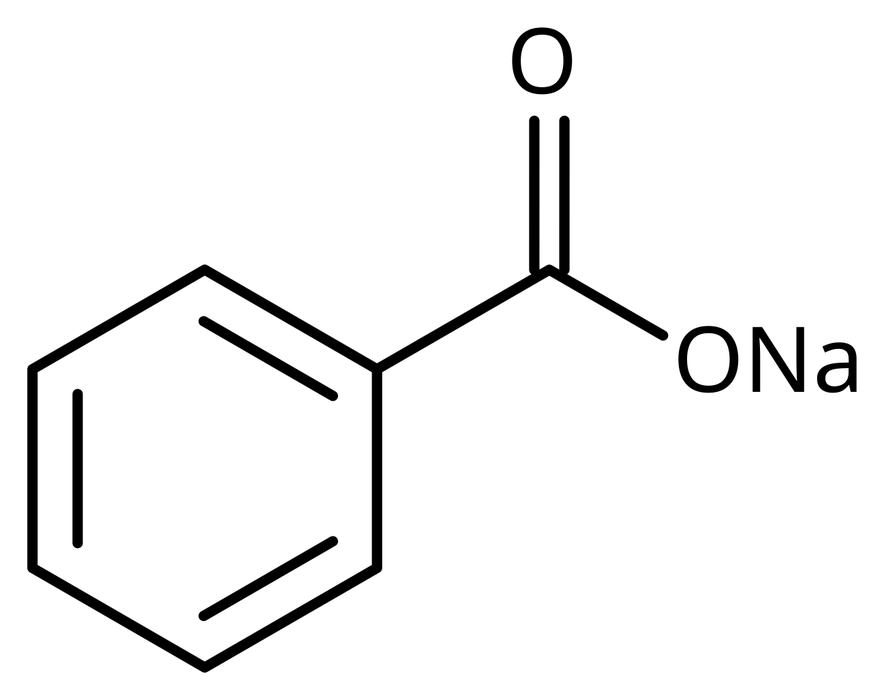
Sodium benzoate structural formula.
Credit: Puck04 / Wikimedia Commons

License: Public domain
Wikimedia-provided PNG rendering of the SVG; whitespace trimmed, no content edits
What it is
Sodium benzoate is the sodium salt of benzoic acid. Its CAS number is 532-32-1. [2,6]
What it does and why it is used
FDA describes benzoate salts being added to drinks to inhibit the growth of bacteria, yeasts and moulds. US regulations list it as an antimicrobial agent and also as a flavouring agent. [1,2]
Regulatory status and health context
Canada
Health Canada's List of Permitted Preservatives allows benzoic acid and its salts, including sodium benzoate, in specified foods, generally at up to 1,000 ppm calculated as benzoic acid. [3]
United States
FDA regulations list sodium benzoate as generally recognized as safe (GRAS) when used as an antimicrobial agent and flavouring agent at no more than 0.1% in food, in line with good manufacturing practice. FDA's benzene questions and answers report that manufacturers reformulated the drinks found above 5 ppb benzene. FDA treats the 5 ppb drinking-water limit as the allowable level for bottled water. [1,2]
European Union
Commission Regulation (EU) No 1129/2011 lists sodium benzoate as the authorised food additive E 211, within the group "E 210–213 benzoic acid — benzoates". It sets maximum levels for each permitted food category. [4]
Environmental notes
The sources used here do not identify sodium benzoate in foods as a meaningful environmental concern and do not give enough data to rate it. [1–4]
Quick facts
- CAS: 532-32-1. [6]
- EU number: E 211. [4]
- Purpose: preservative in acidic foods and drinks. [2,3]
- US limit: 0.1% in food. [2]
- Canada limit: generally 1,000 ppm, as benzoic acid, in permitted foods. [3]
- Storage tip: keep drinks cool and out of sunlight. [1]
Sources
All URLs were fetched on 2026-11-10. Source publication dates differ from this draft's review date.
- FDA: Questions and answers on the occurrence of benzene in soft drinks and other beverages.
- eCFR: 21 CFR 184.1733, Sodium benzoate.
- Health Canada: List of Permitted Preservatives.
- EUR-Lex: Commission Regulation (EU) No 1129/2011, Union list of food additives.
- McCann D et al. Food additives and hyperactive behaviour in 3-year-old and 8/9-year-old children in the community. Lancet, 2007 (PubMed).
- PubChem PUG REST: sodium benzoate synonyms.