
Cleaning and laundryWater, air and residues
Sodium hypochlorite (household bleach): a useful disinfectant that must never be mixed
CAS 7681-52-9.Also known as bleach, household bleach, chlorine bleach, liquid bleach, and hypochlorite.
Editorial draft Last reviewed 10 November 2026 About 939 words
CC INDEX
How it works46/100 Moderate
Mixing bleach with other cleaners releases harmful gases, and splashes or swallowing can cause injury; poison centres see these accidents every year. Used as directed and diluted, it is an effective disinfectant, and the trace chlorine in treated tap water is of low concern.
An editorial summary of this article’s cited evidence. It isn’t medical advice or a personal risk estimate.
Age index
What is the age index?Which age groups are more affected by this chemical’s possible health issues, based on this article’s sources.
- Pregnancy Unborn babies Not well studied
- Infants 0 to 1 Moderate
- Young children 1 to 5 Higher concern
- Children 6 to 12 Moderate
- Teens 13 to 19 Not well studied
- Adults 20 to 64 Moderate
- Older adults 65 and over Not well studied
- Infants (moderate): Swallowing if left within reach
- Young children (higher concern): Large share of poison-centre calls about cleaners
- Adults (moderate): Mixing accidents; frequent cleaning and lung function

Illustration of household bleach with gloves and a measuring cup. Dilute as the label directs, and never mix bleach with other cleaners.
Credit: Chemical Century; AI-generated illustration
License: CC0 1.0
Illustration, not a photograph of a specific product. Resized and cropped for the web.
Household bleach is a trusted tool for cleaning up after a stomach bug, whitening laundry or disinfecting a bathroom, and used diluted and as directed it does the job well. The dangers usually come from ordinary moments that go wrong: mixing it with another cleaner and suddenly coughing on harsh fumes, a splash in the eye, or a young child finding an open bottle under the sink. These accidents can cause burns to the skin, eyes or mouth and harmful fumes in a small room, and poison centres see them every year. Some research also suggests that frequent cleaning may speed the decline in lung function over time, which is one more reason to open a window and use it as the label directs.
Everyday exposure: where you meet it and how much
Sodium hypochlorite is the active ingredient in liquid household bleach. It is also an ingredient in some other cleaning and disinfecting products, so check labels. Most home exposure comes from breathing fumes or splashes while cleaning or doing laundry. Young children can be exposed by swallowing it if it is left within reach. [1,6]
You also meet much smaller amounts in treated drinking water. Chlorine compounds, including hypochlorite, are used to disinfect public water supplies. Health Canada notes typical chlorine levels in Canadian drinking water of about 0.04 to 2.0 mg/L, and has decided no guideline value is needed because of its low toxicity at those levels. [3]
Known and suspected harms
Evidence labels are editorial summaries, not individual risk predictions: established means recognized under the stated conditions; probable means a likely contribution with uncertainty; possible means limited evidence; disputed means assessors disagree. These labels do not describe how common an effect is.
- Established — toxic gases when mixed with ammonia, acids or vinegar: the Washington Poison Center explains that mixing bleach with a strong ammonia product forms chloramine gas, which irritates and injures the airways. In a 2020 CDC report, a woman who soaked groceries in bleach, vinegar and hot water developed coughing, wheezing and difficulty breathing and needed emergency care. [1,2]
- Established — burns to skin, eyes and mouth from concentrated or swallowed bleach: Hazard classifications compiled by PubChem include "causes severe skin burns and eye damage" and "may cause respiratory irritation", and ECHA lists a harmonised EU classification. US poison centres handle many bleach calls, and children aged 5 and under make up a large share of calls about cleaners. In early 2020, bleaches accounted for 62.1% of the rise in cleaner-related calls. [1,5,7]
- Possible — faster decline in lung function with frequent cleaning: a European study that followed adults for about 20 years found faster lung function decline in women who cleaned at home or worked as cleaners. It looked at cleaning in general, including sprays and other products, so it does not single out bleach. [4]
Reducing avoidable exposure and harm
Never mix bleach with ammonia, vinegar, acids or other cleaners, including toilet cleaners. Dilute it with room-temperature water as the label directs, open windows or use a fan, and wear gloves and eye protection. Store it in its original container, out of children's reach. If someone swallows bleach or has trouble breathing after exposure, call a poison centre or emergency services. [1,2]
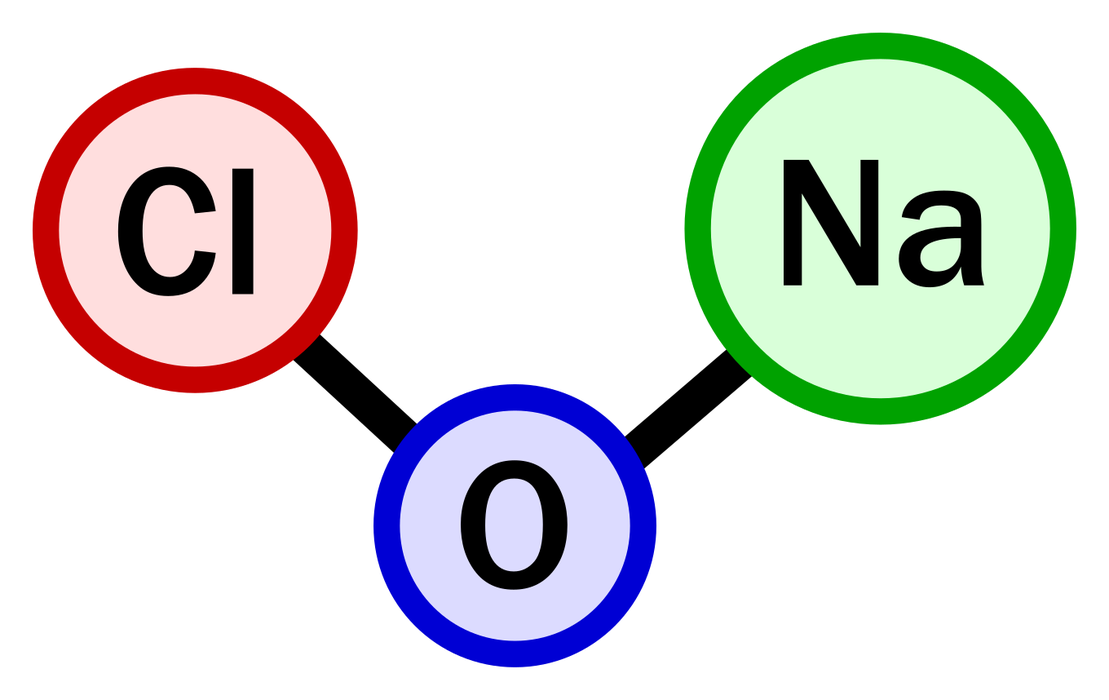
Sodium hypochlorite atom diagram.
Credit: Murraybuckley (author as recorded by Wikimedia Commons) / Wikimedia Commons

License: Public domain
Wikimedia-provided PNG rendering of the SVG; whitespace trimmed, no content edits
What it is
Sodium hypochlorite is a salt made of sodium and hypochlorite ions. Its CAS number is 7681-52-9. It is sold as a solution in water, which is what household bleach is. [5,6]
What it does and why it is used
It is used to disinfect hard surfaces, to whiten laundry and to disinfect water. CDC recommends proper cleaning and disinfection of high-touch surfaces, with label precautions, rather than avoiding disinfectants altogether. [1,3]
Regulatory status and health context
Canada
Health Canada's drinking water guidelines cover chlorine used to disinfect water and conclude that no guideline value is required because of its low toxicity at the concentrations found in drinking water. [3]
United States
CDC's 2020 poison-centre analysis found cleaner and disinfectant calls rose sharply in early 2020, and it advised following label directions, diluting only with room-temperature water, never mixing products, wearing eye and skin protection, ventilating and storing products out of children's reach. [1]
European Union
ECHA lists sodium hypochlorite with a harmonised EU classification and labelling, and as a biocidal active substance under the EU Biocidal Products Regulation. [5]
Environmental notes
Hazard classifications compiled by PubChem describe sodium hypochlorite as very toxic to aquatic life. Use only the amount the label recommends and do not pour concentrated bleach outdoors or into storm drains. The sources used here do not provide enough data for a quantified environmental rating of household use. [7]
Quick facts
- CAS: 7681-52-9. [6]
- Common name: household bleach. [1]
- Purpose: disinfecting surfaces, whitening laundry, water treatment. [1,3]
- Never mix with: ammonia, vinegar, acids or other cleaners. [1,2]
- Drinking water: typical chlorine levels of 0.04 to 2.0 mg/L in Canada; no guideline value required. [3]
Sources
All URLs were fetched on 2026-11-10. Source publication dates differ from this draft's review date.
- CDC MMWR: Cleaning and disinfectant chemical exposures and temporal associations with COVID-19, National Poison Data System, January–March 2020.
- Washington Poison Center: Chloramine gas.
- Health Canada: Guidelines for Canadian Drinking Water Quality, summary table.
- Svanes Ø et al. Cleaning at home and at work in relation to lung function decline and airway obstruction. Am J Respir Crit Care Med, 2018 (PubMed).
- ECHA: Sodium hypochlorite substance infocard.
- PubChem PUG REST: sodium hypochlorite synonyms.
- PubChem: Sodium hypochlorite, GHS hazard classification.