
Nitrite and nitrate in processed meat: preservation and cancer context
CAS 7632-00-0. Also known as sodium nitrite, E250, sodium nitrate, and E251.
Editorial draft Last reviewed 8 November 2026 About 1106 words
Everyday exposure: where you meet it and how much
Sodium nitrite and nitrate salts are used in specified cured or preserved meats. Depending on the product and jurisdiction, examples include certain bacon, sausages and other cured meats. They have preservation functions, not just cosmetic ones. EU rules describe the need to balance control of bacteria such as Clostridium botulinum against the possibility of forming unwanted nitrosamines. That tradeoff is central to an honest account. [1,4,5]
Nitrate also occurs naturally in foods and can contribute to nitrite exposure after conversion in the body. EFSA's 2017 assessment found that nitrate used as an additive represented less than 5% of estimated overall dietary nitrate exposure. It would therefore be misleading to describe all nitrate intake as a processed-meat additive exposure, or to assume that vegetables and cured meat have identical health implications. [2]
An ingredient list can establish use, but not how much nitrite remains in the serving. Amount added before processing, residual concentration after processing and total intake are different measurements. The Canadian and European rules explicitly distinguish these concepts; a legal maximum should not be presented as the measured content of every sandwich. [1,5]
Known and suspected harms
Evidence labels are editorial summaries, not formal GRADE ratings: Established means recognized under stated conditions; Probable means a likely contribution with uncertainty; Possible means limited or suggestive evidence; Disputed identifies differing interpretations. They do not replace the separate IARC classification system.
- Established — processed meat causes colorectal cancer: WHO explains that IARC's Group 1 classification reflects sufficient human evidence for processed meat as an exposure. This is not a finding that sodium nitrite alone explains the whole risk, nor that all Group 1 hazards have the same risk magnitude. [3]
- Possible contribution — nitrosamine formation: nitrites can contribute to formation of N-nitroso compounds, including some carcinogenic nitrosamines. EFSA considered nitrosamine formation from permitted additive uses of low concern in its 2017 evaluation, while recognizing uncertainties about nitrosamines in meat from all sources. The mechanism deserves attention without being converted into proof that every permitted dose causes cancer. [2,5]
- Possible higher exposure in some children: EFSA estimated that highly exposed children could slightly exceed its nitrite acceptable daily intake from additive uses. All-source exposure can be higher still. An ADI exceedance indicates a reason to examine exposure; it does not diagnose injury in a child or identify the content of a specific product. [2]
The important uncertainty is the share of processed-meat harm attributable to a particular additive rather than the wider product and processing pattern. The selected sources do not provide a defensible percentage to assign to sodium nitrite alone. Reporting this gap makes the established processed-meat finding more precise, not less important. [2,3,5]
Reducing exposure and protecting at-risk groups
Reducing the frequency and amount of processed meat is consistent with the dietary advice discussed by WHO. Replacing a regular processed-meat meal changes the overall exposure pattern rather than merely hunting for one unfamiliar ingredient name. No safe threshold for processed-meat cancer risk was established by the IARC evaluation described in its Q&A. [3]
Do not remove curing preservatives from a home recipe and assume the result has become safer. Regulatory limits balance more than one hazard, including botulism prevention. For a product you buy, consider the food category and actual consumption pattern, not just the presence or absence of one label term. This article does not provide curing quantities or food-production instructions. [4,5]
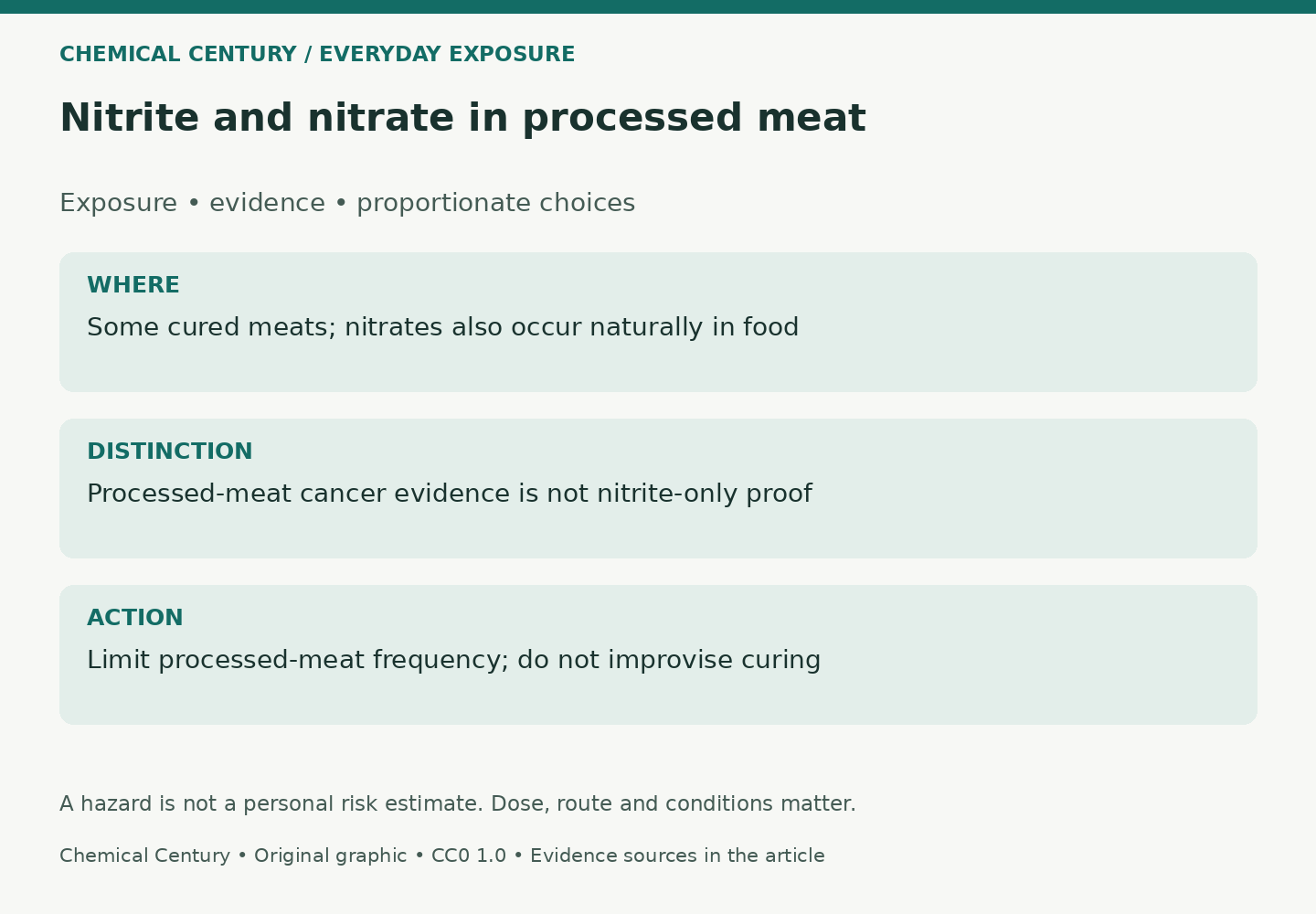
Exposure and evidence guide; not a numerical risk estimate.
Credit: Chemical Century; original graphic
License: CC0 1.0
Data: Data: the sources listed for this article.
What it is
Nitrite and nitrate are related but distinct ions. PubChem verifies 7632-00-0 for sodium nitrite and 7631-99-4 for sodium nitrate. European additive identifiers include E250 and E251 respectively; potassium salts have their own identities. A class discussion must not attach one salt's CAS number to every nitrate or nitrite. [2,5–7]
Likewise, the words “nitrite,” “nitrosamine” and “processed meat” do not identify the same exposure. One is an additive-related chemical species, one a group of compounds that may form, and one a food category with its own epidemiological evidence. This distinction is essential when interpreting cancer headlines. [2,3,5]
What it does and why it is used
Nitrite and nitrate uses help preserve specified foods and contribute to characteristic colour and flavour. Their antibacterial role includes protection against C. botulinum, responsible for botulism. That benefit explains why regulators generally set controlled conditions rather than simply treating removal as risk-free. EU rules seek lower formation of carcinogenic nitrosamines while retaining necessary microbial protection. [1,5]
Regulatory status and health context
Canada
Health Canada's permitted-preservatives list authorizes particular nitrate and nitrite uses, with food-specific limits and conditions. Many preserved-meat entries refer to amounts added before smoking, cooking or fermentation; special categories have different rules. A general “200 ppm everywhere” statement would miss those distinctions. The live list, rather than this overview, is the reference for a manufacturer. [1]
United States
US meat-curing requirements distinguish ingredients and processes. The rule reproduced at 9 CFR 424.22 does not allow nitrate in bacon and sets specific nitrite and curing-accelerator requirements for particular bacon processes. That shows why neither “all cured meat contains nitrate” nor one universal US limit is accurate. This is a description of regulatory scope, not permission to formulate a cure from a website. [4]
European Union
EFSA's 2017 scientific evaluation set an ADI of 0.07 mg/kg body weight/day for nitrite and retained 3.7 mg/kg/day for nitrate. These lifetime-exposure benchmarks are not target intakes or individual meal limits. EFSA's conclusion about then-permitted additive levels also identified uncertainty and all-source exposure issues. [2]
Regulation 2023/2108 subsequently amended permitted levels and conditions, seeking to reduce nitrosamine formation while preserving microbial safety. It contains category-specific added and residual limits and transition provisions. Scientific ADIs and legal formulation limits are different tools; an old scientific news release is not a complete statement of today's manufacturing rules. [5]
Environmental notes
The selected sources concern dietary exposure and food regulation. They do not provide a comparative environmental assessment of cured meat or a household nitrate-discharge estimate. No ecological safety ranking is assigned.
Quick facts
- Lead: sodium nitrite, CAS 7632-00-0; sodium nitrate is separate. [6,7]
- Established food-category harm: processed meat and colorectal cancer. [3]
- Possible contributor: nitrosamine formation, with exposure-specific uncertainty. [2]
- Practical focus: the overall processed-meat pattern, not one ingredient in isolation. [3]
Sources
Fetched 2026-11-08 unless a previously fetched archived source is explicitly identified. Regulations are reported with their scope and dates; this draft is not legal advice.