
Styrene: the building block of foam cups, and why smoke and workplaces matter more than takeout
CAS 100-42-5.Also known as ethenylbenzene, vinylbenzene, phenylethylene, styrene monomer, and cinnamene.
Editorial draft Last reviewed 11 November 2026 About 945 words
CC INDEX
How it works46/100 Moderate
Styrene is classified as a probable or reasonably anticipated human carcinogen, mainly from worker studies and animal data, and high levels affect the nervous system. Everyday exposure is widespread but low, and Health Canada considers it not harmful at normal environmental levels. Workplace classification and a US drinking-water limit add oversight, so the score sits in the moderate band.
An editorial summary of this article’s cited evidence. It isn’t medical advice or a personal risk estimate.
Age index
What is the age index?Which age groups are more affected by this chemical’s possible health issues, based on this article’s sources.
- Pregnancy Unborn babies Lower concern
- Infants 0 to 1 Lower concern
- Young children 1 to 5 Lower concern
- Children 6 to 12 Lower concern
- Teens 13 to 19 Lower concern
- Adults 20 to 64 Moderate
- Older adults 65 and over Lower concern
- Health Canada found blood levels similar across age groups; working-age adults in plastics and resin work, and people who smoke, have the highest exposure.

Illustration of foam packaging. Polystyrene, made from styrene, is used in disposable cups, food containers and packaging.
Credit: Chemical Century; AI-generated illustration
License: CC0 1.0
Illustration, not a photograph of a specific product. Resized and cropped for the web.
Foam coffee cups, takeout containers, packing peanuts, home insulation and car parts all start with styrene, a chemical so common that almost everyone carries a trace of it. It is easy to worry about the cup in your hand, but Health Canada says food and packaging are only a minor source; most styrene comes from the air we breathe, especially cigarette smoke, traffic and some indoor products. Cancer agencies have flagged styrene as a probable human carcinogen, largely on the strength of studies of workers exposed to far higher levels than people meet in daily life. For most households, not smoking and keeping indoor air fresh do more than swapping containers, while people who work with resins and plastics have the most reason to pay attention.
Everyday exposure: where you meet it and how much
Styrene is used to make latex, synthetic rubber and polystyrene resins, and it is found in car parts, protective coatings, home and building insulation, glass-fibre-reinforced resins, and plastic products such as pipes, packaging, disposable cups and food containers. [1] Some plants also produce styrene, and it occurs naturally in foods such as coffee beans, peanuts and cinnamon. [1]
People are mainly exposed by breathing air containing styrene from cigarette smoke, vehicle exhaust, photocopiers and laser printers, industry, and building products such as insulation and flooring. [1] Eating foods that naturally contain styrene, or foods into which it has migrated from packaging, is a minor source. [1] NTP likewise identifies smoking as the greatest source for the general population; for non-smokers, indoor air and food give the highest daily intakes. [3]
The body breaks styrene down and passes almost all of it in urine within one to three days. [1] In Canadian biomonitoring from 2012 to 2017, blood levels were higher in people who smoke, similar across age groups and between sexes, and fell by 36% in non-smokers over the period. [1]
Known and suspected harms
Evidence labels are editorial summaries, not individual risk predictions: established means recognized under the stated conditions; probable means a likely contribution with uncertainty; possible means limited evidence; disputed means assessors disagree. These labels do not describe how common an effect is.
- Probable — cancer risk at high workplace exposure: IARC classifies styrene as probably carcinogenic to humans (Group 2A), and NTP lists it as reasonably anticipated to be a human carcinogen, based on limited evidence in humans, sufficient evidence in animals and supporting mechanistic data. [2,3] Workers exposed to styrene showed increased deaths from and cases of cancers of the blood and lymphatic system. [2,3]
- Established — irritation and nervous system effects at high levels: short-term exposure can irritate the eyes, nose, throat and skin. High levels can cause muscle weakness and tiredness, nausea, headaches, difficulty concentrating, hearing problems, reduced colour discrimination and slower reactions. [1]
- Established — not harmful at normal environmental levels, per Health Canada: Health Canada has identified styrene as not harmful to human health at levels normally found in the Canadian environment. The presence of a substance in the body does not mean it will affect health. [1]
- Disputed — hearing loss in exposed workers: some studies of workers suggest a link with hearing loss and others do not; Health Canada's workplace assessment says it is unclear whether styrene alone causes hearing loss in people. [2]
- Established — no reproductive classification: Health Canada's workplace assessment found styrene does not meet the criteria for reproductive toxicity, noting an expert panel's negligible concern for reproductive and developmental effects in humans. [2]
Reducing avoidable exposure and harm
Because cigarette smoke is the largest source for most people, a smoke-free home lowers exposure the most. [1,3] Indoor air from printers and building products is another main route, so fresh air helps. [1] Workers in the plastics industry can have higher exposure through air and skin or eye contact with liquid styrene or resins, and should follow workplace controls. [1,2]
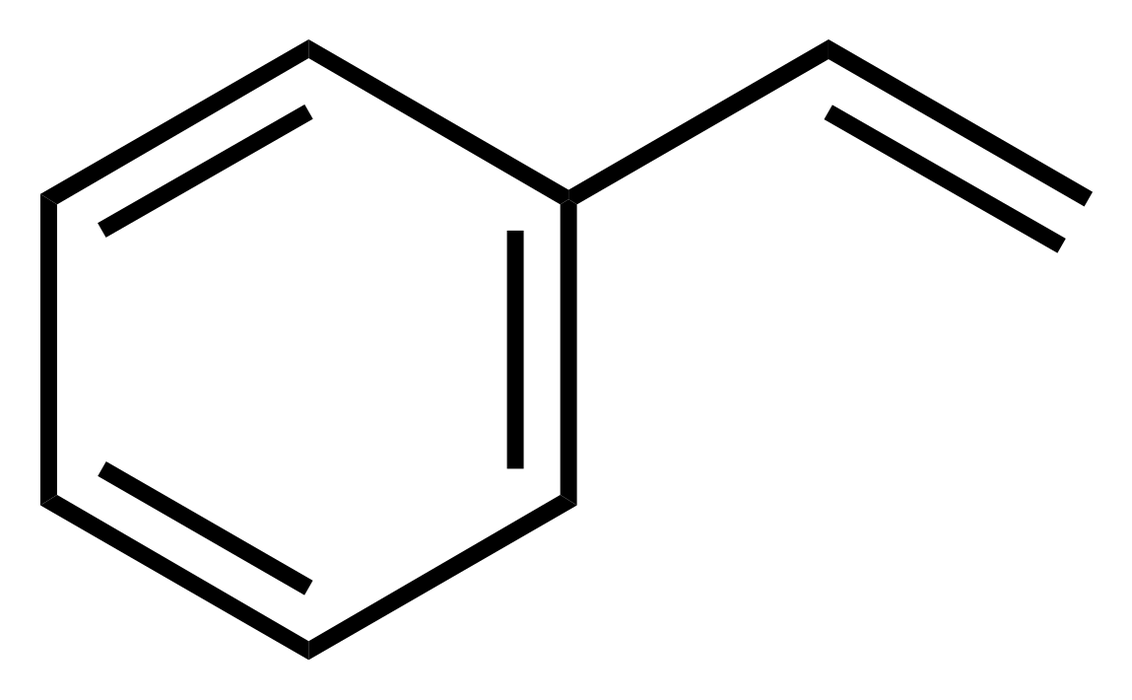
Skeletal structure of styrene.
Credit: Calvero. / Wikimedia Commons

License: Public domain
Rendered from SVG to PNG, whitespace trimmed and placed on white
What it is
Styrene (CAS 100-42-5) is a volatile organic compound, a carbon-based chemical that evaporates quickly at room temperature. [1,2] It is also called ethenylbenzene, phenylethene or cinnamene. [2,5]
What it does and why it is used
Styrene is the building block of polystyrene and other plastics and rubbers used in packaging, insulation, housewares, toys, car parts and many other products. [1,3]
Regulatory status and health context
Canada
Health Canada has set an indoor air reference level for styrene and limits volatile organic compounds, including styrene, in some consumer and commercial products. [1] For workplaces, styrene is classified as a Category 1B carcinogen, a flammable liquid and an aspiration hazard under WHMIS. [2]
United States
NTP has listed styrene in the Report on Carcinogens since 2011. [3] EPA's drinking-water limit for styrene is 0.1 mg/L. [4]
European Union
The sources used for this review do not cover styrene's EU status, so we do not summarize it here.
Environmental notes
Styrene is released to air from industrial production and use and has been measured in outdoor and indoor air, water, soil and food; levels are generally higher indoors than outdoors. [3]
Quick facts
- CAS: 100-42-5. [2]
- Main everyday source: breathing air, especially cigarette smoke. [1,3]
- Food and packaging: a minor source. [1]
- Cancer: IARC Group 2A; NTP reasonably anticipated. [2,3]
- US drinking-water limit: 0.1 mg/L. [4]
Sources
All URLs were fetched on 2026-11-11. Source publication dates differ from this draft's review date.