
Makeup and colourHousehold materialsWater, air and residues
Toluene: a solvent in some nail polishes, paints and glues, and a common indoor air pollutant
CAS 108-88-3.Also known as methylbenzene, toluol, and phenylmethane.
Editorial draft Last reviewed 10 November 2026 About 921 words
CC INDEX
How it works44/100 Moderate
Toluene's nervous-system effects are well established at high or long-term workplace exposures and in solvent misuse. Typical indoor levels are far below Health Canada's guideline values, so ordinary household exposure is low, and evidence does not show it causes cancer.
An editorial summary of this article’s cited evidence. It isn’t medical advice or a personal risk estimate.
Age index
What is the age index?Which age groups are more affected by this chemical’s possible health issues, based on this article’s sources.
- Pregnancy Unborn babies Higher concern
- Infants 0 to 1 Not well studied
- Young children 1 to 5 Moderate
- Children 6 to 12 Moderate
- Teens 13 to 19 Higher concern
- Adults 20 to 64 Moderate
- Older adults 65 and over Not well studied
- Pregnancy (higher concern): High exposure may affect a child's growth and mental abilities
- Young children (moderate): Children's inhalation should be avoided (EU)
- Children (moderate): Children's inhalation should be avoided (EU)
- Teens (higher concern): Risk of deliberate solvent sniffing
- Adults (moderate): Long-term workplace exposure: hearing, colour vision

Illustration of solvent-containing products. Use nail products, paints and glues with good ventilation and close them tightly after use.
Credit: Chemical Century; AI-generated illustration
License: CC0 1.0
Illustration, not a photograph of a specific product. Resized and cropped for the web.
The sharp smell of fresh paint, nail polish, glue or a can of stain remover often includes toluene, and it can linger in the air of homes with an attached garage. Breathing its vapours in a poorly ventilated room can bring on headaches, dizziness and nausea, which usually ease in fresh air. Long-term daily exposure at work has been linked to hearing and colour-vision loss, and deliberate solvent sniffing can cause brain damage and harm during pregnancy. Ordinary home levels are far lower, so opening a window and capping containers go a long way.
Everyday exposure: where you meet it and how much
Toluene is a clear liquid with a distinctive smell that dissolves many other substances. ATSDR lists it in paints and paint thinners, nail polish, lacquers, adhesives and stain removers, and it is present in gasoline and vehicle exhaust. Health Canada says Canadians are exposed mainly through indoor air. Indoor sources include adhesives, floor coverings, paint, chipboard, cleaners, polishes, automotive products and tobacco smoke, plus engine exhaust from attached garages. ATSDR notes it is not often found in drinking water or food. [1,2]
Indoor levels are usually low. Health Canada reports median levels in Canadian homes of about 5.5 to 24.7 µg/m³, far below its long-term indoor guideline of 2.3 mg/m³ (2,300 µg/m³). Peak concentrations can be 10 to 100 times higher than typical levels, for example while products are being used. People who work with fuels, paints, dyes or solvents can be exposed to much more. [1,2]
Known and suspected harms
Evidence labels are editorial summaries, not individual risk predictions: established means recognized under the stated conditions; probable means a likely contribution with uncertainty; possible means limited evidence; disputed means assessors disagree. These labels do not describe how common an effect is.
- Established — headache, dizziness and nausea from breathing vapours: low to moderate levels can cause headache, dizziness, tiredness, confusion, weakness and nausea. ATSDR says these symptoms usually go away when exposure stops. [1]
- Established — hearing and colour-vision loss with long-term daily workplace exposure: ATSDR reports that long-term daily exposure at work may cause some loss of hearing and colour vision. [1]
- Established — brain damage and harm in pregnancy from deliberate solvent sniffing: repeatedly inhaling toluene from glue or paint thinner may permanently damage the brain. High exposure during pregnancy, as with solvent misuse, may affect a child's mental abilities and growth. [1]
- Disputed — cancer: ATSDR says studies in workers and animals generally show that toluene does not cause cancer. IARC considers it not classifiable as to carcinogenicity in humans, and US EPA says the information is inadequate to assess. [1]
Reducing avoidable exposure and harm
Use products containing toluene in well-ventilated areas: open windows, run an exhaust fan and take breaks. Close containers tightly after use, and store paints and solvents in their original labelled containers, ideally in a shed or outside space. Do not run engines in an attached garage. Talk with older children about the dangers of sniffing household chemicals. [1,2]
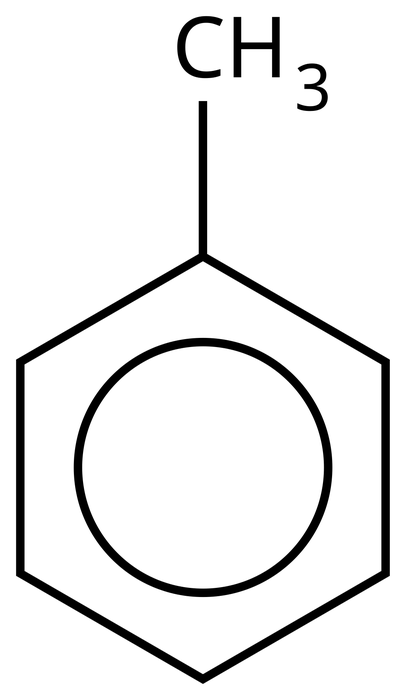
Toluene structural formula.
Credit: Luigi Chiesa / Wikimedia Commons

License: Public domain
Wikimedia-provided PNG rendering of the SVG; whitespace trimmed, no content edits
What it is
Toluene, or methylbenzene, is a volatile organic compound. Its CAS number is 108-88-3. It occurs naturally in crude oil and in the tolu tree, and is produced when gasoline and other fuels are made from crude oil. [1,5]
What it does and why it is used
ATSDR describes toluene as a good solvent, meaning it dissolves other substances, which is why it is used in paints, paint thinners, lacquers, adhesives and some nail polishes. It is also used to make other chemicals, nylon and plastics, and is added to gasoline. [1]
Regulatory status and health context
Canada
Health Canada's residential indoor air quality guideline for toluene sets a short-term (8-hour average) exposure limit of 15 mg/m³, based on headaches, dizziness and feelings of intoxication, and a long-term (24-hour average) limit of 2.3 mg/m³, based on neurobehavioural test results. Its guideline for drinking water is a maximum of 0.06 mg/L. [2,3]
United States
ATSDR's public health summary covers sources, health effects and ways to reduce exposure. It notes that blood and urine tests for toluene are useful only within several days of exposure and cannot predict health problems. [1]
European Union
Under Directive 2009/6/EC, toluene is allowed in nail products at up to 25%, and those products must carry the warnings "Keep out of reach of children" and "To be used by adults only". The EU's scientific committee judged that level safe from a general toxicology point of view but said children's inhalation should be avoided. [4]
Environmental notes
ATSDR says toluene does not usually stay in the environment long. It evaporates from water and soil or is broken down by bacteria, and in air it breaks down quickly. Spills and leaking fuel tanks can contaminate groundwater and soil. [1]
Quick facts
- CAS: 108-88-3. [5]
- Other names: methylbenzene, toluol. [5]
- Main use: solvent in paints, lacquers, glues and some nail products; fuel component. [1]
- Canada indoor air: long-term guideline 2.3 mg/m³; short-term 15 mg/m³. [2]
- Canada drinking water: maximum 0.06 mg/L. [3]
- EU nail products: up to 25%, adult use only. [4]
Sources
All URLs were fetched on 2026-11-10. Source publication dates differ from this draft's review date.
- ATSDR: Toluene, public health summary.
- Health Canada: Residential indoor air quality guideline, toluene.
- Health Canada: Guidelines for Canadian Drinking Water Quality, summary table.
- EUR-Lex: Commission Directive 2009/6/EC amending the cosmetics directive (toluene in nail products).
- PubChem PUG REST: toluene synonyms.