
Skin and personal care Cleaning and laundry
Triclosan: antibacterial claims, human uncertainty and aquatic harm
CAS 3380-34-5. Also known as 5-chloro-2-(2,4-dichlorophenoxy)phenol.
Editorial draft Last reviewed 8 November 2026 About 1142 words
Everyday exposure: where you meet it and how much
Triclosan has been used as a preservative or antibacterial ingredient in personal-care and household products. Health Canada lists examples that may include toothpaste, mouthwash, soaps, cleansers, cosmetics and certain health products. That historical and regulatory list does not establish that every product in those categories still contains it. Check the actual ingredient or active-ingredient panel rather than relying on an old brand reputation. [1,2]
Amount and application matter. Rinsing a wash off skin, using a toothpaste and releasing an ingredient down a drain are different exposure situations. Limits differ across product categories and jurisdictions. A maximum permitted concentration does not tell you the concentration in the product you bought or the amount entering the body. [1,3,4]
Known and suspected harms
These are editorial labels, not formal GRADE scores: Established means recognized under stated conditions; Probable means a likely contribution with uncertainty; Possible means limited or suggestive evidence; Disputed identifies differing interpretations. Where a clinical harm has not been established, the uncertainty is stated rather than filled with speculation.
- Established environmental concern — aquatic organisms: Canada's assessment identifies risk to the environment, including plants and fish, from the quantities of triclosan released. Rinsed-off products can contribute to releases down the drain. This is a real adverse-impact concern even though it does not establish illness in a person using the product. [1]
- Possible — human-health concern under particular combined cosmetic exposures: the EU's 2024 amendment describes safety concerns for certain concentrations, product combinations and age groups, including young children's toothpaste use and mouthwash. These are exposure-specific conclusions; they do not prove that every permitted single use causes endocrine disease. [3]
- Possible but unestablished — harms from prolonged routine consumer-wash use: FDA's 2016 decision reflected manufacturers' failure to provide adequate long-term safety and effectiveness evidence. Missing evidence is not itself proof of a specific injury, but it is a legitimate reason not to assume an added active ingredient provides a net benefit. [2]
Antimicrobial resistance needs especially careful wording. Health Canada's consumer page says its assessment found no evidence that triclosan-containing products cause antimicrobial resistance, and no human-health risk at current exposure levels. The selected sources therefore do not justify stating that using one toothpaste causes resistant infections. This does not turn environmental release into a nonissue or make every potential use acceptable. [1]
Reducing exposure and protecting at-risk groups
For routine hand hygiene, use ordinary soap and water correctly. Both FDA and Health Canada say antibacterial consumer soaps generally are not necessary for effective everyday handwashing; FDA says additional disease protection was not demonstrated for the affected active ingredients. Removing unnecessary triclosan use can reduce a product-related release without abandoning hygiene. [1,2]
If a product is a medicine or dental treatment, ask a pharmacist or dental professional before changing a recommended regimen. Consumer-wash rules should not be used as instructions for healthcare antisepsis, and a rule about one application does not settle every other one. Follow age restrictions and swallowing warnings on oral products. [2–4]
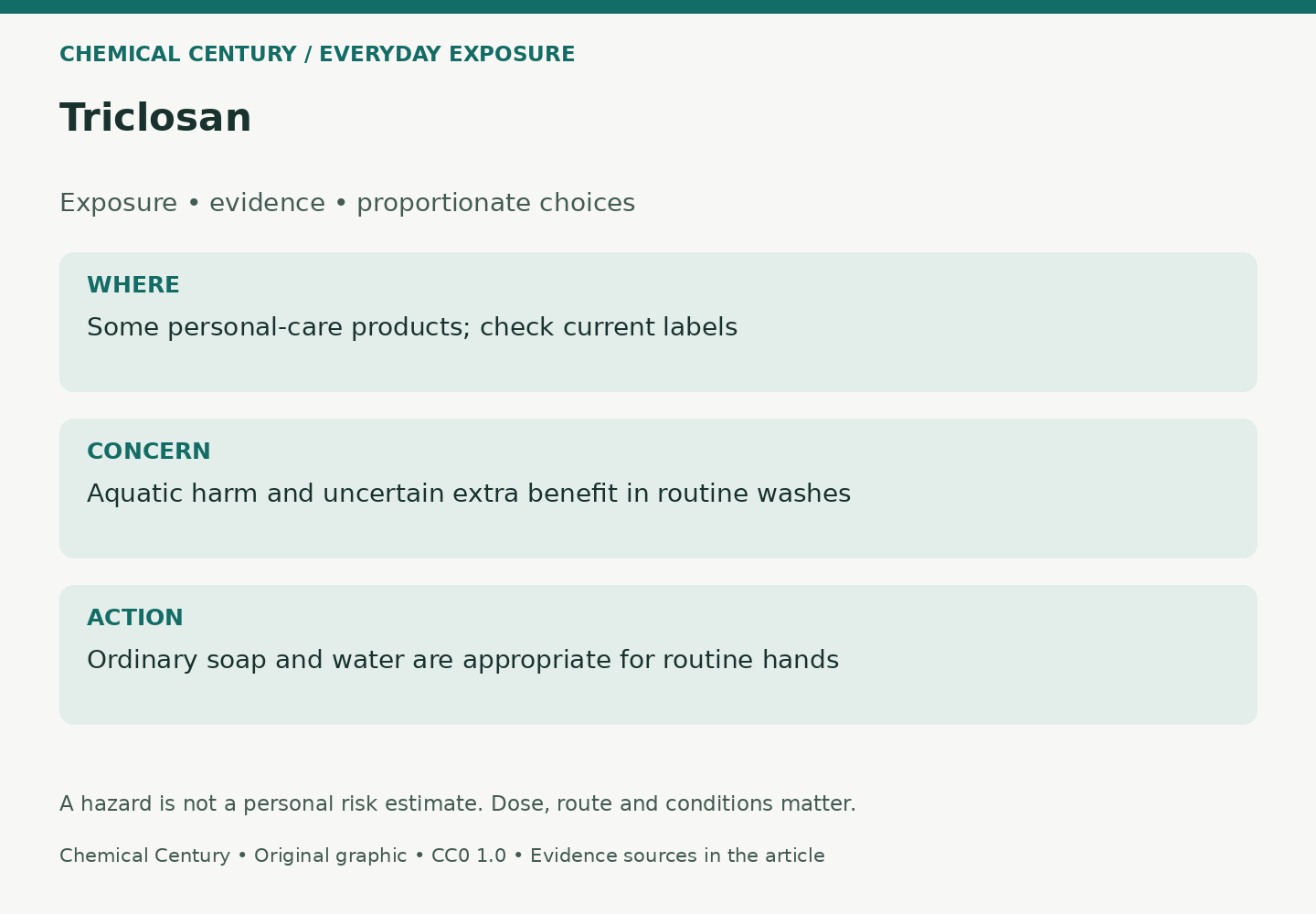
Exposure and evidence guide; not a numerical risk estimate.
Credit: Chemical Century; original graphic
License: CC0 1.0
Data: Data: the sources listed for this article.
What it is
Triclosan is a specific chemical with PubChem-verified CAS 3380-34-5. It is different from triclocarban, another substance discussed in antibacterial-product regulation. Similar names and shared marketing terms do not make their structures, uses or assessments identical. A broad “antibacterial” label also does not establish which active ingredient is present. [2,3,5]
The word “preservative” can refer to protecting a product from microbial growth, whereas an antibacterial wash may make a claim about effects during use. Those purposes should not be silently merged. Canada's product list and the FDA rule show how regulatory treatment depends on both substance and application. [1,2]
What it does and why it is used
Health Canada describes triclosan as able to kill or remove bacteria and inhibit growth of bacteria, fungi and mildew. It can preserve products and help control odours. Those functions explain its use, but an antimicrobial effect does not automatically establish that a routine consumer product prevents more illness than plain soap and water. FDA required evidence for that additional benefit and did not receive the necessary data for the affected washes. [1,2]
This difference between laboratory or preservative function and an actual consumer-health benefit is important. A product can perform a chemical function while still being unnecessary for a particular household task or presenting an environmental cost. The relevant question is not simply whether bacteria can be affected, but whether the specific application is justified. [1,2]
Regulatory status and health context
Canada
Health Canada's triclosan page distinguishes product types and reports limits including 0.3% in cosmetics and natural health products and 0.03% in mouthwashes. The current Cosmetic Ingredient Hotlist adds specific oral-product conditions, including swallowing and age warnings. Its oral entries state that the product is not to be used by children under 12. Do not substitute an older general concentration summary for the actual applicable conditions. [1,4]
Canada's assessment found no human-health risk at current exposures but identified environmental risk. That is not an inconsistency: risks depend on the receiving organism, concentration and exposure route. The conclusion supports targeted controls and reducing unnecessary releases, rather than claiming that everyone exposed has been poisoned. [1]
United States
FDA's 2016 rule removed triclosan and 18 other actives from nonprescription consumer antiseptic wash marketing under that rule. It covers relevant hand and body washes used with water. The cited rule does not cover hand sanitizers, hand wipes or healthcare-setting soaps; it should not be described as a ban on triclosan in every product. Manufacturers lacked necessary evidence of long-term safety and superior effectiveness for the specified routine washes. [2]
European Union
Regulation 2024/996 restricts triclosan preservative use to listed cosmetic applications at the specified maximum, and removes mouthwash use. It also excludes toothpaste intended for children under three and sets associated conditions. Its explanation highlights cumulative exposure from combinations of products, not merely the concentration in one isolated item. These EU provisions differ from Canadian oral-product rules and US consumer-wash regulation. [3]
Environmental notes
The environmental concern is central, not an afterthought. Canada's assessment describes potential effects on aquatic life from releases when products are washed away. It recommends considering ordinary soap and avoiding unnecessary triclosan products, while following responsible-use and disposal instructions. This does not establish that every alternative antimicrobial has a better ecological profile. [1]
Quick facts
- Identity: triclosan, CAS 3380-34-5. [5]
- Established concern: environmental risk to aquatic organisms at assessed releases. [1]
- Human evidence: no current-exposure health risk identified in Canada's assessment. [1]
- Practical priority: proper ordinary handwashing, not unnecessary antibacterial claims. [1,2]
Sources
Fetched 2026-11-08 unless a previously fetched archived source is explicitly identified. Regulations are reported with their scope and dates; this draft is not legal advice.