
Nutrients and supplementsSkin and personal care
Vitamin A (retinol): essential for sight and growth, harmful in high doses, especially in pregnancy
CAS 68-26-8.Also known as retinol, retinyl acetate, retinyl palmitate, preformed vitamin A, and retinoids.
Editorial draft Last reviewed 10 November 2026 About 1060 words
CC INDEX
How it works45/100 Moderate
Vitamin A is essential and deficiency is rare in North America. The score reflects well-established harm from high intakes of preformed vitamin A, above all the risk of birth defects in pregnancy. Most excess comes from supplements and certain medicines, and the EU now caps retinol in cosmetics because skin products can add to total intake.
An editorial summary of this article’s cited evidence. It isn’t medical advice or a personal risk estimate.
Age index
What is the age index?Which age groups are more affected by this chemical’s possible health issues, based on this article’s sources.
- Pregnancy Unborn babies Higher concern
- Infants 0 to 1 Moderate
- Young children 1 to 5 Moderate
- Children 6 to 12 Moderate
- Teens 13 to 19 Moderate
- Adults 20 to 64 Moderate
- Older adults 65 and over Not well studied
- Pregnancy (higher concern): Too much preformed vitamin A can cause birth defects
- Infants (moderate): Lower upper limits
- Young children (moderate): Lower upper limits
- Children (moderate): Lower upper limits
- Adults (moderate): Headache, blurred vision and nausea from excess

Illustration of provitamin A foods and a skin cream. Foods supply beta-carotene; supplements and some creams contain preformed vitamin A.
Credit: Chemical Century; AI-generated illustration
License: CC0 1.0
Illustration, not a photograph of a specific product. Resized and cropped for the web.
Vitamin A helps us see in dim light and supports growth, and most people get enough from eggs, dairy, liver, and colourful fruits and vegetables. Problems usually come from too much of the preformed kind found in some supplements and medicines, which can cause headaches, blurred vision, nausea and dizziness. During pregnancy, high intakes can cause birth defects, so expecting parents are advised to check supplements and medicines carefully, and retinol skin products can add to the total too. Smokers taking high-dose beta-carotene supplements also face a higher lung cancer risk.
Everyday exposure: where you meet it and how much
Vitamin A comes in two kinds. Preformed vitamin A (retinol and its esters) is found in fish, organ meats such as liver, dairy products and eggs. Provitamin A carotenoids, mainly beta-carotene, are found in green leafy, orange and yellow vegetables and fruits, and the body converts some of them into vitamin A. Vitamin A is also added to some foods, such as milk and cereal, and most multivitamins contain it. [1]
Recommended intakes are 900 mcg RAE (retinol activity equivalents) a day for adult men and 700 mcg RAE for adult women. [1,2] Retinol and its esters are also used in skin creams, lotions and other cosmetics as skin-conditioning agents, which can add to total exposure. [3]
Known and suspected harms
Evidence labels are editorial summaries, not individual risk predictions: established means recognized under the stated conditions; probable means a likely contribution with uncertainty; possible means limited evidence; disputed means assessors disagree. These labels do not describe how common an effect is.
- Established — birth defects from too much preformed vitamin A in pregnancy: taking too much preformed vitamin A while pregnant can cause birth defects, including abnormal eyes, skull, lungs and heart. ODS advises people who are or might be pregnant or breastfeeding not to take high-dose preformed vitamin A supplements. [1]
- Established — headache, blurred vision, nausea and dizziness from excess intake: too much preformed vitamin A, usually from supplements or certain medicines, can cause severe headache, blurred vision, nausea, dizziness, muscle aches and problems with coordination. In severe cases it can lead to coma and death. [1]
- Established — higher lung cancer risk with high-dose beta-carotene supplements in smokers: beta-carotene does not cause the same problems as preformed vitamin A; large amounts can turn skin yellow-orange, which is harmless. But studies have found that smokers, former smokers and people exposed to asbestos who take high-dose beta-carotene supplements have a higher risk of lung cancer and death. [1]
- Established — deficiency causes night blindness: the most common sign of deficiency is xerophthalmia, the inability to see in low light, which can lead to blindness if untreated. Deficiency is rare in the US but common in many developing countries, especially among young children. [1]
Reducing avoidable exposure and harm
Stay within the upper limit for preformed vitamin A from all sources: 3,000 mcg a day for adults, and less for children (600 mcg up to age 3, 900 mcg at 4 to 8, 1,700 mcg at 9 to 13 and 2,800 mcg at 14 to 18). The limit does not apply to beta-carotene. [1,2] If you are or could become pregnant, avoid high-dose preformed vitamin A supplements and talk to a clinician before using any. [1] Do not combine vitamin A supplements with acitretin or bexarotene, medicines made from vitamin A, unless your prescriber agrees. The weight-loss drug orlistat can lower vitamin A absorption. [1] In the EU, check cosmetic labels for "Contains Vitamin A. Consider your daily intake before use." [3]
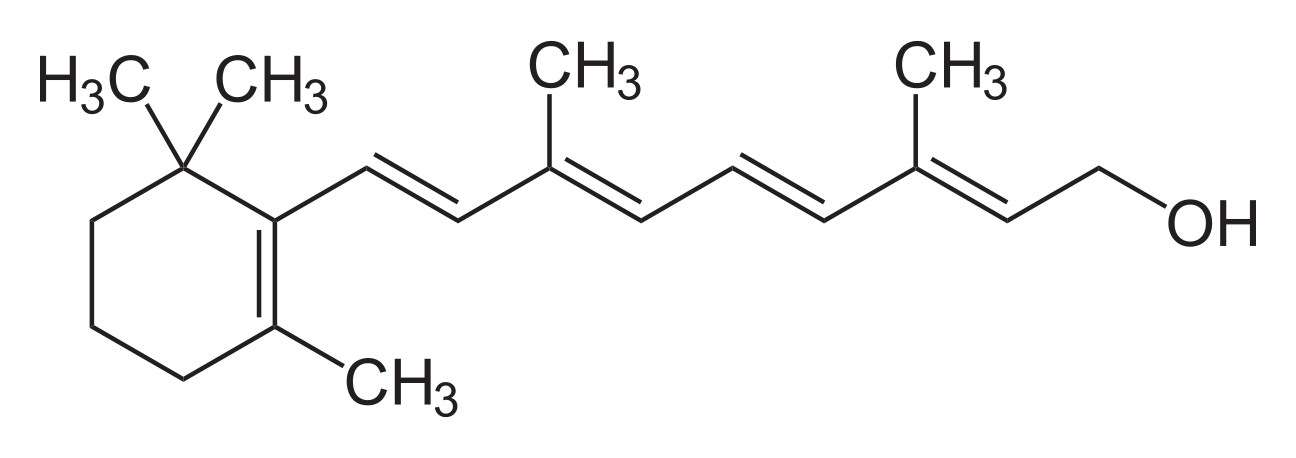
Chemical structure of all-trans retinol.
Credit: NEUROtiker / Wikimedia Commons

License: Public domain
Rendered from SVG to PNG, whitespace trimmed and placed on white
What it is
Vitamin A is a fat-soluble vitamin. Retinol (CAS 68-26-8) is the main preformed form. Supplements usually contain retinyl acetate or retinyl palmitate, beta-carotene, or a mix. [1,3,5]
What it does and why it is used
Vitamin A is important for normal vision, the immune system, reproduction, and growth and development. It also helps the heart, lungs and other organs work properly. [1] In cosmetics, retinol, retinyl acetate and retinyl palmitate are used as skin-conditioning agents. [3]
Regulatory status and health context
Canada
Health Canada's dietary reference intakes set an upper limit for preformed vitamin A of 3,000 mcg a day for adults, including in pregnancy and breastfeeding for those aged 19 and over. The limit applies to preformed vitamin A only; beta-carotene supplements are advised only as a provitamin A source for people at risk of deficiency. [2]
United States
The NIH Office of Dietary Supplements gives the same recommended amounts and upper limits as Canada. It notes that the upper limits do not apply to people taking vitamin A for medical reasons under a doctor's care. [1]
European Union
Commission Regulation (EU) 2024/996 restricts retinol, retinyl acetate and retinyl palmitate in cosmetics to 0.05% retinol equivalent in body lotion and 0.3% in other leave-on and rinse-off products. Any cosmetic containing them must carry the statement "Contains Vitamin A. Consider your daily intake before use". Non-compliant products could not be placed on the market from 1 November 2025 and cannot be made available from 1 May 2027. The rule followed a scientific opinion that cosmetic vitamin A, although a small contribution, may be a concern for the 5% of people with the highest intake from food and supplements. [3] Directive 2002/46/EC lists retinol, retinyl acetate, retinyl palmitate and beta-carotene as forms of vitamin A allowed in food supplements. [4]
Environmental notes
The sources used here do not assess vitamin A as an environmental concern and do not provide data for a rating. [1–4]
Quick facts
- CAS (retinol): 68-26-8. [5]
- Adult upper limit: 3,000 mcg a day of preformed vitamin A. [1,2]
- Main risk: high-dose preformed vitamin A in pregnancy can cause birth defects. [1]
- Beta-carotene: no upper limit set, but high-dose supplements raise lung cancer risk in smokers. [1]
- EU cosmetics: at most 0.3% retinol equivalent, 0.05% in body lotion. [3]
Sources
All URLs were fetched on 2026-11-10. Source publication dates differ from this draft's review date.
- NIH Office of Dietary Supplements: Vitamin A and carotenoids, fact sheet for consumers.
- Health Canada: Dietary reference intakes tables, reference values for vitamins.
- EUR-Lex: Commission Regulation (EU) 2024/996 amending the cosmetics regulation, including vitamin A.
- EUR-Lex: Directive 2002/46/EC on food supplements.
- PubChem PUG REST: retinol synonyms.