
Nutrients and supplementsFood and drink
Vitamin D: an essential nutrient where too little and too much both cause problems
CAS 67-97-0.Also known as vitamin D3, cholecalciferol, vitamin D2, ergocalciferol, and calciferol.
Editorial draft Last reviewed 10 November 2026 About 1057 words
CC INDEX
How it works30/100 Mild
Vitamin D is essential, and Health Canada recommends a daily supplement for many people. Harm comes almost entirely from taking high-dose supplements well above the upper limit for long periods, and the effects at that point can be serious. Sunlight does not cause vitamin D toxicity.
An editorial summary of this article’s cited evidence. It isn’t medical advice or a personal risk estimate.
Age index
What is the age index?Which age groups are more affected by this chemical’s possible health issues, based on this article’s sources.
- Pregnancy Unborn babies Moderate
- Infants 0 to 1 Moderate
- Young children 1 to 5 Moderate
- Children 6 to 12 Moderate
- Teens 13 to 19 Moderate
- Adults 20 to 64 Moderate
- Older adults 65 and over Moderate
- Pregnancy (moderate): Same upper limit as adults
- Infants (moderate): Lower upper limits; breastfed babies need a supplement
- Young children (moderate): Lower upper limits
- Adults (moderate): Toxicity from very high supplement doses
- Older adults (moderate): Daily supplement advised; deficiency weakens bones

Illustration of vitamin D sources, including supplements, fortified milk, fatty fish and eggs.
Credit: Chemical Century; AI-generated illustration
License: CC0 1.0
Illustration, not a photograph of a specific product. Resized and cropped for the web.
Vitamin D supports strong bones, and in places with long, dark winters many people rely on fortified milk, fatty fish or a daily supplement to get enough. Too little can weaken bones over time, but more is not always better: very high supplement doses taken for long periods can cause nausea, confusion and kidney stones. Sunlight itself does not cause vitamin D toxicity. It can also interact with some common medicines, so a quick check with a pharmacist helps when adding a supplement.
Everyday exposure: where you meet it and how much
The body makes vitamin D when skin is exposed to sunlight, and people also get it from food and supplements. Few foods contain it naturally; examples include egg yolks and fatty fish such as salmon, arctic char and rainbow trout. In Canada, most dietary vitamin D comes from fortified foods such as milk, fortified plant-based drinks and soft margarine. [2]
Many factors reduce how much vitamin D the skin makes, including season, time of day, cloud cover, smog, sunscreen, limited time outdoors, older age and darker skin. That is why Health Canada recommends vitamin D from food or a supplement every day. [2] Recommended intakes are 400 IU (10 mcg) a day for infants, 600 IU (15 mcg) for ages 1 to 70 and 800 IU (20 mcg) over age 70. [1,3]
Known and suspected harms
Evidence labels are editorial summaries, not individual risk predictions: established means recognized under the stated conditions; probable means a likely contribution with uncertainty; possible means limited evidence; disputed means assessors disagree. These labels do not describe how common an effect is.
- Established — toxicity from very high supplement doses, with nausea, confusion and kidney stones: very high blood levels of vitamin D (above 375 nmol/L) can cause nausea, vomiting, muscle weakness, confusion, pain, loss of appetite, dehydration, excessive urination and thirst, and kidney stones. Extremely high levels can cause kidney failure, irregular heartbeat and even death. ODS says this almost always comes from supplements; sun exposure does not cause vitamin D toxicity. [1]
- Established — deficiency weakens bones: vitamin D helps the body absorb calcium and build and keep strong bones. In children, deficiency causes rickets, in which bones become soft, weak, deformed and painful. In teens and adults it causes osteomalacia, with bone pain and muscle weakness. [1]
- Established — interactions with some common medicines: ODS gives examples: the weight-loss drug orlistat can reduce vitamin D absorption, cholesterol-lowering statins might not work as well with high-dose vitamin D, steroids such as prednisone can lower vitamin D levels, and thiazide diuretics taken with vitamin D could raise blood calcium too high. [1]
Reducing avoidable exposure and harm
Stay within the upper limit unless a clinician prescribes more. For people aged 9 and older, including during pregnancy and breastfeeding, it is 4,000 IU (100 mcg) a day from all sources. It is lower for younger children: 1,000 IU for infants up to 6 months, 1,500 IU from 7 to 12 months, 2,500 IU for ages 1 to 3 and 3,000 IU for ages 4 to 8. [1,3] Count every product, because multivitamins, single-nutrient supplements and fortified foods add up. Tell your pharmacist about supplements if you take any of the medicines above. [1] Breastfed babies should be given a 400 IU (10 mcg) vitamin D supplement each day, because breast milk alone does not provide enough. [1]
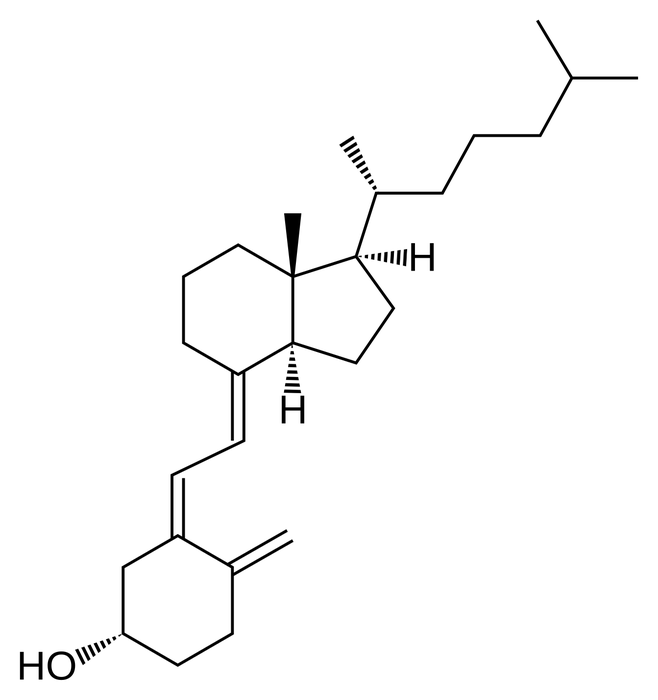
Chemical structure of cholecalciferol (vitamin D3).
Credit: Calvero / Wikimedia Commons

License: Public domain
Rendered from SVG to PNG, whitespace trimmed and placed on white
What it is
Vitamin D is a fat-soluble vitamin. The two main forms in foods and supplements are vitamin D3 (cholecalciferol, CAS 67-97-0) and vitamin D2 (ergocalciferol). [1,5,6] Amounts are given in micrograms (mcg) or international units (IU); for example, 10 mcg is the same as 400 IU. [1]
What it does and why it is used
Vitamin D helps the body absorb calcium and builds and maintains strong bones and teeth. Muscles, nerves and the immune system also need it. [1,2] It is added to some foods and sold as a supplement to prevent deficiency, especially where sunlight is limited for much of the year. [1,2]
Regulatory status and health context
Canada
Health Canada recommends that people aged 2 to 50 eat foods that contain vitamin D every day or take a daily 400 IU (10 mcg) supplement, and that everyone aged 51 and older take a daily 400 IU supplement. When vitamin D is added to a food, it must appear in the nutrition facts table. [2] Canada uses the same upper limits as the US, including 4,000 IU (100 mcg) a day for people aged 9 and over. [3]
United States
The NIH Office of Dietary Supplements sets out the same recommended amounts and upper limits as Canada. It notes that most people in the US have adequate blood levels, but almost one in four have levels that are too low or inadequate for bone and overall health. Health care providers sometimes recommend doses above the upper limit for a period to treat deficiency. [1]
European Union
EFSA reviewed its upper level in 2023 and kept it at 100 mcg a day for adults, with a conversion factor added for another vitamin D form. EFSA concluded that European populations are unlikely to exceed the upper level, except for regular users of food supplements containing high doses of vitamin D. [4] Directive 2002/46/EC lists cholecalciferol and ergocalciferol as forms of vitamin D that may be used in food supplements. [5]
Environmental notes
The sources used here do not assess vitamin D as an environmental concern and do not provide data for a rating. [1–5]
Quick facts
- CAS (vitamin D3): 67-97-0. [6]
- Daily recommended amount: 600 IU (15 mcg) for ages 1 to 70; 800 IU (20 mcg) over 70. [1,3]
- Upper limit from age 9: 4,000 IU (100 mcg) a day. [1,3,4]
- Toxicity: almost always from supplements, never from sunlight. [1]
- Breastfed infants: 400 IU a day as a supplement. [1]
Sources
All URLs were fetched on 2026-11-10. Source publication dates differ from this draft's review date.
- NIH Office of Dietary Supplements: Vitamin D, fact sheet for consumers.
- Health Canada: Vitamin D.
- Health Canada: Dietary reference intakes tables, reference values for vitamins.
- EFSA: Dietary reference values (topic page).
- EUR-Lex: Directive 2002/46/EC on food supplements.
- PubChem PUG REST: cholecalciferol synonyms.