
Bisphenol A: packaging exposure and disputed health risks
CAS 80-05-7. Also known as BPA and 4,4′-isopropylidenediphenol.
Editorial draft Last reviewed 8 November 2026 About 1035 words
Everyday exposure: where you meet it and how much
Bisphenol A, usually shortened to BPA, has been used to make hard, clear polycarbonate plastic and epoxy resins. Everyday encounters can include some reusable food containers and the protective linings of metal food and drink cans. These examples do not mean every plastic bottle or can contains BPA. Health Canada also lists thermal receipts, showing why a food-packaging article cannot account for every source of exposure. [1,3]
Small amounts can migrate from food-contact materials into food. The amount reaching someone depends on the material, its use and how much of the food is consumed. An ingredient name, recycling symbol or photograph cannot establish a personal daily dose. The main regulatory disagreement concerns how evidence about biological effects should be translated into risk at these dietary exposures. [1–4]
Known and suspected harms
Evidence labels here are editorial summaries, not formal GRADE ratings or predictions about an individual. Established means recognized under specified conditions; Probable means a likely contribution with uncertainty; Possible means limited or suggestive evidence; Disputed identifies disagreement between assessments. A regulatory decision is not itself a disease diagnosis.
- Established experimental finding, not established ordinary-dose human harm: BPA can have estrogen-related biological effects. FDA's discussion distinguishes effects at higher experimental doses from findings at lower doses, and emphasizes that oral metabolism differs from injection exposure. It would be misleading to translate any hormone activity into proof that a particular container causes infertility. [3]
- Possible — immune-system harm: EFSA's 2023 assessment identified an increase in a type of immune cell, the T-helper cell, as a sensitive endpoint. Such changes could contribute to allergic inflammation or autoimmune problems. These findings helped support EFSA's concern; they are not direct measurements of autoimmune disease caused by a household package. [2]
- Possible — reproductive, developmental and metabolic effects: EFSA considered these additional endpoints in its assessment. The type of study, dose and uncertainty matter; the assessment does not establish that every low-level exposure produces a clinical effect. [2]
- Disputed — safety of current dietary exposure: EFSA concluded that estimated dietary exposure raised concern across age groups. Health Canada's consumer guidance and FDA's published food-contact position reach different conclusions. Their existence should not be erased to make the story uniformly reassuring or alarming. [1–3]
Reducing exposure and protecting at-risk groups
Use only containers intended for food, and follow heating and storage directions. Health Canada recommends suitable glass or food-grade, microwave-safe plastic for microwaving, and avoiding visibly damaged, stained or unpleasant-smelling containers. Choosing suitable glass for heating is a practical ingredient-avoidance option, not a proven percentage reduction in disease risk. [1,5]
For older baby bottles, Health Canada suggests looking for a polycarbonate or “PC” marking alongside the relevant recycling identification and contacting the manufacturer when uncertain. A number alone is not a laboratory result. Do not improvise infant feeding practices or stop using necessary equipment without a safe replacement. Canadian baby-bottle restrictions are described below. [1]
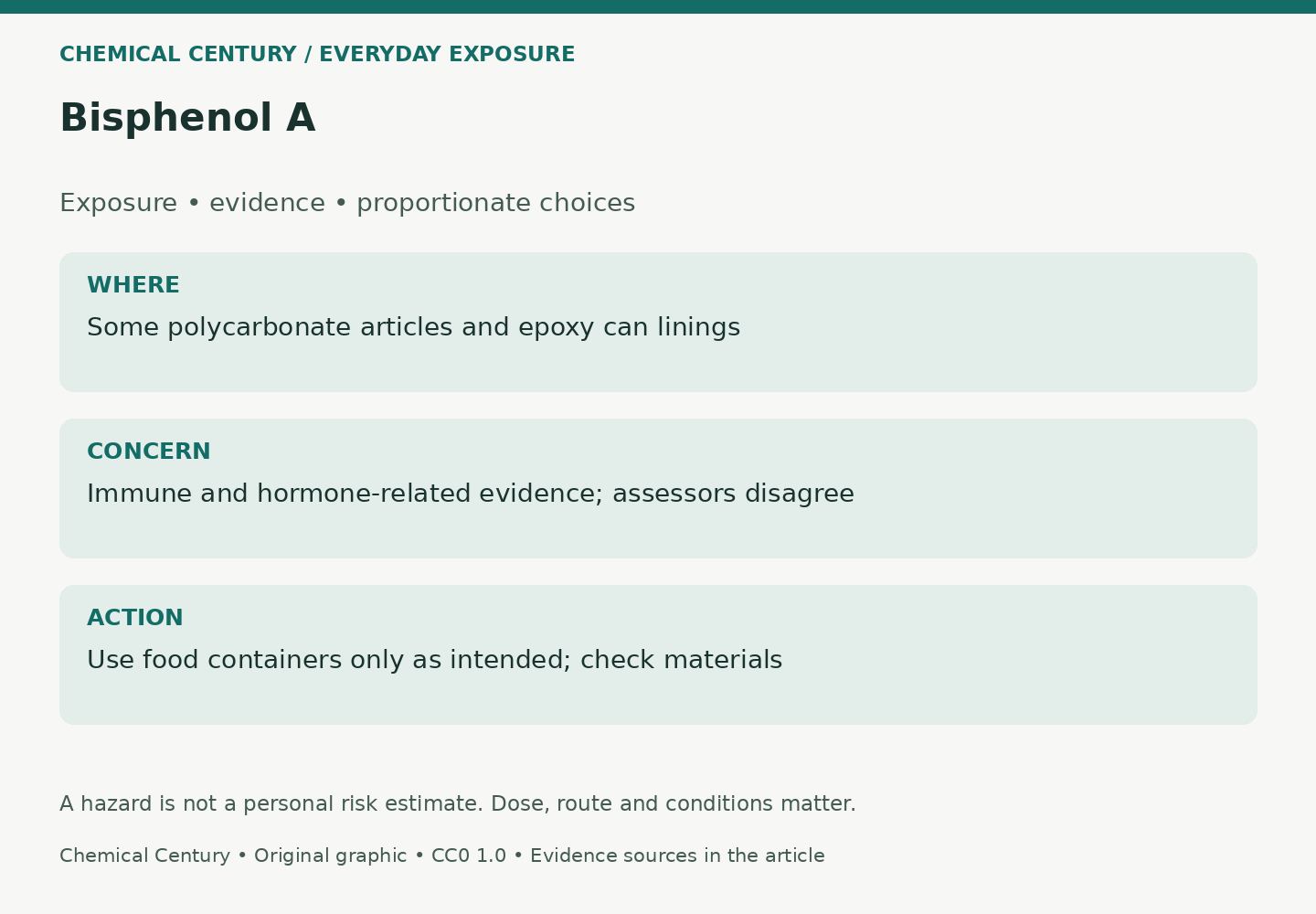
Exposure and evidence guide; not a numerical risk estimate.
Credit: Chemical Century; original graphic
License: CC0 1.0
Data: Data: the sources listed for this article.
What it is
BPA is one specific bisphenol, with CAS number 80-05-7, verified in the fetched PubChem synonyms record. “Bisphenols” describes a broader family, not several names for the same molecule. BPS or BPF is not automatically BPA, and a label excluding BPA does not establish the identity or safety of every substitute. [4,6]
What it does and why it is used
Polycarbonate provides a hard, transparent material. Epoxy coatings help keep food from directly contacting metal can surfaces. These functional benefits explain why BPA became common in food-contact systems; they do not settle its toxicology. Replacing a formulation also requires maintaining packaging performance and food safety, a consideration explicitly discussed in the EU regulation. [3,4]
Regulatory status and health context
Canada
Health Canada says it is illegal to manufacture, import, advertise or sell polycarbonate baby bottles containing BPA. It also reports working with industry to phase out BPA-containing liquid infant-formula packaging. Its consumer guidance retains the conclusion that exposure from food packaging does not pose a health risk to Canadians, including infants, while monitoring and gathering broader bisphenol information continue. This is not a ban on all food-contact BPA. [1]
United States
FDA's published BPA position supports the safety of currently approved food-contact uses. The detailed assessment page is dated and describes research available at that time; it should not be presented as a new 2026 clinical trial. FDA removed authorizations for BPA-based baby bottles, sippy cups and infant-formula packaging after those uses were abandoned. The agency explicitly distinguishes abandonment-based regulatory changes from a finding that those uses were unsafe. [3]
European Union
Regulation 2024/3190 adopted a broad BPA prohibition for specified food-contact materials, with limited derogations and transition arrangements. The original general transition ran to July 2026; certain packaging and professional equipment have longer provisions. Packaged-food stocks and filling rules mean “banned in 2024” does not mean every relevant item disappeared immediately. The regulation also addresses certain other hazardous bisphenols, rather than treating all substitutes as automatically acceptable. [4]
EFSA's 2023 tolerable daily intake is 0.2 nanograms/kg body weight/day, far below its previous temporary value. EFSA compared that benchmark with earlier exposure estimates and acknowledged that intervening restrictions may have reduced intake. A benchmark exceedance signals a reason for protection; it does not calculate whether one individual will become ill. [2]
Environmental notes
These selected sources primarily address food-contact exposure and regulation. They do not support a numerical environmental ranking of a BPA-containing container versus every alternative. No such ranking is assigned. Packaging's chemical safety and its overall environmental footprint require related but separate assessments.
For the wider migration context, see Plastics in food packaging.
Quick facts
- Identity: BPA; CAS 80-05-7. [6]
- Encounter: some polycarbonate articles and epoxy can linings. [1,3]
- Possible harms: immune, reproductive and metabolic effects under assessment. [2]
- Central dispute: interpreting low-dose evidence and dietary risk. [1–3]
- Practical focus: use appropriate food containers as directed. [1,5]
Sources
Fetched 2026-11-08 unless a previously fetched archived source is explicitly identified. Regulations are reported with their scope and dates; this draft is not legal advice.