
Topic Plastics & packaging Food and drink
Plastics in food packaging: what leaches into food and what the evidence says
Also known as food contact materials, migration, packaging chemicals, and microplastics.
Editorial draft Last reviewed 8 November 2026 About 1265 words
Everyday exposure: more than the wrapper
Food can contact plastics during preparation, processing, storage and reheating. Certain chemicals can move from a material into food, a process called migration. The migrant may be an ingredient used to make the material rather than the bulk plastic itself. BPA, for example, has been used in polycarbonate and in resins lining metal cans. Paper packaging can also have chemical coatings. “Plastic-free” appearance therefore does not identify every food-contact substance. [2,4,9]
A chemical's presence in packaging does not reveal how much reaches a meal. Assessments need the material's composition, the food, contact time and temperature, migration measurements and toxicology. A hazard at one dose or in one laboratory system is not a measured disease risk from every packaged lunch. Nor does regulatory permission mean that every uncertainty has been resolved. [2,3]
Known and suspected harms
The evidence labels below are editorial summaries, not formal GRADE scores or individual risk estimates. Established means recognized under the specified conditions; probable means a likely contribution with uncertainty; possible means limited or suggestive evidence; disputed identifies disagreement about interpretation.
- Established experimental hazard; possible human effects at packaging-related exposure: certain phthalates can interfere with fetal testosterone and reproduction in animal studies. EFSA used these findings to group DBP, DEHP and related compounds in its 2019 assessment. That establishes a toxicological concern, not proof that an ordinary food container causes infertility. Estimated dietary exposures in that assessment were below its temporary group threshold, and packaging's precise contribution could not be established. [7]
- Possible/disputed dietary BPA harm: EFSA identified immune-system effects, including changes in T-helper cells, as the basis of its 2023 concern; it also considered reproductive, developmental and metabolic findings. These are not direct counts of autoimmune disease caused by packaging. Health Canada's consumer guidance retains a different risk conclusion for food-packaging exposure. The disagreement should remain visible. [3,4]
- Possible, substance-dependent PFAS health effects: Health Canada identifies potential effects on immune, reproductive and developmental systems and organs including liver and thyroid. This is not evidence that every PFAS has identical toxicity or that a particular wrapper caused disease. Multiple environmental and product sources contribute exposure. [8,9]
- Possible but unquantified particle harm: microplastics and nanoplastics have been reported in foods and human samples. FDA says present evidence does not demonstrate a human-health risk at levels detected in foods. Detection alone does not establish causation or a personal risk estimate. [10]
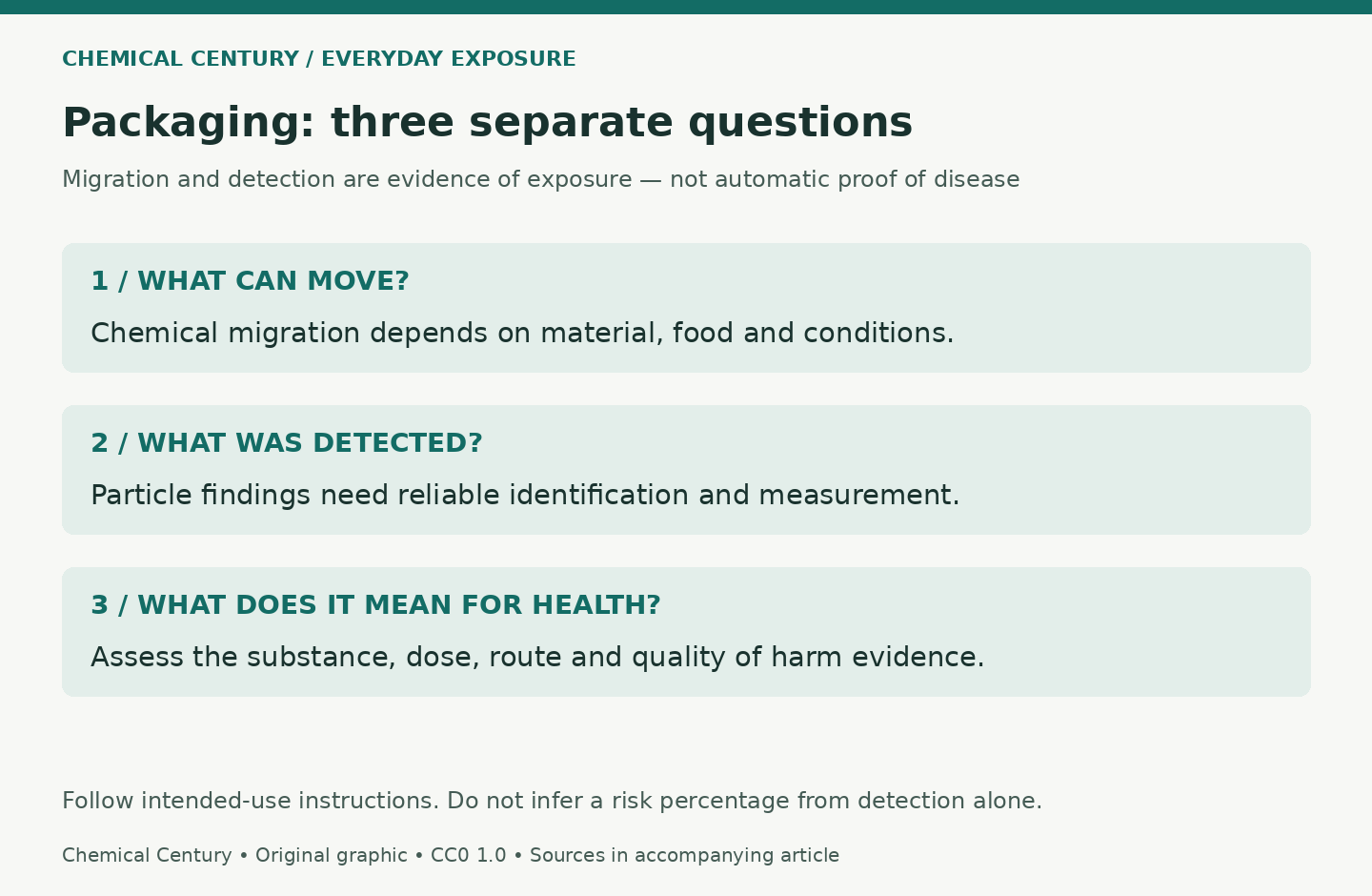
A detection result is not by itself a disease-risk estimate.
Credit: Chemical Century; original diagram
License: CC0 1.0
Data: Data: Health Canada migration guidance [1,2,13]; FDA particles assessment [10]
Heat, microwaves, fat and acidity
Health Canada warns that additives such as plasticizers and colourants can transfer into food, especially at high temperatures. Microwaving is relevant because it heats food and its container; it is not evidence that every microwave-safe plastic becomes dangerous. Use only containers, lids and wraps suitable for that purpose, and follow instructions. Packaging designed for cold storage should not automatically be treated as cookware. [1,11]
Food composition matters too. A fat-soluble plasticizer suitable for refrigerated aqueous food may be unsuitable for hot fatty food, as Health Canada's recycled-plastics guidance explains. Acidity is another condition assessed using appropriate food simulants. This does not mean all acidic foods extract every chemical more strongly: the interaction depends on the material and migrant. Time, temperature and food type must be assessed together, not turned into a universal “leaching multiplier.” [2,13]
Endocrine disruption is not a single plastic effect
Bisphenols and some phthalates raise hormone-related concerns, but they are distinct substances with different evidence. EU rules address BPA and certain other bisphenols with specified hazardous classifications; the regulation specifically discusses BPS's reproductive-hazard classification. A “BPA-free” claim therefore answers one ingredient question, not whether every substitute has been adequately assessed. It does not prove that BPS or BPF is present either. [6,7]
PET illustrates why specificity matters. Germany's BfR says orthophthalate plasticizers are not used to manufacture PET bottles; the word “terephthalate” does not make PET the same as those plasticizers. Antimony compounds can be manufacturing catalysts. BfR reports measured antimony in mineral water far below the applicable migration limit, providing no indication of health impairment in that context. This does not support describing every PET bottle as an established endocrine hazard. [14]
What regulators have actually done
European Union: the Commission adopted the BPA food-contact ban in December 2024 through Regulation 2024/3190. The original regulation entered into force in January 2025, with a general transition to July 2026 and longer periods for specified applications. Certain single-use packaging has a January 2028 deadline; existing stock and filling provisions mean not every BPA-containing package disappeared at once. Limited derogations also exist. The regulation targets specified materials and hazardous bisphenols, not all plastics indiscriminately. [5,6]
Canada: manufacturing, importing, advertising or selling BPA-containing polycarbonate baby bottles is illegal. Health Canada also reports an industry phase-out of BPA-containing liquid infant-formula packaging. Its consumer page says food-packaging BPA exposure does not pose a health risk to Canadians while monitoring and broader bisphenol information gathering continue. That narrower Canadian position should not be silently replaced with EFSA's conclusion. [4]
For PFAS, Canada's March 2025 approach proposes phased prohibitions, with consumer food packaging among Phase 2 uses. It excludes fluoropolymers for separate assessment. The document describes proposed actions and future consultations, not an already-completed ban on every PFAS package. Existing controls on PFOS, PFOA and certain other groups have exemptions. Status and implementation dates need rechecking before publication or a purchasing decision. [8,9]
Particles, oligomers and the remaining blind spots
Dissolved migrating chemicals are different from microplastic particles. FDA highlights inconsistent particle definitions, sampling and measurement methods, especially for nanoplastics. Its page also says evidence is insufficient to establish migration of packaging-derived particles into food and beverages. Findings in blood or organs do not by themselves identify a food wrapper as their source. These uncertainties are reasons for better research, not proof of harmlessness or of inevitable harm. [10]
Packaging assessments also consider impurities and reaction or degradation products, often discussed as non-intentionally added substances, or NIAS. Oligomers belong in the research inventory, but neither “NIAS” nor “microplastics” identifies one molecule with one CAS number. Assessment requires identifying the actual substance, exposure and evidence; a category name cannot supply a universal toxicity verdict. [2,12]
Practical ways to reduce avoidable exposure
Use suitable glass for microwave reheating if you prefer to avoid heating plastic, while following the cookware's directions. Do not microwave unsuitable take-out trays or reuse single-use meal packaging as permanent cookware. Avoid visibly damaged, stained or unpleasant-smelling plastic containers. Store food only in containers intended for food contact. These steps follow Health Canada's guidance; they are not proven disease-prevention percentages. [1,4,11]
Ask manufacturers about unclear materials rather than guessing from appearance or a recycling number. For PFAS, local drinking-water and fish advisories may matter more than focusing exclusively on packaging. Keep food refrigerated and heated safely: reducing one possible chemical exposure should not create a food-poisoning risk. [4,8,11]
Sources
Fetched 2026-11-08; original regulatory documents are dated, not a substitute for consolidated legal advice.
- Health Canada: Safe use of cookware.
- Health Canada: Food packaging submission requirements.
- EFSA: BPA food health risk, 2023.
- Health Canada: Bisphenol A.
- Commission: BPA ban adoption, December 2024.
- Regulation (EU) 2024/3190, particularly Articles 3–5 and 11–14.
- EFSA 2019 phthalate assessment, archived full-text PDF, DOI: 10.2903/j.efsa.2019.5838. Publisher access failed; this fetched archived copy was used.
- Health Canada: PFAS and your health.
- ECCC/Health Canada: PFAS risk management approach, March 2025.
- FDA: Microplastics and Nanoplastics in Foods.
- Health Canada: Food safety tips for microwaves.
- EU Regulation 10/2011: impurities, reaction/degradation products and NIAS.
- Health Canada: Recycled plastics—secondary recycling considerations.
- BfR: PET bottles—no indication of health risk, May 2025.