
Plastics & packaging Household materials
PFAS: food wrappers, nonstick cookware and real exposure differences
Also known as per- and polyfluoroalkyl substances and forever chemicals.
Editorial draft Last reviewed 8 November 2026 About 1063 words
Everyday exposure: where you meet it and how much
PFAS means per- and polyfluoroalkyl substances, a large family used for properties such as resistance to oil, water and grease. Food-related encounters have included grease-resistant paper packaging, some nonstick cookware and processing equipment. PFAS also reach people through drinking water, food, dust and other products. A photograph of a wrapper cannot determine whether it contains PFAS or identify someone's dose. [1,2,4]
An important distinction is often lost: a small, mobile PFAS is not the same material as a highly polymerized coating bonded to cookware. FDA describes negligible migration from authorized nonstick coatings made using the specified high-temperature manufacturing process. This does not mean every PFAS exposure is negligible, or that overheating cookware is harmless. It means that packaging and cookware require different exposure assessments. [3,4]
Known and suspected harms
These are editorial labels, not formal GRADE scores: Established means recognized under stated conditions; Probable means a likely contribution with uncertainty; Possible means limited or suggestive evidence; Disputed identifies differing interpretations. Formal IARC classifications are reported separately and do not quantify risk from a meal.
- Established carcinogenic hazard for PFOA, not for the entire family: IARC classified PFOA as Group 1 in 2023, based on sufficient animal evidence and strong mechanistic evidence, including in exposed people. Human cancer evidence was limited for kidney and testicular cancers. Group 1 does not calculate the risk from using a particular pan. [8]
- Possible carcinogenic hazard for PFOS: IARC classified PFOS as Group 2B, with strong mechanistic evidence, limited animal evidence and inadequate human cancer evidence. It is incorrect to assign PFOA's classification to PFOS or every fluoropolymer. [8]
- Possible, substance-dependent organ and immune effects: Health Canada identifies potential effects involving liver, kidney, thyroid, metabolism, immunity, development and reproduction. The strength and applicability of evidence differ across substances. A class-wide concern is not proof that every member causes every listed effect at household exposure. [1]
- Established hazard under overheating conditions: Health Canada warns that overheated nonstick cookware can produce irritating or poisonous fumes. This is a heat-related inhalation issue, distinct from low migration during intended food-contact use. [3]
Reducing exposure and protecting at-risk groups
Do not preheat an empty nonstick pan or use it at excessive heat. Health Canada recommends staying below 260°C/500°F for nonstick cookware and using kitchen ventilation. Follow the manufacturer's instructions rather than assuming that every coating tolerates the same use. Choosing another suitable cooking material is an option, but does not establish that a previous pan caused illness. [3]
For PFAS more generally, follow local drinking-water, fishing and hunting advisories. Health Canada notes that most consumer products do not have to disclose every ingredient, so asking manufacturers can be more informative than assuming an unlabelled package is PFAS-free. Do not let a packaging discussion distract from a known contaminated-water exposure or occupational controls. [1,8]
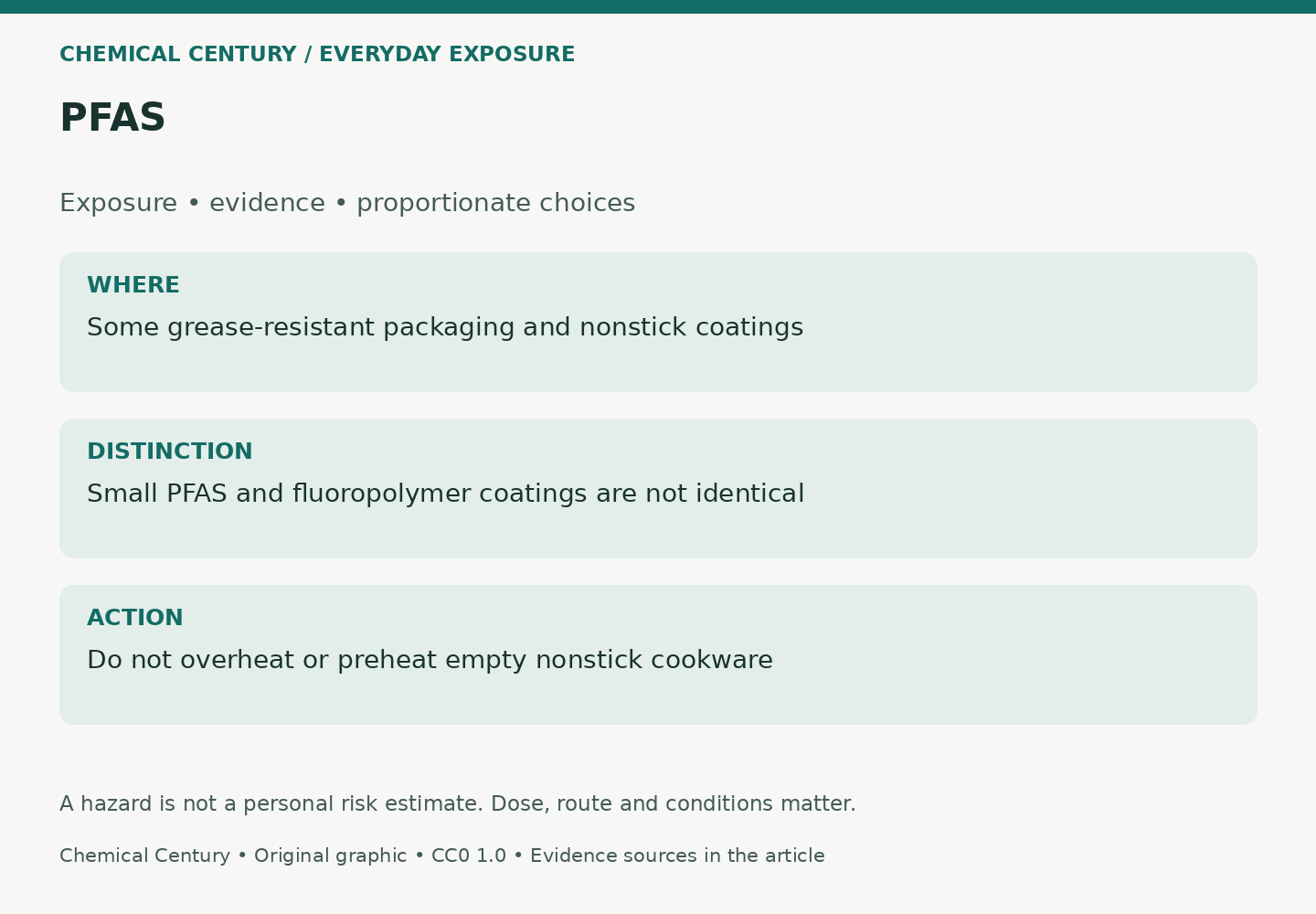
Exposure and evidence guide; not a numerical risk estimate.
Credit: Chemical Century; original graphic
License: CC0 1.0
Data: Data: the sources listed for this article.
What it is
There is no single CAS number for PFAS. PubChem verifies 335-67-1 for the representative substance PFOA; that number is not the identity of PFOS, PTFE or the whole class. Canada's recent class assessment explicitly excludes fluoropolymers for separate consideration. This exclusion concerns assessment scope, not an automatic certificate of safety or harm for every polymer. [1,2,7]
“Forever chemicals” refers to the persistence of these substances or their persistent transformation products. It is a useful warning about environmental longevity, but it does not describe an identical biological lifetime, migration rate or potency for thousands of different chemicals. Product structure and manufacturing conditions remain important. [1,2,4]
What it does and why it is used
Grease-resistant treatments help stop oils soaking into paper, while nonstick coatings help food release from cookware. FDA distinguishes those applications from processing-equipment gaskets and manufacturing aids. Its food-contact discussion identifies paper grease-proofers as the application presenting potential dietary safety concern, rather than treating all uses as equivalent. [2,4]
The persistence that makes many PFAS useful also creates difficulty when they are released. Canada's approach seeks to reduce emissions and exposure across a substance's life cycle, not merely replace one familiar acronym with an inadequately characterized alternative. [2]
Regulatory status and health context
Canada
Controls already apply, with exemptions, to PFOS, PFOA and certain long-chain perfluorocarboxylic acids, their salts and precursors. The March 2025 class approach proposes phased prohibitions: firefighting foams first, then selected consumer uses including food packaging, followed by uses needing more evaluation. These are described as proposals with future implementation work, not a completed universal packaging ban. Fluoropolymers are outside that assessment. [1,2]
United States
FDA announced in 2024 that PFAS grease-proofing substances for paper and paperboard were no longer being sold by manufacturers into the US market. In January 2025 it determined that 35 related food-contact notifications were no longer effective because the uses were abandoned. This is not a ban on every fluoropolymer cookware coating: other specified food-contact applications have a different status and exposure profile. [4]
European Union
From 12 August 2026, EU packaging rules restrict placing food-contact packaging on the market when PFAS meet or exceed specified concentration thresholds. The Commission's implementation announcement and Regulation 2025/40 distinguish this packaging measure from the wider PFAS debate. It should not be described as an immediate ban on every PFAS use in every household product. [5,6]
Environmental notes
Persistence, mobility and environmental accumulation are central reasons for class-based action. Canadian authorities identify release pathways through manufacture, use, waste and disposal. A product's negligible direct migration under intended use does not settle its environmental effects during production or at end of life. Conversely, persistence alone does not supply a numerical cancer risk from a cooked meal. [1,2,4]
See Plastics in food packaging for chemical migration versus particle detection.
Quick facts
- Identity: class; PFOA is only one member. [1,7]
- Cancer classifications: PFOA Group 1; PFOS Group 2B, not all PFAS. [8]
- Practical priority: intended cookware use and credible local exposure advisories. [1,3]
- Key uncertainty: substance-specific exposure and toxicity across the class. [1,2]
Sources
Fetched 2026-11-08 unless a previously fetched archived source is explicitly identified. Regulations are reported with their scope and dates; this draft is not legal advice.
- Health Canada: PFAS and health.
- ECCC/Health Canada: March 2025 PFAS approach.
- Health Canada: Cookware and nonstick coatings.
- FDA: Authorized PFAS food-contact uses.
- European Commission: Packaging rules applying August 2026.
- EU Regulation 2025/40: packaging.
- PubChem PUG REST: perfluorooctanoic acid synonyms.
- IARC: PFOA/PFOS cancer hazard evaluation, 2023.