
Phthalates: DEHP, flexible plastics and reproductive concerns
CAS 117-81-7. Also known as DEHP and bis(2-ethylhexyl) phthalate.
Editorial draft Last reviewed 8 November 2026 About 1072 words
Everyday exposure: where you meet it and how much
Phthalates are a family of chemicals, not one ingredient. Some soften plastics; others have different functions. Health Canada lists possible encounters in household materials, personal-care products, electronics, children's products and some food packaging. Exposure can also occur through indoor air, dust, water and food. A flexible object does not identify which phthalate it contains, and a class-level product list does not mean that every example contains DEHP. [1]
This article uses bis(2-ethylhexyl) phthalate, or DEHP, as the lead substance because its reproductive effects and regulatory history are particularly important. Its PubChem-verified CAS number is 117-81-7. That number identifies DEHP, not every phthalate. Questions about the family need both substance identity and actual exposure conditions. [1,3,5]
Individual intake cannot be inferred from a recycling symbol or one food label. EFSA's 2019 food assessment estimated combined dietary exposures but could not establish how much came specifically from plastic food-contact materials. Food, packaging and the broader environment therefore should not be treated as interchangeable source measurements. [3,4]
Known and suspected harms
These labels are editorial summaries: Established means recognized under stated conditions; Probable means a likely contribution with uncertainty; Possible means suggestive or limited evidence; Disputed flags differing interpretations. They are not formal GRADE scores, and a hazard label does not predict an individual's outcome.
- Established experimental reproductive hazard: DEHP, DBP and BBP share evidence involving reduced fetal testosterone and reproductive effects in animal studies. EFSA used a common mechanism to derive a temporary group intake benchmark. These are meaningful toxicological findings, but not proof that touching one flexible product causes reproductive injury. [3,4]
- Possible — human harm from particular combined exposures: risk depends on dose, timing and the mixture of substances. The group assessment includes relative potencies rather than assuming every phthalate is equally potent. The uncertainty concerns translating the evidence into specific human exposure scenarios, not whether the animal evidence exists. [3,4]
- Regulatory finding, not a clinical evidence grade — DEHP versus the class: Health Canada identifies DEHP as harmful to health and the environment under its assessments. It says most assessed phthalates do not pose a risk at current exposures. A legal assessment and an individual clinical diagnosis answer different questions. [1]
DINP illustrates an important distinction. EFSA included it conservatively in the reproductive group because of fetal-testosterone findings, while recognizing liver effects at lower doses. DIDP was assessed separately on liver effects. Replacing these details with “all phthalates disrupt hormones equally” would misrepresent the assessment. [3,4]
Reducing exposure and protecting at-risk groups
Health Canada recommends checking product information, choosing phthalate- or PVC-free options when appropriate, and asking manufacturers when composition is unclear. Its child-specific advice is concrete: keep soft PVC articles not intended for children out of reach, and do not let children suck or chew them. These are reasonable exposure-reduction measures, not guarantees against future disease. [1]
For food-contact products, use conditions matter. A material assessed for a particular food or repeated-use application should not automatically be repurposed for another. EU restrictions on DEHP explicitly distinguish non-fatty-food applications and technical-support uses. Concern about an additive should not lead someone to reject necessary medical care: Canada's approach includes managing DEHP in medical devices, not a general instruction for patients to remove devices themselves. [1,4]
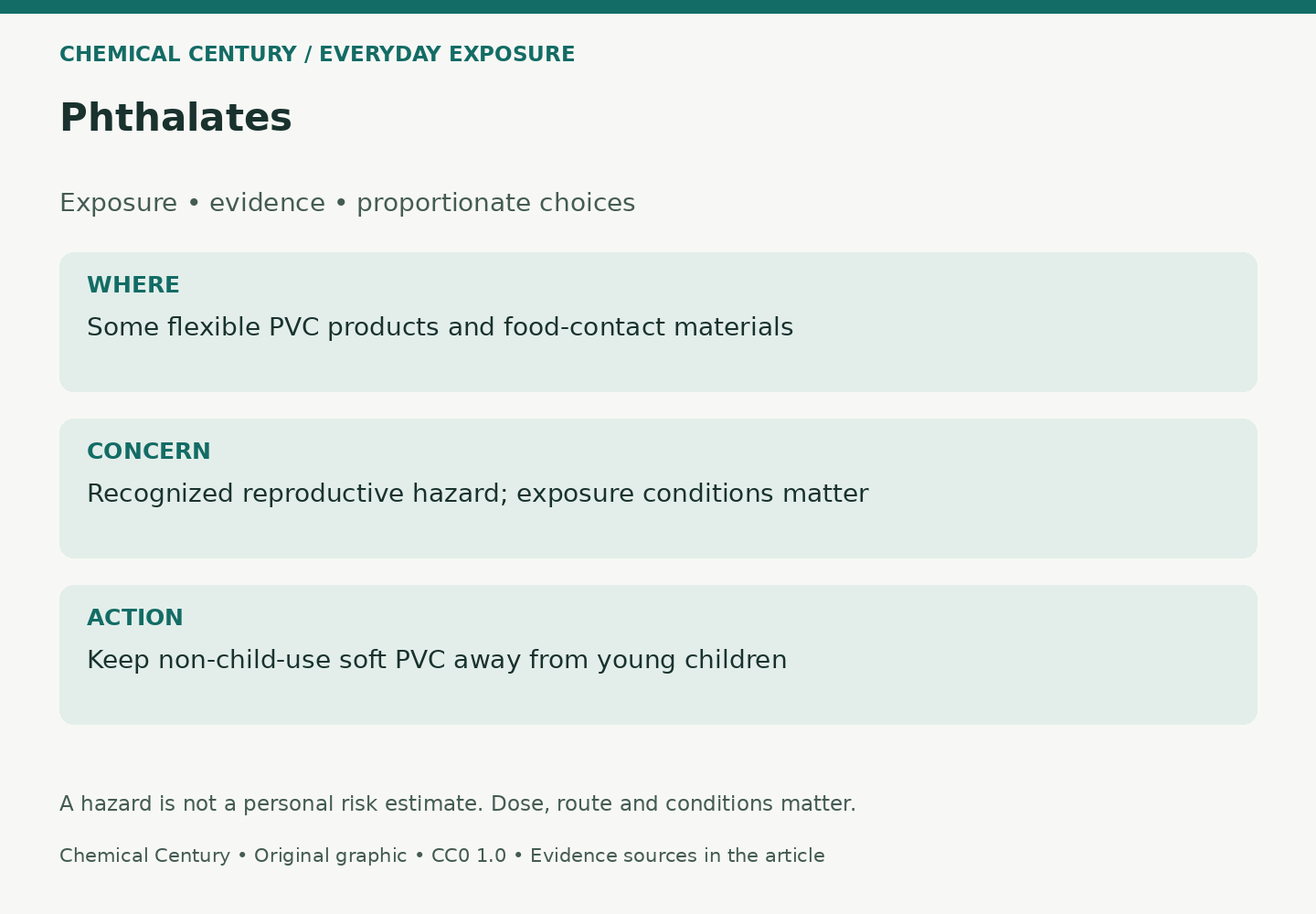
Exposure and evidence guide; not a numerical risk estimate.
Credit: Chemical Century; original graphic
License: CC0 1.0
Data: Data: the sources listed for this article.
What it is
DEHP is one chemical within the phthalate family and is also called di(2-ethylhexyl) phthalate. Abbreviations such as DBP, DINP and DIDP identify other materials, not synonyms for DEHP. PubChem's fetched record verifies the lead identity; a class article still needs substance-by-substance checking before making claims about substitutes. [3,5]
The practical distinction is between a chemical hazard, its presence in a material and the amount reaching the body. Evidence for one of those steps does not fill in the others. EFSA's inability to isolate packaging's contribution shows why assigning a precise “dose per wrapper” without product data would be unjustified. [3]
What it does and why it is used
Plasticizers soften materials and increase flexibility. FDA also describes historical phthalate use in minor food-contact applications, including adhesives, lubricants and sealants. They are not authorized to be deliberately added directly to food under the food-contact permissions discussed here. A packaging use and a food ingredient use are different regulatory questions. [1,2]
Regulatory status and health context
Canada
Health Canada describes action following its earlier DEHP assessment: banning it in cosmetics, managing medical-device uses, and regulating it in vinyl children's toys and child-care articles. The same page continues to distinguish DEHP from other assessed phthalates. These measures should not be rewritten as either “Canada banned every phthalate” or “all flexible products are proven safe.” [1]
United States
FDA's page, updated in June 2026, describes nine phthalates permitted for food-contact applications: eight plasticizers and one monomer. Its review continues. The 2022 revocation of 23 phthalate authorizations followed abandonment of those uses; it was not a blanket withdrawal of DEHP or every phthalate. Regulatory review and remaining permissions must both be reported. [2]
European Union
Regulation 2023/1442 tightened conditions and migration controls for phthalates in plastic food-contact materials. For example, its DEHP entry limits plasticizer use to repeated-use articles contacting non-fatty foods and sets conditions for technical-support uses. Group migration restrictions address combined exposure. This is conditional authorization with restrictions, not permission for every polymer, food or concentration. [4]
EFSA's earlier temporary group benchmark was 50 micrograms/kg body weight/day expressed as DEHP equivalents. Estimated dietary exposure was below it in that assessment, but limitations remained and the benchmark was explicitly temporary. Neither a favourable estimate nor the recognized hazard justifies ignoring the other. [3,4]
Environmental notes
Health Canada's DEHP assessment also identifies environmental concern. This does not establish the same environmental profile for all phthalates or quantify the footprint of a particular household item. Product disposal should follow local and manufacturer instructions. [1]
For migration and material distinctions, see Plastics in food packaging.
Quick facts
- Lead substance: DEHP, CAS 117-81-7. [5]
- Function: plasticizer and specified technical uses. [1,2,4]
- Established animal concern: reproductive effects. [3]
- Key gap: individual dose and packaging's share of total exposure. [3]
Sources
Fetched 2026-11-08 unless a previously fetched archived source is explicitly identified. Regulations are reported with their scope and dates; this draft is not legal advice.