
High-fructose corn syrup: added sugar, not a unique poison
Also known as HFCS, glucose-fructose, and isoglucose.
Editorial draft Last reviewed 8 November 2026 About 1144 words
Everyday exposure: where you meet it and how much
High-fructose corn syrup, or HFCS, is a caloric sweetener used in processed foods and drinks. FDA describes HFCS 42 in products such as cereals, baked goods and some beverages, and HFCS 55 mainly in soft drinks. Those numbers identify common formulations, not the percentage of a finished food that is sugar. The amount you consume still depends on the serving and the actual recipe. [1]
The familiar US ingredient name is not universal. In Canada, qualifying glucose syrups and isomerized glucose syrups containing no more than 60% fructose on a dry basis use the common name glucose-fructose. EU syrup names also distinguish whether glucose or fructose predominates. A reader searching only for the letters “HFCS” can therefore overlook a related sweetener. [2,3]
Measure the added/free-sugar pattern, not simply the corn origin. FDA does not identify evidence that common HFCS formulations are less safe than similar amounts of comparable glucose/fructose sweeteners. That does not make unlimited amounts of either sweetener harmless. [1,4]
Known and suspected harms
These labels are editorial summaries, not formal GRADE ratings: Established means recognized under stated conditions; Probable means a likely contribution with uncertainty; Possible means limited or suggestive evidence; Disputed identifies disagreement. A result about all sugars or sugary beverages is not automatically an HFCS-specific experiment.
- Established — sugar and dental caries: EFSA identifies sugar consumption as a known cause of dental decay. HFCS contributes sugars when used as a sweetener. The concern is not eliminated by replacing it with another free-sugar source. This is a sugar-related effect, not proof of a unique toxicity created by corn processing. [1,4]
- Probable contribution — excess intake and metabolic disease: EFSA links sugar-sweetened beverages, juices and nectars to obesity, fatty liver and type 2 diabetes with varying degrees of certainty. These findings support concern about habitual high-sugar exposure, but do not establish that HFCS alone causes every outcome independently of calories, diet and other risk factors. [4]
- Disputed claim — uniquely greater harm than equivalent ordinary sweeteners: FDA's review does not support a safety difference between HFCS 42/55 and similar amounts of nutritive sweeteners with comparable glucose/fructose composition. That is not a claim that all foods containing them are identical; portions, accompanying nutrients and consumption patterns differ. [1]
For the broader strength-of-evidence discussion, see Health effects of high sugar intake. That article separates weight and liver-fat findings from less certain long-term disease associations rather than assigning every outcome to one industrial sweetener.
Reducing exposure and protecting at-risk groups
Compare the actual serving and sugar information for drinks, cereals and other regular sources. Replacing a frequently consumed sweetened drink with an unsweetened option reduces that source of added sugar; replacing HFCS with honey or table sugar does not automatically do so. FDA explicitly compares the similar glucose/fructose composition of those caloric sweeteners. [1]
People managing diabetes or other dietary conditions may need an individualized plan rather than a simple ingredient blacklist. Check the nutrition information and product name appropriate to your country. “No HFCS” is a statement about an ingredient, not a measurement of a food's total sugar or a guarantee of a healthy overall diet. [1–4]
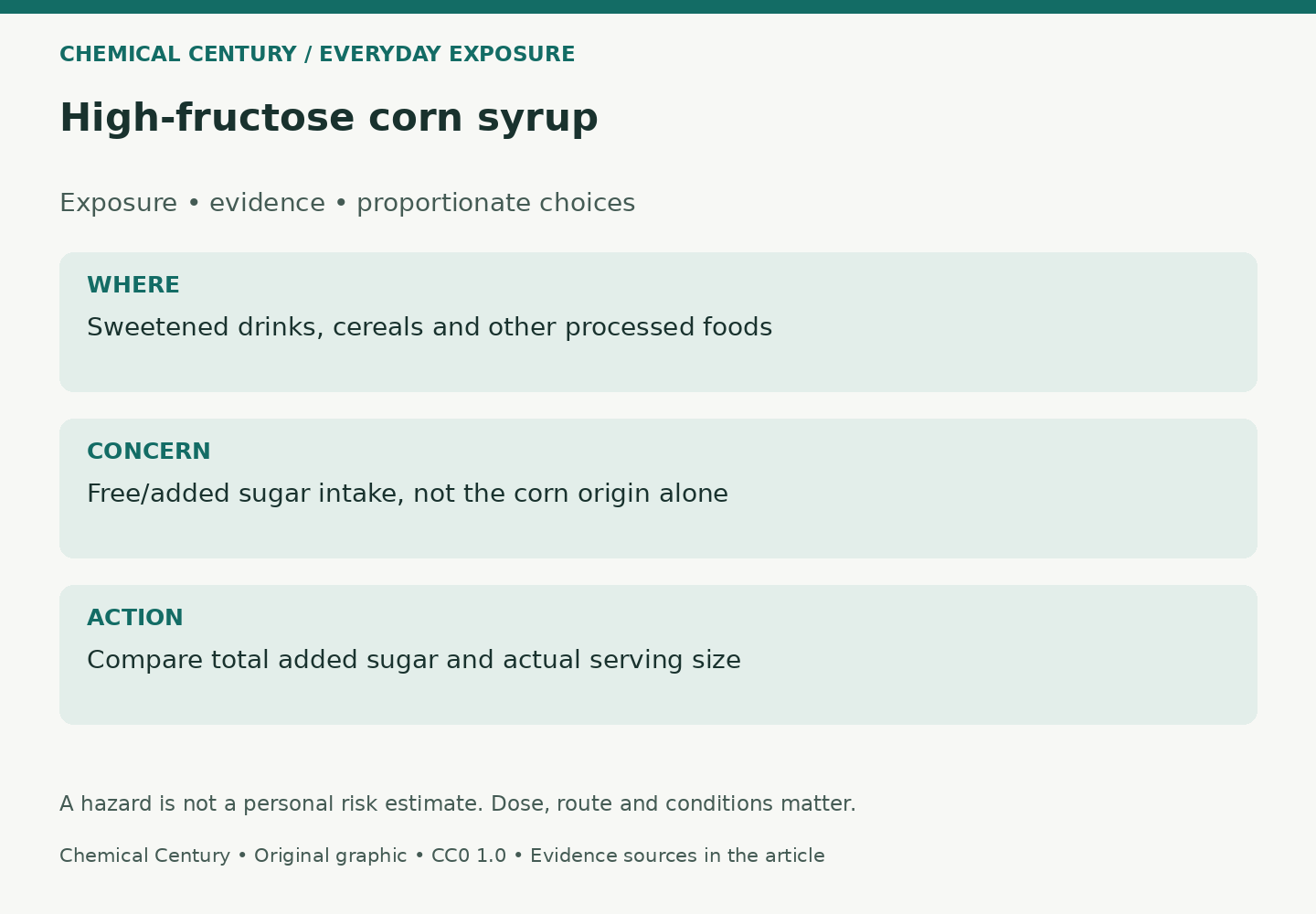
Exposure and evidence guide; not a numerical risk estimate.
Credit: Chemical Century; original graphic
License: CC0 1.0
Data: Data: the sources listed for this article.
What it is
HFCS is made by breaking corn starch down into glucose and converting some of that glucose to fructose using enzymes. “High fructose” is a comparison with ordinary glucose-rich corn syrup, not a statement that HFCS 42 consists mostly of fructose. The common 42 and 55 formulations differ, and a variable syrup should not be illustrated as one chemical molecule. [1,5]
No single HFCS CAS identity was verified in the PubChem compound-name search for this batch, so this article deliberately uses CAS: null. The fetched constituent records verify 57-48-7 for fructose and 50-99-7 for glucose. Neither number identifies the entire syrup. This is an identity limitation, not a claim that HFCS lacks specifications or regulatory recognition. [5–7]
Table sugar, sucrose, joins glucose and fructose within one molecule. In common HFCS those sugars are not joined in that way. FDA explains that digestion rapidly splits sucrose's bond. The structural difference is real, but by itself does not demonstrate a clinically important difference in safety at comparable intake. [1]
What it does and why it is used
HFCS supplies sweetness and calories. The US identity standard describes a sweet, nutritive saccharide mixture prepared from high-dextrose-equivalent corn starch hydrolysate. Products use different formulations; appearance cannot establish sweetener content. Use current label information rather than assuming every cola or cereal contains HFCS. [1,5]
Regulatory status and health context
Canada
The Canadian Food Inspection Agency's incorporated common-name list specifies glucose-fructose for qualifying syrups at or below 60% fructose on a dry basis, and fructose syrup for those above that level. It also recognizes the combined “sugar/glucose-fructose” name in specified circumstances. These are labelling provisions, not a medical endorsement of high intake or a requirement to consume the sweetener. [2]
United States
US 21 CFR 184.1866 recognizes HFCS under the listed identity and purity conditions and good manufacturing practice. FDA's consumer Q&A supports limiting added sugars generally rather than singling out HFCS as demonstrably less safe than equivalent common sweeteners. The Q&A includes older dietary-guideline references; this article does not represent those dates as a newly issued 2026 intake prescription. [1,5]
European Union
Directive 2001/111/EC specifies names including glucose-fructose syrup or fructose-glucose syrup, depending on the predominant sugar when the relevant conditions apply. This directly contradicts the claim that Europe simply has no such syrups because their American name is uncommon there. The naming rule does not settle appropriate intake. [3]
EFSA's 2022 assessment says added and free sugars should be as low as possible within a nutritionally adequate diet. It could not set a tolerable upper intake level from the available data. Inability to identify a safe upper threshold is not a finding that any tiny exposure causes disease, nor permission for unrestricted consumption. [4]
Environmental notes
The selected sources do not establish a comparative life-cycle footprint for HFCS versus cane sugar, honey or other alternatives. The health comparison above should not be reused as an environmental ranking.
For practical examples, see Hidden added sugar; for carbohydrate response rather than ingredient names, see GI and blood sugar.
Quick facts
- Identity: variable syrup mixture; no single verified CAS assigned.
- Common US formulations: HFCS 42 and 55. [1]
- Established sugar-related harm: dental caries. [4]
- Key caution: “no HFCS” does not mean “no added sugar.” [1,2]
Sources
Fetched 2026-11-08 unless a previously fetched archived source is explicitly identified. Regulations are reported with their scope and dates; this draft is not legal advice.