
High sugar intake: which health harms are well supported?
Also known as sugar and health, sugary drinks, and metabolic health.
Editorial draft Last reviewed 8 November 2026 About 1182 words
Everyday exposure is a pattern, not one guilty food
Regular sugary drinks, sweet snacks and other sources of free or added sugars can make a substantial contribution to a person's diet. The concern is repeated intake within a whole eating pattern, not the mere presence of sugar molecules. Health Canada links high-sugar foods with tooth decay and excess calorie intake; excess calories can contribute to overweight and obesity. That is a stronger, more useful statement than claiming that a spoonful of sugar inevitably causes several chronic diseases. [2,3]
This article focuses on free and added sugars, especially sugar-sweetened beverages. It does not treat intact fruit and unsweetened milk as equivalent exposures. WHO's free-sugar definition excludes sugars naturally contained in intact fruits, vegetables and milk, but includes juice, honey and syrups. The distinction matters when evaluating both an individual's choices and the studies behind a headline. [2]
Known and suspected harms: the evidence map
The following labels are editorial summaries, not formal GRADE ratings. “Established” means a recognized effect under the conditions described; “probable” means a likely contribution with uncertainty; “possible” means limited evidence; “disputed” would flag disagreement between interpretations. A label does not tell you an individual's absolute risk, and it should not hide uncertainty about dose or duration.
| Outcome | Editorial assessment | Important qualification |
|---|---|---|
| Dental decay | Established | Free sugars contribute to caries; exposure over time matters. [2] |
| Weight gain and obesity | Established contribution when intake promotes energy surplus | Not inevitable after a sweet food; other determinants remain important. [1,3] |
| Type 2 diabetes | Probable contribution from habitual sugary-drink intake | Cohort associations do not establish the exact causal effect or apply equally to all sugars. [1,4] |
| Liver fat | Probable with high added-sugar intake, especially excess energy | Trials of liver-fat accumulation are not proof of future cirrhosis. [1,5] |
| Long-term fatty-liver disease | Possible independent association with sugary drinks | Observational evidence is less certain than the intermediate liver-fat findings. [1] |
| Coronary heart disease | Probable contribution from habitual sugary-drink intake | Much evidence is observational; precise independent effects remain uncertain. [1] |
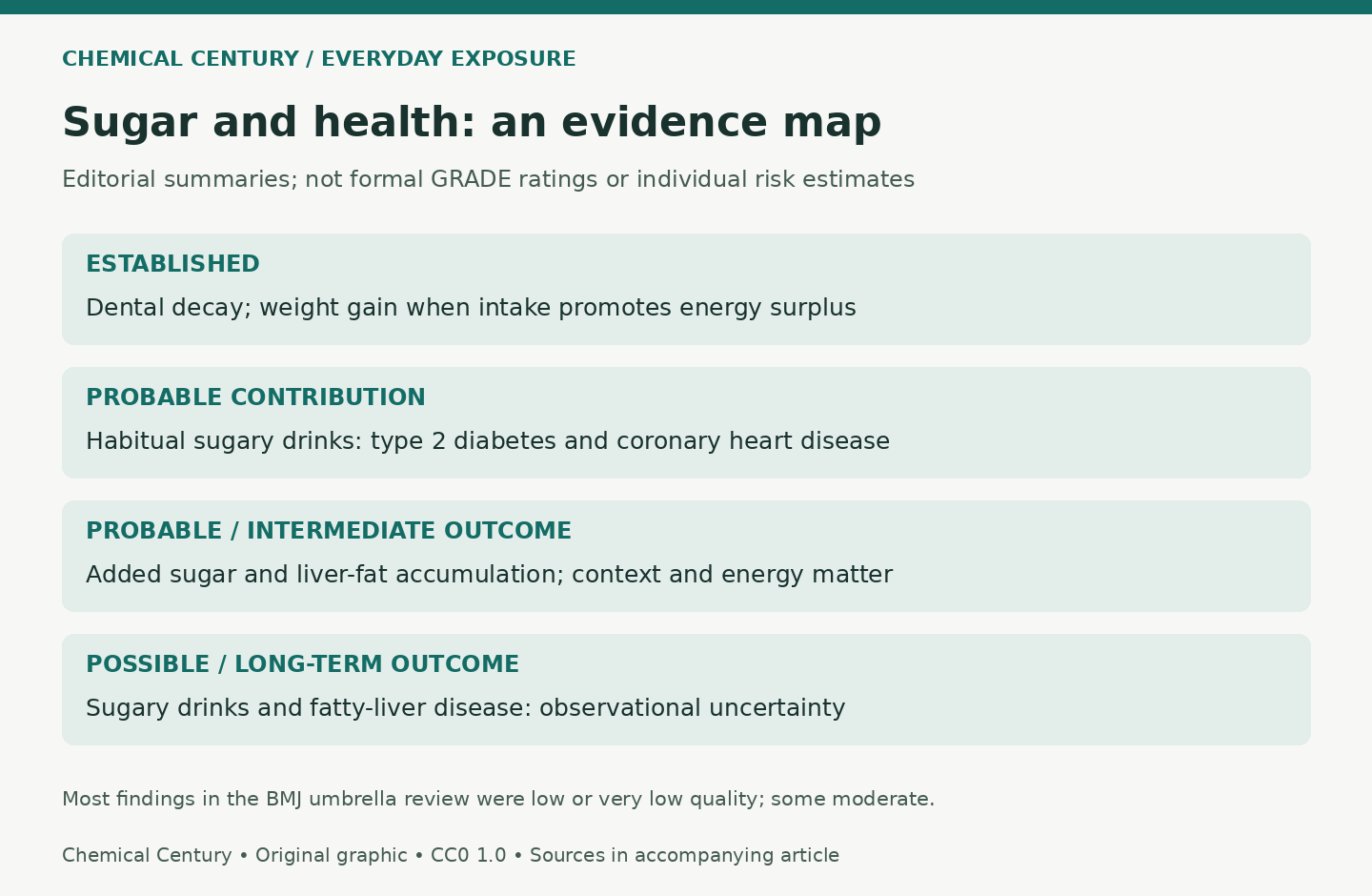
Editorial evidence map; categories are not numerical risk estimates or formal GRADE ratings.
Credit: Chemical Century; original diagram
License: CC0 1.0
Data: Data: BMJ review [1], PAHO/WHO [2], Health Canada [3]
Dental decay: a direct reason to reduce free sugars
WHO's sugar guidance draws on evidence concerning dental caries as well as unhealthy weight gain. It recommends free sugars below 10% of total energy, and suggests below 5% for additional benefit. The lower recommendation is conditional, with a less certain evidence base. This supports reducing regular free-sugar exposure without claiming that a numerical limit guarantees a cavity-free life. [2]
Children are an important group: Health Canada specifically identifies tooth decay in children among the concerns associated with added sugars. Dental risk also should not be reduced to body weight. A person who is not gaining weight can still have a reason to cut back on sugary drinks and snacks. The WHO recommendation addresses oral health as well as energy balance. [2,3]
Weight gain and obesity: energy matters
A 2023 BMJ umbrella review brought together 73 meta-analyses and assessed 83 outcomes. Randomized evidence supported an increase in body weight with sugar-sweetened beverages, with moderate-quality evidence for that outcome. Health Canada's practical explanation is that high-sugar intake can add excess calories, and excess calories can lead to overweight and obesity. This does not require portraying sugar as a uniquely poisonous calorie. [1,3]
The relevant distinction is between a contribution and a destiny. Diet, activity, underlying conditions and other factors influence health. A study showing weight change when sugary drinks are added does not prove the same change when they replace an equal amount of energy from another food. The review distinguishes energy conditions and exposures; its findings should not be flattened into “all sugar always makes everyone fat.” [1]
Type 2 diabetes: association is not a complete mechanism
The BMJ review found associations between sugar-sweetened beverages and type 2 diabetes. However, confidence in specific observational estimates was often low or very low. Some analyses of total sugar or fructose did not show the same association. The strongest practical concern therefore centres on the repeated sugary-drink pattern, not an accusation against every gram of sugar in every food. [1]
NIDDK explains that insulin resistance involves muscle, fat and liver cells responding poorly to insulin. The pancreas may initially compensate; when it cannot keep up, blood glucose rises. Causes are not fully understood. Risk factors include excess weight, inactivity, family history, age, previous gestational diabetes and certain medical conditions. Sugar intake is not a complete explanation, and diabetes should not be treated as evidence that someone made a single bad choice. [4]
Fatty liver: separate fat accumulation from advanced disease
The review reports moderate-quality randomized evidence concerning added sugars and accumulation of ectopic fat, including liver fat. It also describes associations between sugary drinks and fatty-liver disease, but those observational disease findings are less certain. Trials measuring liver fat over a limited period do not establish that the same participants will develop inflammation, scarring or liver failure. [1]
NIDDK's guidance for the condition historically called nonalcoholic fatty liver disease—now also called metabolic dysfunction-associated steatotic liver disease, or MASLD—includes limiting large amounts of simple sugars, especially fructose in sweetened beverages and juice. It also emphasizes portions, healthy eating and gradual weight management where appropriate. This is a comprehensive approach, not evidence for a sugar-only cure or a reason to start an extreme diet. [5]
Heart disease: a concerning pattern, with limitations
Higher sugary-drink intake was associated with coronary heart disease in the BMJ review. Plausible pathways include effects on body weight and other metabolic factors, but biological plausibility does not remove confounding. People with different beverage habits may differ in many other ways, and dietary questionnaires do not capture intake perfectly. Our “probable contribution” label is therefore a cautious editorial interpretation, not a claim of high-certainty randomized proof. [1]
That distinction is important because the review found no high-quality GRADE evidence across its assessed outcomes. Many findings were low or very low quality, though some were moderate. The breadth of associations deserves attention; it is not permission to present every association as established causation. The practical case for limiting sugary drinks is stronger than any promise that a precise reduction will prevent a particular individual's heart attack. [1]
Reducing exposure without blame or overcorrection
Start with frequent sugary drinks, then compare portions and labels for other regular sources. Health Canada recommends an overall healthy pattern, with most sugars coming from fruit, vegetables and unsweetened dairy. Water and unsweetened options are useful substitutions; there is no need to remove whole fruit because a review examined sweetened beverages. [2,3]
People with diagnosed diabetes, liver disease or nutritional concerns may need individualized guidance. Prediabetes is usually identified through appropriate testing, not a food label or a feeling after dessert. If treatment is already prescribed, dietary changes should complement professional care rather than replace it. Real harms deserve honest documentation, and people deserve advice that does not exaggerate certainty or assign blame. [4,5]
Sources
Fetched 2026-11-08.