
Hidden added sugar: what everyday foods can add up to
Also known as free sugars, added sugars, and sugar labels.
Editorial draft Last reviewed 8 November 2026 About 1112 words
Everyday exposure: a drink, breakfast and a sauce
Sugar exposure does not begin and end with a spoonful added to coffee. Sweetened yogurt, breakfast cereal, granola bars, sauces and drinks can all contribute. Harvard's Nutrition Source gives a 12-ounce cola example containing 39 grams of sugar. That single drink approaches the 50-gram amount corresponding to 10% of a 2,000-calorie day's energy. But not all sugar on a label is added sugar, and not every product in a category contains the same amount. The useful question is: what does this serving contribute to my usual pattern? [1,2,5]
Known and suspected harms
Established: free sugars contribute to dental decay; higher intake can also contribute to excess calories and weight gain. Health Canada connects excess calories with overweight and obesity, which in turn increase chronic-disease risks. These statements do not mean that one sweetened yogurt causes diabetes or that naturally occurring sugar in whole fruit should be treated like a soft drink. Stronger and weaker disease evidence is examined in the companion health-effects article. [1,4]
Here, “hidden” means easy to overlook, not necessarily concealed illegally. Ingredients may be listed clearly yet still surprise someone who regards a cereal, sauce or snack bar as savoury or healthy. A product can contain useful nutrients and a substantial quantity of added sugar at the same time. Reading the complete label is more informative than judging the package's front alone. [3,5]
Total, added and free sugars are different measures
Total sugars include sugars naturally present in a food plus any added sugars. Added sugars, as described by the FDA, include sugars added during processing, honey, syrups and certain concentrated juices used as sweeteners. Naturally occurring sugars in milk, fruits and vegetables are not included in that added-sugars category. “Includes added sugars” is a subset of total sugars, not a second amount to add on top. [2]
Free sugars, the WHO term, also include sugars naturally present in honey, syrups, fruit juices and fruit juice concentrates. Thus a juice can have no sugar added during manufacture and still contribute free sugars. Conversely, lactose naturally present in unsweetened milk or yogurt contributes total sugar without being added sugar. Mixing these definitions produces misleading comparisons and inflated totals. [1,2]
How much is in common products?
These are specific examples published by the named sources, not universal ranges, market averages or measurements of today's Canadian brands. Source serving sizes are retained; compare like portions before deciding which product contributes more. [1,2,5]
| Food or drink example | Source serving | Reported sugar | What the number means |
|---|---|---|---|
| Cola | 12 US fluid ounces, approximately 355 mL | 39 g | Sugar in Harvard's sweetened-cola example; not every soda. [5] |
| Sweetened yogurt | FDA illustrative serving, weight unspecified | 15 g total, including 7 g added | The other 8 g are naturally occurring; do not count 22 g. [2] |
| Sweetened cereal | Harvard's example “small bowl,” weight unspecified | 18 g added | Illustrative product example, not a standard-sized bowl. [5] |
| Crunchy granola bars | Two-bar pack in Harvard's example | 12 g added | Each bar contributes 6 g; eating both doubles exposure. [5] |
| Ketchup | 1 tablespoon | Approximately 4 g free | PAHO/WHO's example; recipes vary. [1] |
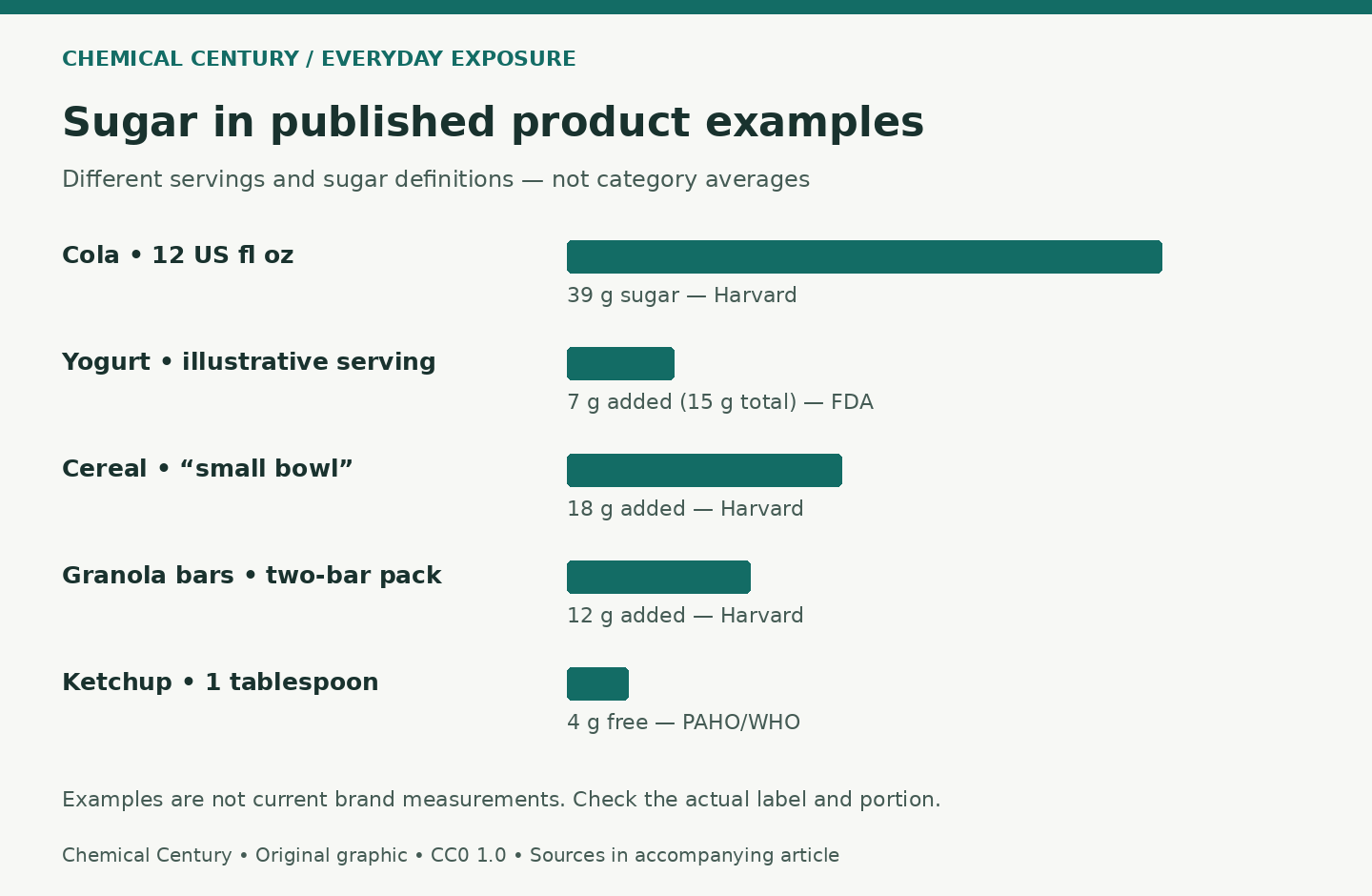
Published examples, not category averages; serving sizes and sugar definitions differ.
Credit: Chemical Century; original chart
License: CC0 1.0
Data: Data: Harvard [5], FDA [2], PAHO/WHO [1]; sources identify examples, not current brand-label measurements
The cereal and yogurt examples deliberately lack gram serving weights because their source explanations do not provide them. Filling those gaps with a guessed “usual” portion would create false precision. For an actual shopping comparison, use current package labels and the portion you will eat. A bigger portion increases intake even when the printed grams per serving look modest. [2,3,5]
Which intake limits apply?
WHO recommends free sugars below 10% of total energy, and suggests reducing them below 5% for additional benefits. For a 2,000-calorie example, these correspond to less than 50 g and less than 25 g respectively, calculated using four calories per gram. The lower recommendation is conditional; the recommendation strength should not disappear when it is turned into a headline. Energy requirements vary, so these examples are not everyone's personal allowance. [1,2]
Health Canada's consumer guidance used here recommends limiting highly processed sugary foods and choosing a healthy pattern in which most sugars come from fruit, vegetables and unsweetened dairy. It does not give a numerical added-sugar limit in those pages. We therefore do not relabel WHO's percentage as a Health Canada daily prescription. Canadian sugar-label percentages concern total sugars; they should not be substituted for WHO free-sugar percentages. [3,4]
The FDA's US label reference is 50 g of added sugars for a 2,000-calorie diet. The AHA gives stricter advice—no more than 6% of calories from added sugars—and examples of about six teaspoons for most women and nine for most men. These are different frameworks, not contradictory measurements of the same thing. State the organisation, sugar definition and energy basis whenever quoting a number. [2,6]
Names to recognize on the ingredient list
Look for sucrose, dextrose, glucose, fructose, maltose, invert sugar, cane sugar, brown sugar, corn syrup, high-fructose corn syrup, molasses, honey, maple syrup, agave nectar and fruit juice concentrates. A natural-sounding name does not prevent an ingredient from contributing added or free sugar. Nor does the suffix “-ose” by itself mean a food is unhealthy: the food and its use matter. [1,5,6]
Canadian labels group sugar-based ingredients in brackets after “sugars,” in descending order by weight. This helps readers recognize their combined prominence. It does not disclose the exact grams contributed by each sweetener. The Nutrition Facts table supplies total sugars per stated serving; the ingredient list identifies sources. Use both rather than pretending the ingredient order is a laboratory measurement. [3]
A practical lower-exposure routine
First, check what you drink regularly. Water and unsweetened beverages can reduce added-sugar intake without requiring a complicated ingredient search. Second, compare plain yogurt with sweetened versions, and add fruit if desired. Third, check cereals, bars and sauces against realistic portions rather than their healthy-sounding category names. These are substitutions within an eating pattern, not a demand to eliminate every pleasurable food. [4,5]
In Canada, 5% Daily Value or less is “a little” total sugar and 15% or more is “a lot.” On the US added-sugar line, the FDA uses 5% or less as low and 20% or more as high. The different cutoffs and sugar measures are precisely why a Canadian reader should not apply an American label rule without noticing the jurisdiction. [2,3]
Sources
Fetched 2026-11-08. Examples retain their source context and are not a current product survey.
- PAHO/WHO: Reduce sugar consumption, 2015.
- FDA: Added Sugars on the Nutrition Facts Label.
- Health Canada: Sugars—Using food labels.
- Health Canada: Sugars and your health.
- Harvard Nutrition Source: Added Sugar, reviewed April 2022.
- American Heart Association: Added Sugars, reviewed August 2024.